
What Should You Do If a Supplier Cannot Provide an SDS?
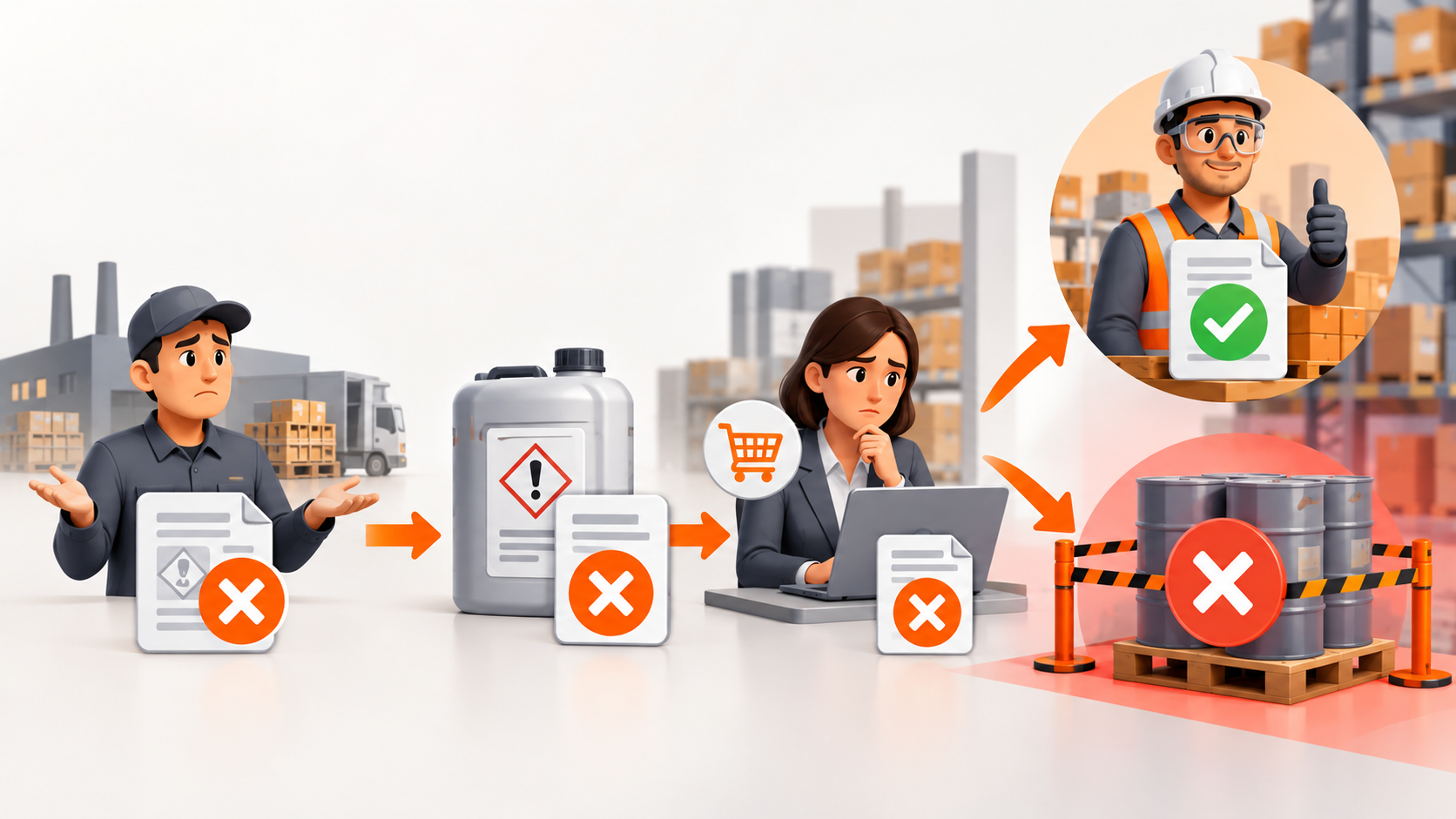
- First verify whether an SDS is legally required for the supplied product and whether another form of safe-use information should accompany it.
- Request the exact product and version from the responsible supplier in writing and preserve the response and product identifiers.
- Do not substitute a generic or competitor SDS unless exact product equivalence has been established.
- Restrict purchase or use when missing information prevents a suitable COSHH or DSEAR assessment, and escalate persistent supplier refusal appropriately.
If a supplier cannot provide an SDS, first confirm the exact product and whether an SDS is required. Ask the responsible supplier in writing, keep the request and response, and do not use an unrelated sheet as a substitute. If the missing information prevents a suitable assessment, restrict use until the gap is resolved.
Is the supplier always required to provide an SDS?
An SDS is required for many hazardous workplace chemicals, but not for every product in every circumstance. HSE says SDSs are required under UK REACH and are a must when a hazardous chemical is supplied for use at work; some non-classified mixtures also require an SDS because they contain specified hazardous substances (HSE safety data sheets).
Where a product is not dangerous for supply, HSE says the supplier should provide safe-use instructions with it. Ask the supplier to state why an SDS is not required and to provide the information needed for safe use.
What should you verify before contacting the supplier?
Confirm that the request identifies the exact supplied product. Record:
- full trade name and product code;
- supplier, distributor and manufacturer;
- concentration, grade, colour or variant;
- package label photographs;
- batch or lot number;
- purchase date and order reference;
- country and intended market;
- current document already held, if any.
Many failed searches result from a renamed product, distributor-only listing or a sheet filed under a manufacturer code. Do not assume two products with similar names share a formulation.
How should you request the SDS?
Send a traceable request to the supplier that placed the product on the market. Ask for the current UK SDS in English for the exact product and code, including issue or revision date. If the supplier says no SDS is required, ask for the classification basis and safe-use information.
A useful request states:
Please provide the current UK safety data sheet for [product name, code and variant] supplied under order [reference]. If an SDS is not required, please confirm the reason and provide the information necessary for safe workplace use.
Record the date, contact, response and follow-up. Procurement should prevent repeated orders from bypassing the unresolved request.
Can you download an SDS from the internet instead?
Use only a document whose product identity and responsible supplier match can be verified. A search-engine result, retailer upload or competitor SDS may describe another concentration or formulation.
Check Section 1, product code, supplier, Section 2 classification and label against the container. If any conflict exists, mark the document unverified. The SDS workflow should show source and matching status rather than treating every uploaded PDF as approved.
What should happen while the SDS is missing?
Decide whether sufficient information exists to assess and control the work safely. Do not confuse “SDS missing” with “chemical automatically unusable”, but do not permit work on unsupported assumptions.
Use a staged decision:
| Situation | Interim action |
|---|---|
| Exact product and hazards confirmed through authoritative supplier information | Complete the assessment using verified evidence and continue chasing the formal document where required |
| Supplier says no SDS is required and provides adequate safe-use information | Record the basis and assess the task normally |
| Product identity or classification is uncertain | Quarantine or restrict use pending clarification |
| Serious hazard or process risk cannot be assessed | Do not start or continue the task until competent evidence is available |
| Existing product is already in use | Review immediate safeguards, exposure and alternatives; escalate promptly |
An SDS is only one input. HSE stresses that it does not replace the COSHH assessment, which must account for the workplace and task (HSE COSHH FAQ).
When should you escalate the supplier problem?
Escalate when the responsible supplier refuses or repeatedly fails to provide required safety information. HSE advises users to ask the supplier when information is missing and to contact the local HSE office if the supplier refuses to help.
Before escalation, preserve the label, purchase evidence, written requests, responses and why the information is needed. Involve procurement and the internal safety owner. A commercial block on future purchasing can often resolve the root cause faster than repeated requests from individual users.
What should procurement change?
Move SDS verification before first use, ideally before purchase approval. Require product identity, supplier contact, SDS or documented no-SDS basis, assessment owner and approval status.
For online marketplaces or imported products, clarify who is the GB supplier and whether the product was placed on the correct market. UK REACH roles can differ between Great Britain and Northern Ireland, so obtain advice where supply-chain status is uncertain (HSE UK REACH explained).
The Safe Foundry features can connect purchasing evidence, source documents and assessment review without making the document itself the approval.
How should the case be closed?
Close the case only when the product status and assessment route are documented. Record the current SDS or safe-use information, supplier confirmation, assessment decision, restrictions removed, workers informed and future purchasing rule.
If the product is rejected, manage return or disposal through the proper process rather than leaving it as unidentified stock. The help centre can support document organisation and product records.
A disciplined workflow protects workers and gives suppliers a clear opportunity to correct the gap. It also prevents the common failure of finding a plausible PDF and quietly attaching it to the wrong product.
What if the seller and manufacturer are different?
Map who supplied the product and who holds the technical information. A distributor may provide the manufacturer's SDS, but the document must still match the exact product and supply chain. Record both organisations and the contact route used.
Online marketplaces can obscure the responsible supplier. Preserve the listing, invoice, seller identity, package label and import information. Do not accept a marketplace category page or a seller's assurance that the product is “non-toxic” as equivalent to safety information.
Where your organisation imports directly into Great Britain, its UK REACH role may differ from that of an ordinary downstream user. Obtain competent regulatory advice rather than assuming an overseas manufacturer's document completes every duty.
What information can support an interim assessment?
Use authoritative, product-specific evidence and state its limits. This may include the physical label, technical data sheet, supplier composition statement, current manufacturer information and documented operating experience. For a pure substance, authoritative property and exposure sources may help, but impurities and grade still matter.
Do not assemble a fictional SDS by copying sections from several competitors. If the evidence cannot establish classification, incompatibility, exposure controls or emergency response, the safe decision may be to stop use or substitute a supported product.
How should purchasing qualify chemical suppliers?
Include safety-information performance in supplier approval. Before first order, test whether the supplier can provide the current UK document, answer product-identity questions and notify revisions. Define acceptable response times for routine and urgent queries.
Track repeated missing, incorrect or foreign-market sheets. Procurement can require correction, select an alternative supplier or block the product. This turns the problem from repeated workplace chasing into a supply-chain control.
What should workers be told during the gap?
Communicate a specific status and instruction. Mark the product approved, restricted, quarantined or rejected and explain what that means. Avoid vague messages such as “SDS pending” while the container remains freely available.
If limited work continues under an interim assessment, state the permitted task, quantity, controls, people and expiry of the decision. Rebrief users when the final document arrives and record whether controls changed.
How can repeat cases be prevented?
Connect receiving to the approved-product register. A delivered chemical should match an approved supplier, product code and document status before release to use. Unknown variants or substitutions enter quarantine and review.
Audit urgent purchases, maintenance orders and local card transactions because they often bypass normal checks. Measure missing-SDS cases by source and root cause, then improve the approval rule that failed.
Frequently asked questions
Can I use a chemical while waiting for the SDS?
Only if competent assessment using verified information shows the work can be controlled. Restrict use where identity, hazards or necessary controls remain uncertain.
What if the supplier says the product is non-hazardous?
Ask for the basis and safe-use information, then consider process-generated hazards and actual use. Non-classification does not remove the need to assess harmful workplace circumstances.
Can a distributor send the manufacturer's SDS?
Yes, if it accurately covers the exact supplied product and meets the applicable supply requirements. Verify identifiers and responsible supplier details.
Should I report a supplier who refuses to provide an SDS?
Preserve the evidence and seek guidance from the appropriate enforcing authority. HSE advises contacting it when a supplier refuses to provide needed safety information.
Check that an SDS matches your chemical by comparing product identifiers, supplier, concentration, form, label classification and intended use.
Chemical Stocktake Checklist: What to Record and CheckUse this chemical stocktake checklist to reconcile containers with your register, verify SDS links, find storage issues and assign follow-up actions.
COSHH Assessment Review Checklist for UK WorkplacesUse this COSHH assessment review checklist to compare records with current tasks, products, exposure routes, controls and workplace evidence.