
COSHH Assessment Review Checklist for UK Workplaces
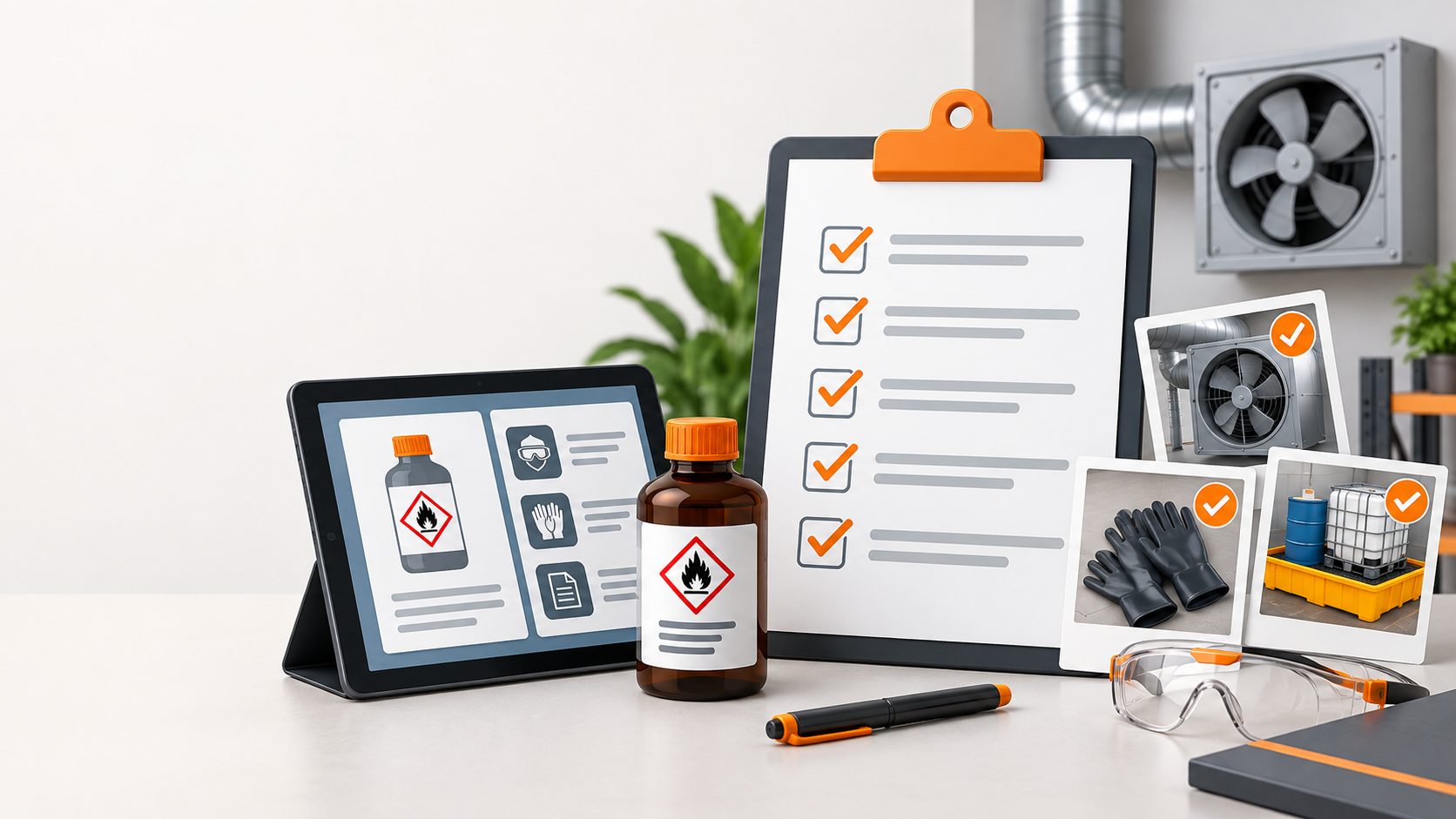
- A COSHH review should compare the assessment with the current product, task, exposure pattern, people at risk and control performance.
- The reviewer should use evidence from labels, safety data sheets, observations, maintenance, monitoring, incidents and worker feedback.
- Each checklist item should end with a clear outcome: confirmed, action required, assessment amended or reassessment needed.
- The completed review should preserve version history and assign owners and due dates to every corrective action.
Use this COSHH assessment review checklist to test whether a recorded assessment still matches the work being done. It is a review worksheet, not a substitute for competent judgement: observe the task, speak with workers, check current source documents and record evidence for every decision.
When should you use this COSHH review checklist?
Use the checklist at the planned review date and whenever a change or warning sign could make the assessment inaccurate. Regulation 6 of the Control of Substances Hazardous to Health Regulations 2002 requires regular review and an immediate review when there is reason to suspect an assessment is no longer valid, when monitoring shows a need, or when work changes significantly (COSHH Regulation 6).
Typical triggers include a new product, revised safety data sheet (SDS), different concentration, increased quantity, changed method, new equipment, failed control, exposure complaint, incident or near miss. HSE also points to changes in staff, processes, substances or equipment and to problems reported by workers (HSE assessment guidance).
Start by writing down:
- assessment title, ID and current version;
- task, area and department;
- review date and reason;
- reviewer and people consulted;
- previous review date and open actions;
- SDS issue or revision date and supplier.
For the reasoning behind review intervals and event triggers, use this worksheet with your organisation's review policy. Safe Foundry's COSHH workflow overview illustrates how assessments can remain linked to source documents and task context.
Does the assessment match the chemical actually in use?
Confirm the identity before reviewing the risk. Similar names, reformulated products and alternative suppliers can make a well-written assessment irrelevant to the container on the bench.
| Check | Evidence | Outcome |
|---|---|---|
| Product name and code match | Container label, purchase record, SDS Section 1 | Confirmed / action |
| Supplier or manufacturer matches | Label and SDS supplier details | Confirmed / action |
| Concentration and physical form match | Label, specification, SDS Sections 1, 3 and 9 | Confirmed / action |
| SDS is the current supplier version | Supplier source, revision date and change notes | Confirmed / request update |
| Hazard classification matches the label | SDS Section 2 and container label | Confirmed / quarantine and investigate |
| Product is still required | Task owner and substitution review | Keep / reduce / replace |
Do not use the SDS date alone as proof that it is current. Check product identity, supplier and revision information, then ask the supplier if there is doubt. HSE says suppliers must provide an up-to-date SDS when a dangerous chemical is supplied for work and stresses that an SDS is not itself a risk assessment (HSE chemical safety data sheets).
Does the assessment describe the current task?
Compare the assessment with a normal task from preparation through cleanup and waste disposal. Product hazards do not reveal how much exposure the activity creates.
Check each item:
- [ ] The purpose of the task is clear.
- [ ] The method matches practice, including pouring, mixing, spraying, brushing, machining, heating or transfer.
- [ ] Maximum and typical quantities are realistic.
- [ ] Frequency and duration reflect current workload.
- [ ] Temperature, pressure and agitation are recorded where relevant.
- [ ] Normal release points for dust, mist, fume, vapour, gas or splash are identified.
- [ ] Non-routine work covers setup, cleaning, maintenance, spills, breakdowns and disposal.
- [ ] The location, room volume and ventilation assumptions still apply.
- [ ] Storage and movement between locations are covered where they affect exposure.
If the written task says “use cleaner” while workers decant five-litre containers into trigger bottles, the assessment is too vague. Record the actual transfer, use and cleanup stages so controls can be matched to each release opportunity.
Are all exposure routes and people still covered?
Check inhalation, skin, eye and ingestion routes against the task, then identify everyone who may be exposed. HSE's principles of good control practice say an adequate assessment considers all routes into the body, including direct skin contact (HSE good control practice).
Review:
- operators and assistants;
- workers nearby or sharing ventilation;
- cleaners and waste handlers;
- maintenance and engineering staff;
- contractors, temporary staff, trainees and visitors;
- emergency responders;
- individual factors that need a separate confidential workplace process.
Ask workers where splashes, dust deposits, odours or difficult steps actually occur. Their observations can expose a gap between the planned method and normal practice.
Are the controls appropriate and working?
Review controls in the order of prevention and collective protection before relying on personal protective equipment (PPE). A glove entry cannot compensate for an avoidable release into the breathing zone.
Elimination and substitution
- [ ] The substance or task is still necessary.
- [ ] A safer product, form or method has been considered.
- [ ] Quantities at the point of use are kept to what the task needs.
Engineering controls
- [ ] Enclosure, automation, local exhaust ventilation or general ventilation matches the release.
- [ ] Equipment is present, switched on and positioned correctly.
- [ ] Examination, test and maintenance records are current and defects are closed.
- [ ] The assessment states what users should check before starting.
Working methods and supervision
- [ ] Instructions describe the safest sequence and prohibited practices.
- [ ] Containers remain closed when not in use.
- [ ] Housekeeping prevents contamination from spreading.
- [ ] Training and supervision match the complexity and risk.
PPE and hygiene
- [ ] PPE is selected for the substance, task, duration and wearer.
- [ ] Glove material and breakthrough considerations are specific, not just “chemical gloves”.
- [ ] Respiratory protective equipment, where needed, has the right type, fit and maintenance arrangements.
- [ ] Washing, changing and storage arrangements prevent secondary exposure.
Use the assessment features page to see how control records can sit with assessment context rather than becoming an isolated PPE list.
What evidence shows that the controls work?
An assessment review should test assumptions against performance evidence. Tick the evidence examined and note the date or record reference:
- [ ] workplace observation;
- [ ] worker and supervisor feedback;
- [ ] engineering-control inspections and examinations;
- [ ] exposure monitoring results, where applicable;
- [ ] health surveillance trends handled through the appropriate confidential process;
- [ ] spills, incidents, near misses and symptoms reported;
- [ ] housekeeping and contamination checks;
- [ ] PPE issue, fit, inspection and replacement records;
- [ ] action completion from the previous review.
A control described in an assessment is only an assumption until there is reasonable evidence it is installed, used and maintained. Escalate defects that could allow harmful exposure instead of marking the review complete with an open-ended note.
Are emergency and supporting arrangements still usable?
Check whether people can act on emergency information under real conditions. Review foreseeable spills, loss of containment, fire interactions, first aid, waste and contaminated clothing.
- [ ] Spill materials are compatible and accessible.
- [ ] Emergency instructions match the product and quantity.
- [ ] Eyewash or washing provision is suitable and unobstructed.
- [ ] First-aid information is current and workers know how to summon help.
- [ ] Waste containers are compatible, identified and removed through the correct route.
- [ ] Contractors and emergency responders can access relevant information.
- [ ] Drills or practical checks have exposed no unresolved problems.
The SDS can inform these checks, but site arrangements must account for the actual room, equipment, quantities and people.
How should you close and record the review?
Finish with a decision, not a collection of ticks. Choose and record one outcome:
- Assessment confirmed current. State what evidence supports the conclusion.
- Minor amendments required. Update the affected sections and communicate the change.
- Controls need corrective action. Assign an owner and due date, and decide whether work can safely continue meanwhile.
- Full reassessment required. Stop relying on the old assessment where the scenario has materially changed.
Record the next planned review date and all event triggers. Preserve the superseded version, link the current SDS and confirm that affected workers received updated information, instruction or training. The Safe Foundry help centre provides further guidance for organising chemical safety records.
The completed worksheet should let another competent person understand what was checked, what evidence was used and why the assessment was confirmed or changed. That traceability is more valuable than a signature beside a date.
Frequently asked questions
Can I use one COSHH review checklist for every substance?
A common checklist can structure the review, but the evidence and controls must be specific to the product, process and workplace. Add specialist checks where the hazard or task requires them.
Should workers sign the COSHH assessment review?
Signatures can record participation or briefing, but they do not prove understanding or control effectiveness. Record consultation, questions, practical observations and any training or corrective action.
What if a control fails during the review?
Assess the immediate exposure risk, take the affected equipment or task out of use where necessary, arrange repair or alternative controls, and update the assessment before relying on the control again.
How long should an old COSHH assessment version be kept?
COSHH does not set one general retention period for every superseded assessment. Use your legal, health-surveillance, incident, insurance and document-control needs to set a proportionate retention policy.
Learn how to assess process-generated dust and fumes without an SDS by defining the process, exposure routes, evidence and practical controls.
How to Check an SDS Matches the Chemical You UseCheck that an SDS matches your chemical by comparing product identifiers, supplier, concentration, form, label classification and intended use.
COSHH Control Measures: How to Go Beyond PPELearn how to choose COSHH control measures beyond PPE by controlling exposure at source, using a worked activity example and review checklist.