
How to Check an SDS Matches the Chemical You Use
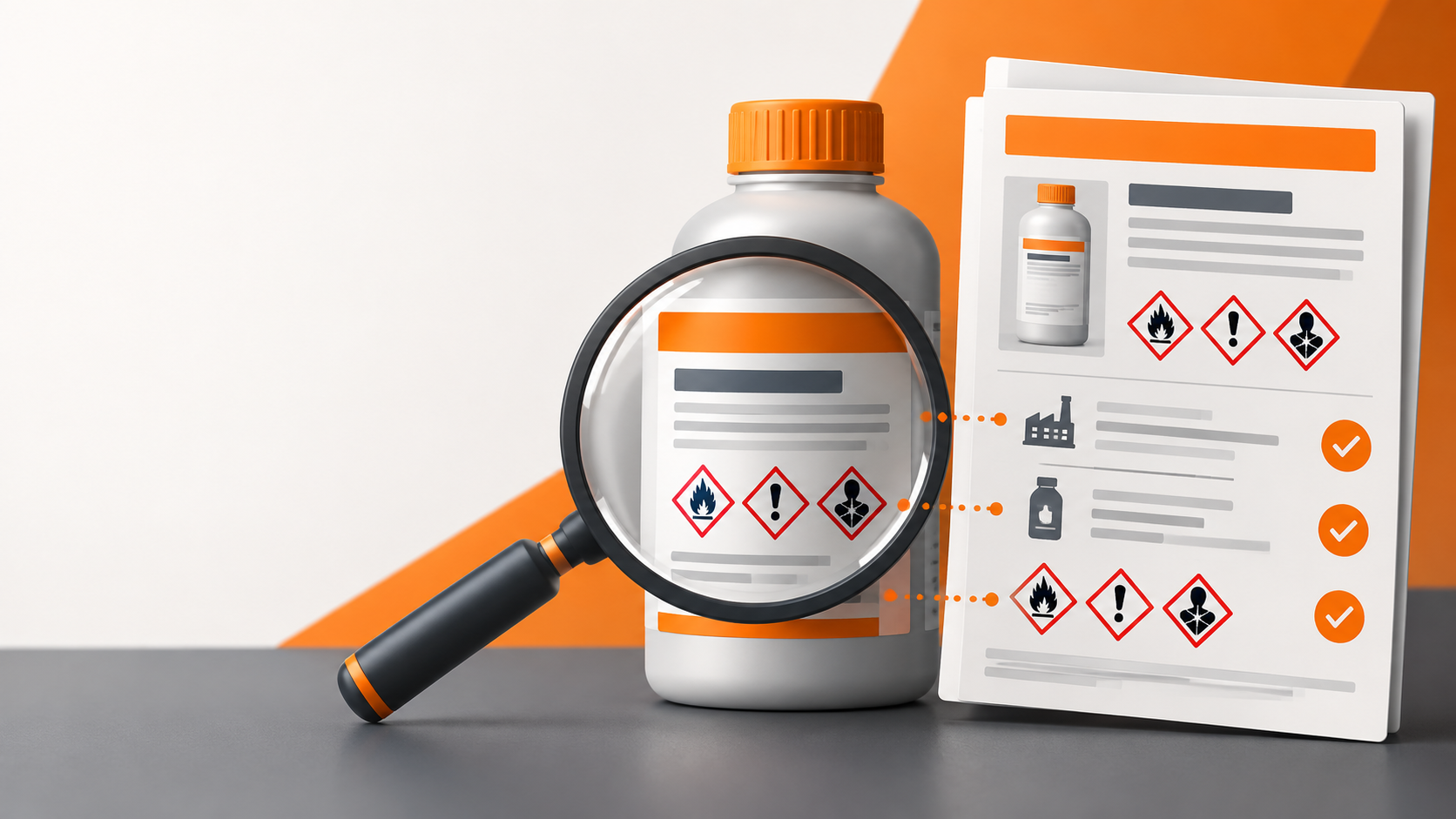
- Match an SDS using the product name, supplier, product code, concentration and physical form rather than a similar chemical name alone.
- Compare SDS Section 2 with the physical label and stop if pictograms, signal words or hazard statements conflict.
- Confirm the document is the supplier's current UK version and record its source, revision and verification date.
- A matching SDS still requires a task-specific COSHH or DSEAR assessment before work begins.
To check that an SDS matches your chemical, compare the container label with SDS Section 1, including the product identifier, supplier and product code. Then verify concentration, physical form and Section 2 classification. Resolve every mismatch before using the document for a COSHH or DSEAR assessment.
Why is a similar product name not enough?
Products with similar names can contain different ingredients, concentrations or physical forms. A concentrate and ready-to-use cleaner, or an aerosol and bulk liquid, may have different classifications and controls. Another supplier's product may also use a similar trade name for a different formulation.
HSE says an SDS provides information needed for assessment but is not the assessment itself (HSE safety data sheets). The first step is proving that the information belongs to the product in front of you.
Which identifiers should you compare?
Start with fields that distinguish the exact supplied product. Compare:
| Container or purchase evidence | SDS field | Decision |
|---|---|---|
| Product trade name | Section 1 product identifier | Must match or be explicitly cross-referenced |
| Product or catalogue code | Section 1 or header | Strong match key |
| Supplier or manufacturer | Section 1 supplier details | Confirm responsible source |
| Variant, grade or colour | Product identifier or description | Confirm exact variant |
| Concentration or dilution | Sections 1 and 3 | Confirm supplied strength |
| Physical form | Sections 1 and 9 | Check liquid, solid, aerosol or gas |
| Batch or lot | Label and supplier records | Useful for formulation queries |
CAS or EC numbers can help for single substances, but mixtures and trade products often need the supplier's product code. Do not use one ingredient identifier as proof that two mixtures are equivalent.
How should the label and Section 2 compare?
The label and SDS classification should tell a consistent hazard story. Compare pictograms, signal word, hazard statements and precautionary statements. HSE explains that these are core GB CLP hazard-communication elements (HSE labelling and packaging).
A mismatch may indicate the wrong SDS, a revised classification, old stock, a relabelled product or an error. Do not choose whichever source seems more convenient. Photograph the label, record the batch and ask the supplier to resolve it.
How do you check the SDS version and market?
Confirm the document is current for the responsible supplier and intended market. Record the issue or revision date, version number, download source and date checked. Look for revision notes and language.
Great Britain uses UK REACH and GB CLP, while EU REACH continues to apply in Northern Ireland under current arrangements (HSE UK REACH explained). An international SDS may contain foreign exposure limits or regulatory references, so confirm that the version is appropriate for the place of use.
The SDS workflow should preserve the verified source and version instead of only the filename.
What if the product has been decanted or diluted?
Trace the secondary container back to the original product and preparation method. Check who decanted it, when, at what dilution and under which procedure. Ensure workplace identification remains clear and the assessment covers the diluted use and transfer task.
Do not assume dilution always removes hazards. It may change classification, pH, volatility or compatibility, and the mixing step may create a separate exposure.
Does matching the SDS prove it covers the intended use?
No. Product identity is necessary, but the assessment must still consider the real activity. Read the identified and advised-against uses in Section 1 and relevant handling and exposure sections. Then compare with quantity, method, temperature, duration, ventilation and people.
If the workplace use differs materially from supplier assumptions, seek supplier or specialist advice. The assessment features can link one verified product record to several task-specific assessments.
What should you do when the SDS does not match?
Mark the document unverified and prevent it from silently supporting an assessment. Then:
- recheck product code and variant;
- search the responsible supplier's official source;
- request the exact SDS using purchase and batch details;
- compare any replacement with the label;
- restrict use if the gap prevents safe assessment;
- review assessments that relied on the wrong document;
- preserve the discrepancy and corrective action.
HSE advises users who think an SDS is out of date to ask the supplier for another and to seek help when information is missing (HSE COSHH FAQ).
How should you record verification?
A verification record should let another person repeat the match. Store product and supplier identifiers, label evidence, SDS version and source, date checked, checker, discrepancies, supplier confirmation and linked assessments.
Use the help centre for document-record guidance. Recheck the match when a product, supplier, label or SDS changes. This small control prevents a polished assessment from being built on the wrong source.
What are the most common matching failures?
Most errors come from treating one familiar field as decisive. Common failures include matching on trade name without supplier, accepting an SDS for a different concentration, using a pure-substance sheet for a mixture, confusing a transport name with the product identifier and attaching a document intended for another national market.
Old stock creates another trap. A supplier website may show the current formulation while a container in the cupboard predates the change. Use batch, purchase and revision evidence to establish which document applied. Ask the supplier when the transition date is unclear.
Decanted containers can also break traceability. A handwritten “degreaser” label may refer to several products. The workplace procedure should preserve the original product ID, dilution, preparer and date so the secondary container can be linked back confidently.
How should you sample-check a large SDS library?
Use risk and data quality to select records for verification rather than trusting a bulk import. Start with high-hazard products, high-use materials, several suppliers, old documents, duplicate names, manual uploads and products linked to many assessments.
For each sample, walk from the physical container to the digital record and back. Confirm that a worker scanning or searching the container reaches the correct active SDS. Then inspect whether the assessment cites the same version.
Track failure types and expand the sample when a pattern appears. If several documents from one supplier use mismatched product codes, review that supplier group. If decanted containers repeatedly lose identity, fix the labelling workflow rather than conducting endless document cleanup.
When is supplier confirmation especially important?
Obtain written confirmation where the match depends on a name change, distributor relationship or formulation transition. Preserve the exact question and answer with the document record. A telephone assurance can guide immediate action, but a traceable response is stronger for future reviewers.
Ask the supplier to confirm the product code, formulation or version range and applicable market. Avoid requesting a blanket statement that two vaguely named products are “the same”; provide photographs, batch details and purchase evidence so the answer is specific.
How should grouped or similar products be handled?
A shared assessment does not remove the need to match every covered product to its own source. If several products are grouped because their hazards and use are sufficiently similar, keep each product, supplier and SDS identifiable.
Compare classification, signal word, relevant H-statements, concentration, physical properties and control implications. Record the grouping basis and require review when any covered SDS changes. Do not attach one representative sheet and lose the evidence for the other products.
What should happen after a mismatch affected an assessment?
Identify every decision that relied on the wrong document. Review hazard extraction, exposure limits, controls, PPE, emergency information, worker instructions and sign-off. Correct the assessment version and tell affected workers what changed.
Preserve the original error, discovery date and corrective action. The event can reveal a broader weakness in purchasing, upload review or product naming that should be checked elsewhere.
Frequently asked questions
Can I use a generic SDS for a chemical substance?
Only if you can establish that it accurately covers the exact supplied substance, grade, concentration and impurities relevant to use. The supplier's document is normally the strongest source.
What if the product code matches but the supplier name changed?
Ask the supplier to confirm continuity and whether the formulation or responsible legal entity changed. Preserve that confirmation with the SDS record.
Should the label and SDS pictograms always be identical?
They should be consistent for the supplied product and version, subject to applicable labelling rules. Treat unexplained differences as a discrepancy requiring supplier clarification.
Can one SDS cover several container sizes?
Yes, when the chemical formulation and classification are the same. Package-specific handling or transport information may still differ.
Use this chemical stocktake checklist to reconcile containers with your register, verify SDS links, find storage issues and assign follow-up actions.
COSHH Assessment Review Checklist for UK WorkplacesUse this COSHH assessment review checklist to compare records with current tasks, products, exposure routes, controls and workplace evidence.
Do Safety Data Sheets Expire? UK Update RulesDo safety data sheets expire in the UK? Learn how revision dates, supplier updates and workplace checks determine whether an SDS remains current.