
SDS Section 6: Using Spill Advice in UK Workplaces
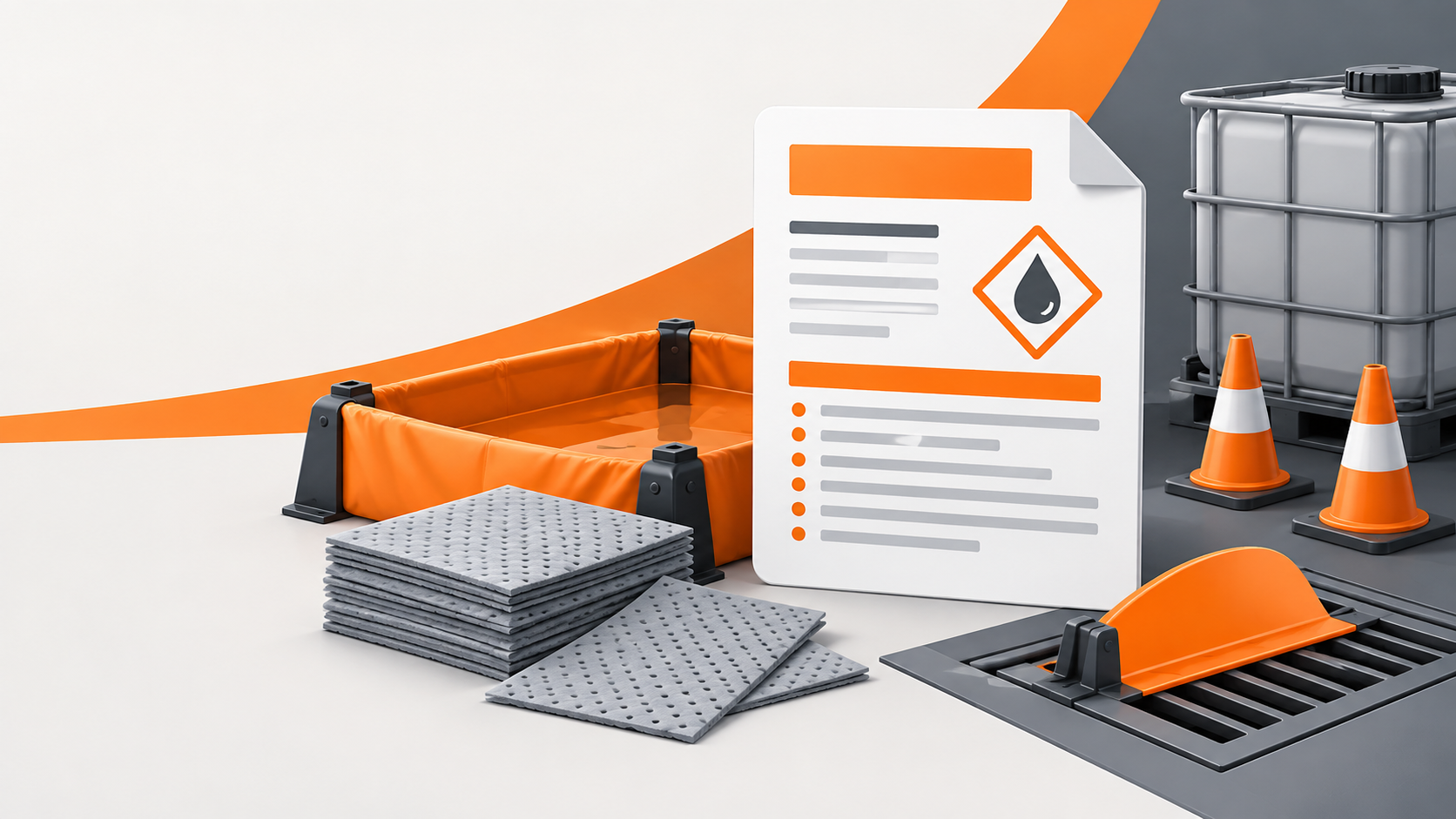
- SDS Section 6 covers accidental release measures such as personal precautions, environmental precautions and clean-up methods.
- Supplier guidance must be tested against the site's credible spill quantity, layout, drains and responder capability.
- A small trained response and a large or unknown release need different escalation routes.
- Spill planning should also review the handling and storage controls that could prevent the release.
SDS Section 6 describes how a supplier recommends managing an accidental release of its product. It can help select precautions and clean-up materials, but it does not know the size of your containers, the position of your drains or who is trained to respond. Use it as evidence for a site-specific spill plan.
What does Section 6 tell you?
In the REACH safety data sheet structure, Section 6 addresses accidental release measures. The legislation text describes personal precautions, environmental precautions and clean-up methods, with detail depending on the substance or mixture. A current SDS may direct users to remove ignition sources, prevent contact, keep material out of drains or use a particular absorbent. Read the exact product's instructions; these examples are not universal instructions.
Compare Section 6 with Sections 2, 4, 5, 8 and 13. Hazard classification, first aid, fire response, protective equipment and disposal information may change how a release is handled. Check product identity and revision before using the sheet. HSE says an SDS is not a risk assessment, so the site's spill decision cannot be made from one section alone.
If the SDS uses vague wording, seek supplier or competent advice before designing a kit or instruction around it. Do not interpret a broad phrase such as “absorb with suitable material” as permission to use whatever happens to be on the shelf.
What local details change the response?
The largest credible spill is often set by the container and transfer method. A cracked small bottle, a punctured drum and a failed hose differ in volume, spread and responder capability. Map the surface, gradient, drains, ventilation, ignition sources and occupied areas. The Health and Safety Executive (HSE) asks COSHH assessors to consider people who could be harmed and the controls needed for their work.
Set a clear threshold for withdrawal and escalation. Unidentified material, symptoms, spreading vapour, a release beyond the kit or a risk to people nearby may require isolation and specialist help. Staff should know how to alert others without approaching the release to identify it by smell or colour. Only trained responders should use a clean-up method within the conditions for which it was planned.
The plan should assign roles: who blocks access, obtains the current SDS, calls for assistance and decides when work may resume. If contractors share the area, include them in warnings and handover arrangements. Test these decisions on evening and weekend shifts as well as during the main day.
How should kit and equipment be chosen?
Choose containment, absorbent, collection containers and protective equipment for the product and credible quantity. Make sure equipment is reachable without crossing the spill. Check it after use and at intervals. A kit label does not prove chemical compatibility or capacity; document why its contents suit the scenario and get competent advice where necessary.
Provide a safe route for contaminated waste. The material recovered after a spill may need different handling from an unopened product. State who packages and identifies it and how it is handed over. Do not mix an unknown spill residue with other waste on an assumption of compatibility.
HSE's control measures guidance includes spillage capture, decontamination and clean-up, as well as maintaining equipment and procedures. The spill kit is one part of that system. Training and a stop condition matter just as much as the absorbent inside it.
What should be learned from a spill?
Record the product, estimated quantity, cause, exposure, response and any failure in equipment or communication. Review the transfer, container and storage method that allowed the release. HSE advises reviewing assessments after accidents and near misses; the lesson may be a better pump or shelf, not a larger kit.
Update the plan if the product, container size or layout changes. Keep the SDS linked to the task and location through the Safe Foundry feature overview, and use the assessment workflow to revisit the controls. A good Section 6 review ends with people knowing when they can act and when they must get clear.
What would a Section 6 comparison table include?
Use one row per credible spill scenario rather than one row per product alone. Columns can show the product and SDS revision, container size, location, likely spread, people at risk, relevant Section 6 precautions, local response level, equipment, waste route and escalation contact. The table exposes gaps such as a supplier instruction to ventilate an area that has no controllable ventilation or a kit located across a narrow corridor the spill could block.
Compare the largest normal package with the planned containment capacity. If a kit was chosen for a small bottle but the site now receives drums, the response assumptions have changed. Do not ask untrained workers to improvise by using several small kits together unless the revised scenario has been assessed and practised.
How can a drill test the plan without a real release?
Describe a leaking container in a named location and ask the first observer to explain their first actions. Can they warn others and identify the area without touching the substance? Can the trained responder find the current SDS and correct kit? Does the team know who decides that the release is too large or uncertain for a site response? A tabletop exercise or walk-through can reveal access and communication failures without creating a hazard.
Test a less convenient scenario too: a leak near a drain, a spill after hours or a release when the usual responder is absent. The answer may be to restrict work, move the kit, change staffing or improve container design. Do not record “drill completed” without closing the actions it produced.
How does prevention connect with Section 6?
Section 6 prepares for failure, but the stronger control is often to prevent the spill. Review containers, shelves, transfer equipment, transport routes and housekeeping. If small releases repeatedly occur at one pump, a different pump or fitting may eliminate the problem. If bottles are dropped during a long carry, change the storage point or trolley.
Include a review trigger in the plan for a changed product, container size, site layout or near miss. Record the reason for the selected response and the person who approved it. This keeps the document from becoming a generic kit inventory and makes it clear which real conditions the response was designed to cover.
What if the SDS gives only broad spill wording?
Broad advice may be appropriate for a supplier serving many workplaces, but it leaves the site to define a method. Ask the supplier or a competent adviser what matters for the product and credible spill size. Record the chosen materials, personal precautions and disposal route, including any uncertainty. Do not convert a vague statement into an unverified claim that one universal absorbent or glove works for every chemical in the store.
If the current sheet lacks enough information for a planned transfer, pause the transfer design until the gap is resolved. It is easier to change equipment before a spill than to decide under pressure whether a product can be safely contained near a drain or ignition source.
The final plan should be short enough for a trained responder to use under pressure, with the fuller source evidence retained behind it. A readable stop condition is more valuable than an exhaustive list of equipment without a decision rule.
Frequently asked questions
Can I follow SDS Section 6 exactly for any spill size?
No. The site's response must account for quantity, location and the capability of trained responders.
Does Section 6 replace a spill risk assessment?
No. It supplies product guidance, while the assessment adds local people, layout, drains and equipment.
Should every employee clean up a small spill?
No. Staff should know how to alert others, but clean-up should be limited to people trained and equipped for the assessed scenario.
What if the spill material is unknown?
Avoid contact, keep others away and use the site's escalation procedure until competent identification and response are arranged.
SDS Section 9 lists physical and chemical properties. Learn which values affect workplace exposure, storage and spill planning, and how to use them.
SDS Section 7: Handling and Storage in Practice at WorkSDS Section 7 covers safe handling and storage. Learn how to turn supplier conditions into workable controls for your task, containers and storeroom.
SDS Section 4: Turning First Aid Advice Into a PlanSDS Section 4 gives first aid information by exposure route. Learn how to check it, place it in context and prepare a usable workplace response.