
SDS Section 8 Explained: Exposure Controls and PPE
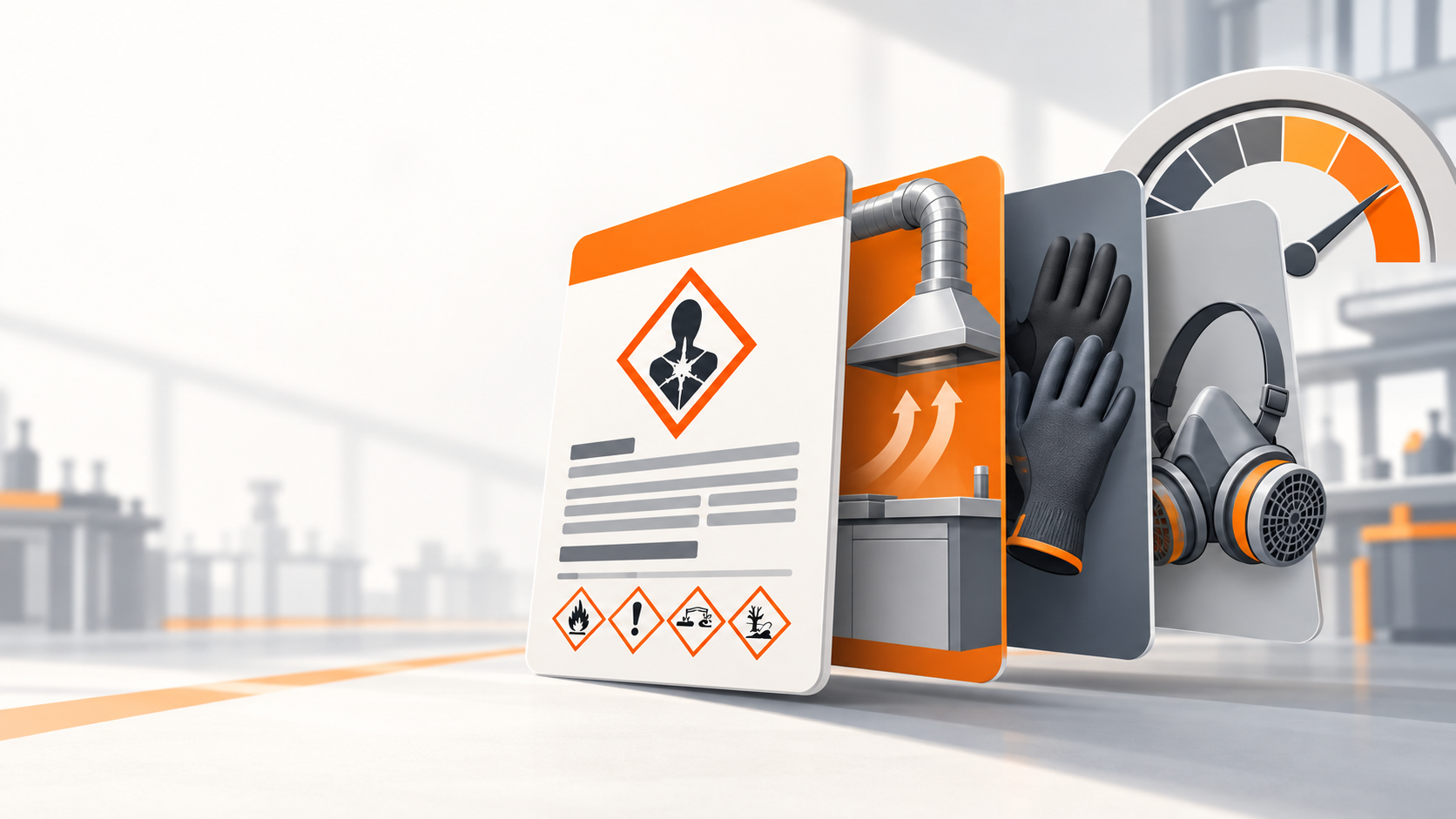
- SDS Section 8 normally contains control parameters and exposure-control or personal-protection information.
- Workplace exposure limits must be interpreted with their averaging period, units, substance identity and applicable UK source.
- Supplier PPE advice is a starting point; the COSHH assessment must select controls for the actual task and residual exposure.
- Section 8 should be read with hazard, handling, physical-property and stability sections rather than in isolation.
SDS Section 8 explains exposure-control parameters and personal protection for the supplied product. It can list occupational exposure limits, engineering-control advice and PPE. Use it as source information, then apply a COSHH assessment to the actual quantity, method, duration, ventilation and people exposed.
What are the two main parts of Section 8?
Section 8 is usually divided into control parameters and exposure controls. Section 8.1 can contain occupational exposure limits, biological limits and monitoring information. Section 8.2 can cover engineering controls, eye and face protection, skin protection, respiratory protection and environmental exposure controls.
The exact detail varies. A sparse Section 8 does not prove low risk, and an extensive PPE list does not prove every item is needed for every use.
How do you read an exposure-limit table?
Read the substance, value, units, averaging period, source and notation together. A number without its context is unsafe to apply.
| Field | Meaning to check |
|---|---|
| Substance or component | Which ingredient the limit covers |
| Long-term limit | Commonly an eight-hour time-weighted average |
| Short-term limit | Commonly a 15-minute reference period |
| Units | Often ppm or mg/m³, which are not interchangeable |
| Form | Vapour, inhalable dust, respirable dust or another fraction |
| Skin notation | Warns that skin absorption may contribute materially |
| Source | Whether it is the current applicable UK limit |
Compare with the current HSE EH40 source rather than relying blindly on a copied international table. A limit is not a target; controls should prevent or adequately control exposure and may need to reduce it below the limit by a substantial margin for certain serious hazards.
What does engineering-control advice mean?
Engineering advice describes possible control types, not a finished design for your workplace. “Use adequate ventilation” may be insufficient for open spraying or heated solvent use. The assessment should identify the release point and decide whether enclosure, closed transfer, local exhaust ventilation or another control is needed.
HSE says effective measures usually combine process or workplace modifications, applied controls and methods of work, with PPE where needed (HSE good control practice).
Should you copy the PPE list into the COSHH assessment?
No. Translate supplier advice into task-specific selection. Check:
- chemical and physical hazard;
- expected contact or airborne concentration;
- splash, immersion or incidental contact;
- duration and temperature;
- glove material and breakthrough information;
- eye, face and skin coverage;
- respirator type, filter and assigned protection;
- fit, compatibility, maintenance and replacement;
- residual exposure after engineering controls.
HSE states that PPE should be used where other measures are inadequate and that it protects only the wearer while worn (HSE PPE guidance). “Wear suitable gloves” is not a usable specification until the assessment defines suitable.
Which other SDS sections should you read?
Read Section 8 with the sections that explain identity, hazard and behaviour. Use:
- Section 1 for product and supplier identity;
- Section 2 for classification and label elements;
- Section 3 for composition information;
- Section 6 for accidental release;
- Section 7 for handling and storage;
- Section 9 for volatility and physical properties;
- Section 10 for reactivity and incompatibility;
- Section 11 for health effects.
The SDS workflow can keep the source connected to the assessment without collapsing the two documents.
What are common Section 8 mistakes?
Common mistakes remove the task context or misread the data. Watch for:
- applying a US or EU limit as if it were the current GB WEL;
- confusing ppm with mg/m³;
- ignoring short-term peaks;
- treating “no limit assigned” as “no hazard”;
- copying generic glove or respirator advice;
- relying on room ventilation for a strong local source;
- ignoring skin exposure and ingestion routes;
- treating PPE as the only control.
If information appears incomplete or inconsistent, ask the supplier. HSE advises users to seek missing information from the supplier (HSE COSHH FAQ).
How do you turn Section 8 into an action plan?
Use a short chain from source statement to workplace decision and evidence. For each relevant entry, record:
- what Section 8 says;
- which task and exposure route it affects;
- the control selected and why;
- the performance standard;
- user checks, maintenance and monitoring;
- residual PPE specification;
- review triggers.
The assessment features can store this reasoning with source references. The final plan should be understandable to workers and testable by supervisors.
Section 8 is valuable because it brings exposure and protection information together. Its limitation is equally important: the supplier cannot see your process. Use it to ask better workplace questions, not to avoid them.
What do skin and biological notations mean?
A skin notation warns that absorption through the skin may contribute materially to total exposure. It is not simply an instruction to add gloves. Review splash, immersion, contaminated surfaces, clothing and the ability of the substance to pass through skin.
Biological monitoring information, where relevant, needs competent interpretation and an appropriate occupational-health process. Do not place identifiable health data in a general SDS or assessment record. Section 8 may point to a parameter, but the employer must decide whether monitoring or health surveillance duties arise from the actual work.
How do you choose between ppm and mg/m³?
Use the unit stated by the applicable limit and a valid conversion only when the required conditions are known. Parts per million expresses a volume ratio for gases or vapours, while milligrams per cubic metre expresses mass concentration. Temperature, pressure and molecular mass affect conversion.
Do not compare a detector reading in ppm with a limit in mg/m³ by looking only at the numbers. Confirm substance, calibration, units, averaging period and sampling method. Seek occupational-hygiene support where measurement informs a significant decision.
What if Section 8 says “use adequate ventilation”?
Translate the phrase into a designed control for the source and task. General room ventilation may be adequate for a small low-rate release, while spraying, heating or open mixing may require enclosure or local capture.
Document the emission point, hood or enclosure, airflow direction, user indicator and examination or maintenance arrangements. Observe smoke or other appropriate commissioning evidence only through competent methods. “Window open” should not become the default answer without an assessment of reliability and conditions.
How should glove advice be reviewed?
Specify glove material, thickness or performance, contact type, expected duration and replacement rule. The same material can perform differently against a mixture, at higher temperature or under abrasion. A breakthrough time from a supplier test may not equal a safe wear time in the task.
Check cuffs, dexterity, double-gloving, contamination during removal and compatibility with sleeves or other PPE. Provide sizes and training. Where direct contact can be eliminated through tools or closed transfer, do that before relying on gloves.
How should respiratory advice be reviewed?
Determine the contaminant and required protection before choosing a respirator. Filtering devices depend on oxygen-sufficient atmospheres and suitable filters; they are not universal emergency equipment. Tight-fitting masks require fit testing and clean-shaven seal areas.
Record selection, assigned protection, filter change, inspection, cleaning, storage and wearer limitations. RPE should cover assessed residual exposure and foreseeable short-duration work, not substitute for feasible source control.
What if Section 8 conflicts with the label or another section?
Treat unexplained inconsistency as a supplier query. A glove recommendation may conflict with corrosive classification, or an exposure limit may name a component absent from the disclosed composition. First confirm that the SDS matches the product and version.
Record the exact fields, page and question. Restrict work where the conflict prevents safe control selection. Do not silently edit the SDS; keep supplier information intact and document the workplace decision separately.
How should Section 8 changes be reviewed?
A revised limit or PPE statement should trigger comparison of affected assessments. Identify tasks using the product, then review engineering controls, monitoring, PPE and worker information.
Record whether the assessment remains valid, needs limited amendment or requires reassessment. Withdraw old point-of-use copies while retaining version history, so the organisation can show which information supported earlier decisions.
Frequently asked questions
What does TWA mean in SDS Section 8?
TWA means time-weighted average. The stated reference period and source must be checked, commonly eight hours for long-term workplace exposure limits.
Does “no workplace exposure limit” mean no control is needed?
No. Many hazardous substances have no assigned WEL. Control must still reflect health effects, exposure and available guidance.
Can I choose gloves from Section 8 alone?
Section 8 may guide selection, but confirm material, thickness, contact type, duration, temperature, breakthrough and task practicality with competent information.
Is Section 8 the same as a PPE assessment?
No. It is supplier information. Workplace PPE selection must account for the task, wearer, other controls and compatibility.
Learn how to assess process-generated dust and fumes without an SDS by defining the process, exposure routes, evidence and practical controls.
How to Check an SDS Matches the Chemical You UseCheck that an SDS matches your chemical by comparing product identifiers, supplier, concentration, form, label classification and intended use.
Chemical Stocktake Checklist: What to Record and CheckUse this chemical stocktake checklist to reconcile containers with your register, verify SDS links, find storage issues and assign follow-up actions.