
How to Manage Unlabelled and Unidentified Chemicals
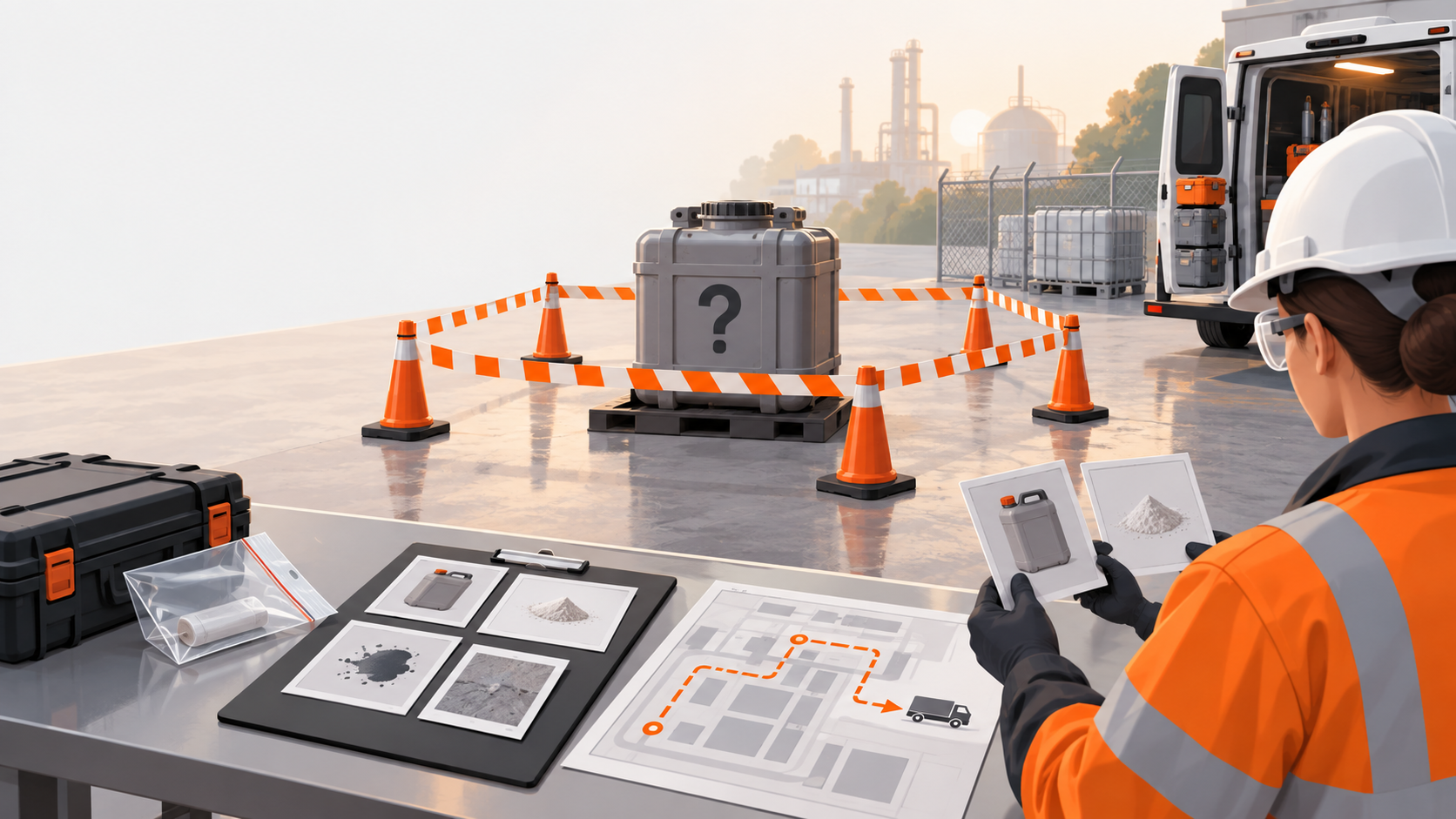
- An unlabelled chemical should be treated as unknown until identity is established from reliable evidence.
- Do not open, smell, mix, move or test a suspicious container through improvised methods.
- Immediate priorities are people, isolation, condition assessment, evidence preservation and competent escalation.
- The incident should close with verified identification or disposal, corrected records and action on the process that allowed the unknown to arise.
Treat an unlabelled chemical as unknown until reliable evidence proves its identity. Keep people away, avoid disturbing the container, record its location and visible condition, and escalate through the workplace's chemical incident or hazardous-waste procedure. Never guess from colour, odour, shelf position or a nearby label.
What should you do first?
Protect people and prevent disturbance. If there is leakage, pressure, heat, fumes, crystals, corrosion or reaction, activate emergency arrangements and avoid entry. Otherwise restrict access and prevent use or disposal with normal waste.
Do not:
- open or loosen the closure;
- smell or touch the contents;
- move a degraded container unnecessarily;
- pour out a sample;
- mix it with a “test” chemical;
- attach a guessed name;
- place it beside another material without compatibility evidence.
What evidence can be recorded safely?
Preserve observations without pretending they establish identity. From a safe position, record:
- exact site and storage location;
- container type, size, closure and condition;
- visible colour, layers or deposits;
- fragments of labels, codes or handwriting;
- nearby products and location records;
- date found and people with relevant knowledge;
- purchase, transfer, experiment or waste records;
- photographs where authorised and safe.
Give the item a neutral quarantine reference such as UNKNOWN-2026-014, not a chemical name.
How should the area be controlled?
Use controls proportionate to the credible worst case while competent advice is obtained. This may include isolating a cabinet or room, controlling ignition, improving perimeter security, stopping nearby work and informing emergency contacts.
Do not relocate the container simply to tidy the area. Movement can trigger failure or place incompatible materials together. HSE says containers and pipes must be identifiable where dangerous substances are present and controls should keep incompatible substances apart (HSE DSEAR in detail).
Who should identify an unknown chemical?
A competent person should decide whether documentary evidence is enough or specialist analysis is required. The decision depends on container condition, possible substances, quantity and proposed handling.
Potential sources include purchasing, laboratory notebooks, batch records, supplier codes, previous inventory exports and people who worked in the area. Independent clues should agree. A shelf position or memory alone is not proof.
Specialist hazardous-waste contractors or analytical services may be required. Sampling itself needs a risk assessment, suitable containment, controls and chain of custody.
Can the chemical be relabelled?
Relabel only after identity and required hazard information are established through an approved process. Record the evidence, decision maker and link to the correct SDS and assessment. If identity remains uncertain, disposal as unknown hazardous material may be safer than continued investigation.
HSE notes that labels communicate hazard through pictograms, signal words and statements (HSE labelling guidance). A new label must not create false certainty.
How should disposal be arranged?
Give the waste contractor accurate uncertainty and condition information. Do not send the container through a routine waste stream under a guessed name. Provide photographs, size, location history, possible identities and visible warning signs.
The contractor may specify overpacking, stabilisation, sampling or collection conditions. Preserve transfer and disposal records. Deleting the inventory exception before confirmed removal breaks the audit chain.
What if the container is leaking or unstable?
Treat it as an emergency or specialist hazardous-material situation. Evacuate or isolate according to the emergency plan, call trained responders and provide the evidence available. Do not attempt cleanup with a generic spill kit when compatibility is unknown.
HSE's storage guidance tells workers to report damage and leaks and not simply continue work (HSE storage sheet OCM8). Unknown contents increase the need for caution.
How can future unknowns be prevented?
Fix the lifecycle gap that allowed identity to be lost. Review receiving, decanting, temporary samples, experimental work, shift handover, container reuse, transfers and waste.
Controls can include:
- no container without immediate durable identification;
- pre-approved secondary-container labels;
- owner and date for temporary samples;
- routine location reconciliation;
- prohibition on unattended “mystery” waste;
- transfer and disposal records;
- escalation when labels are damaged.
The chemical register features and QR workflow can support traceability, but the human-readable label must remain clear.
How should the incident be closed?
Close only when identity or disposal is confirmed and the root cause is addressed. Record timeline, evidence, risk decisions, responders, final identity or waste classification, destination, register correction and preventive action.
Use the help centre for record organisation. An unknown chemical is both a material risk and a process failure; resolving only the container leaves the next one waiting to happen.
How should possible identity be evaluated?
Build an evidence table that separates facts, clues and excluded possibilities. Facts may include a readable supplier code, sealed original packaging or a laboratory notebook entry tied to a unique sample ID. Clues include colour, shelf position or a person's recollection. An exclusion may come from a verified inventory showing a substance was never present in the area.
Require more than one independent source where practical. Record confidence and the person making the decision. If the evidence is insufficient to support safe handling, keep the status unknown and move to specialist identification or disposal.
Never use absence of a hazard label as evidence that the material is harmless. The label may have detached, the container may predate current systems or the material may have changed in storage.
What container conditions require specialist response?
Treat signs of instability or packaging failure as more than an identification problem. Warning signs include bulging, crystallisation around a cap, rust through metal, pressure release, heat, gas generation, colour change, phase separation, degraded plastic or a container fused to a shelf.
Do not clean crystals, tighten a cap or place a suspect container inside an incompatible secondary container. Isolate the area and describe the condition precisely to trained responders or the waste contractor.
Older ethers, organic peroxides and other stability-sensitive materials can require specialist knowledge, but do not infer identity from appearance. The visible condition determines caution; verified evidence determines the substance.
How should temporary samples be controlled?
Give every temporary container a minimum identity, owner and removal date at the moment it is created. Include source material or sample ID, date, responsible person and hazard or assessment link. Define how long an unattended sample may remain and who reviews it at project close.
Prohibit reused food or drink containers and undocumented abbreviations. Provide label materials that survive cold, moisture, solvents and the expected duration. A procedure that requires workers to find a printer in another building will often create handwritten gaps.
What can an investigation teach the organisation?
Use the event to test chemical lifecycle controls. Determine whether the unknown entered through purchasing, decanting, research, contractor work, relocation, staff departure or waste accumulation. Check nearby records for similar weaknesses.
Track time to isolation, time to resolution, specialist cost and root cause. Use those findings to improve induction, project closeout, location ownership and stocktake frequency. The purpose is learning and prevention, not assigning a guessed label quickly enough to clear the shelf.
How should nearby work be reviewed?
Check whether the unknown could have affected other containers, surfaces or people. Look for leakage paths, shared secondary containment, ventilation movement and evidence that anyone handled or moved the item before it was isolated.
Where exposure may have occurred, follow the organisation's incident and occupational-health process without speculating about health effects. Preserve dates, names and observations securely. The absence of immediate symptoms does not establish that the event was harmless.
What should a stocktake do with unresolved unknowns?
Keep each unknown visible as a controlled exception until final resolution. Count it under its quarantine reference, location, condition and owner. Do not hide it in an “other” row or reduce the registered quantity to zero before removal.
Report ageing unknowns to accountable management. Long-open items often indicate unclear budget, ownership or contractor arrangements, all of which require a management decision rather than another inspection note.
Frequently asked questions
Can I identify an unknown chemical by smell?
No. Smelling intentionally exposes the person and is unreliable. Use documentary evidence or a competent specialist identification process.
Should I move an unlabelled bottle to a quarantine cabinet?
Only after a competent person determines that movement and the destination are safe. Isolation in place may be safer for a damaged or reactive container.
Can an old handwritten abbreviation count as identification?
Treat it as a clue, not proof. Verify it against independent records and the container history before assigning an identity.
Who pays for identifying or disposing of an unknown chemical?
The organisation should arrange competent handling as part of its workplace risk and waste responsibilities; internal charging does not change the safety decision.
Check that an SDS matches your chemical by comparing product identifiers, supplier, concentration, form, label classification and intended use.
Chemical Stocktake Checklist: What to Record and CheckUse this chemical stocktake checklist to reconcile containers with your register, verify SDS links, find storage issues and assign follow-up actions.
Do Safety Data Sheets Expire? UK Update RulesDo safety data sheets expire in the UK? Learn how revision dates, supplier updates and workplace checks determine whether an SDS remains current.