LEV and COSHH: Checks That Keep Extraction Working
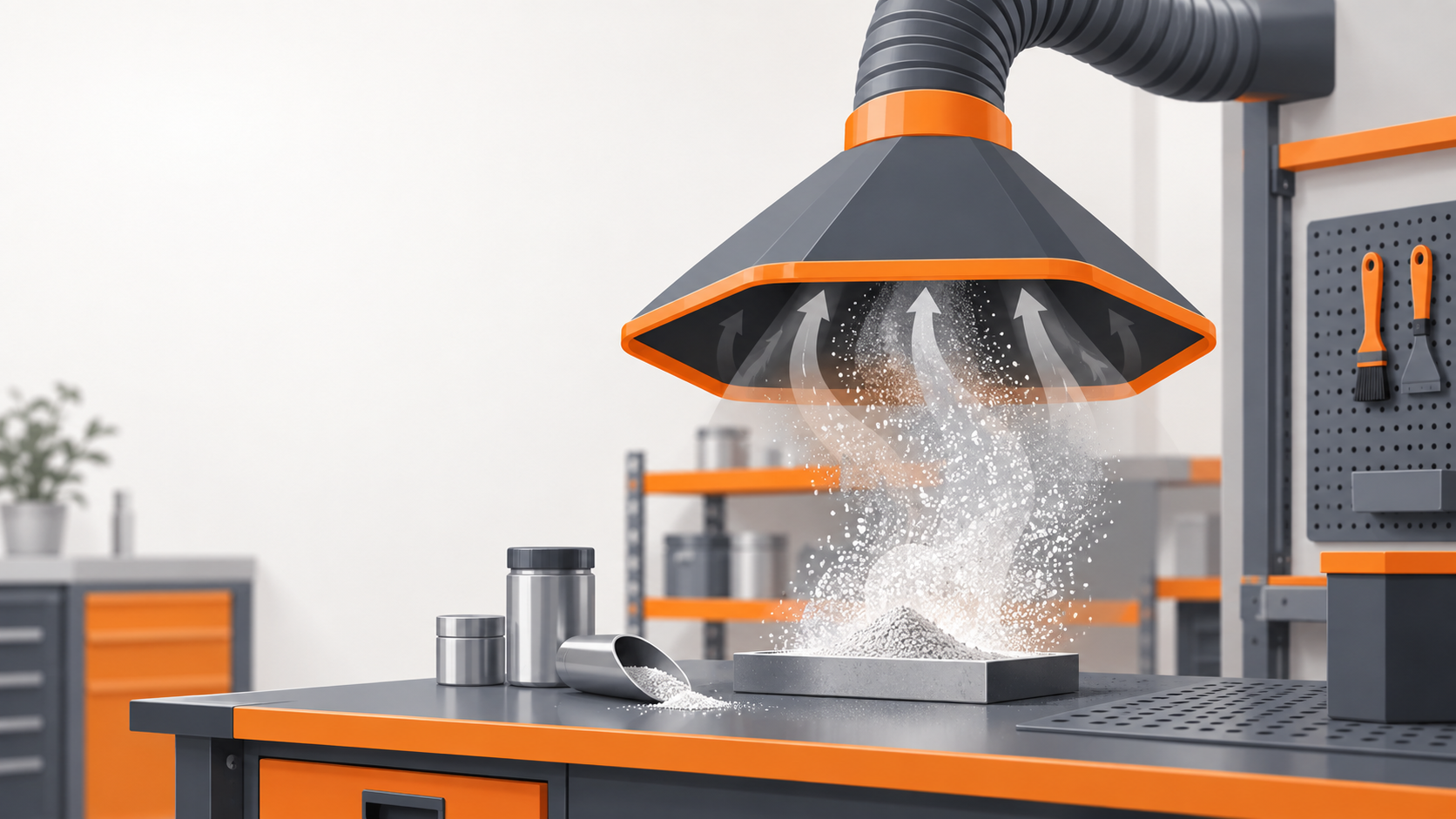
- Local exhaust ventilation (LEV) controls airborne contaminants by capturing them close to where they are released.
- Operators need practical checks that show the system is working during the task, alongside competent examination and testing.
- Most COSHH LEV systems require thorough examination and testing at least every 14 months, with some process-specific exceptions.
- A failed extraction system should trigger a work decision, not merely a note for the next maintenance visit.
Local exhaust ventilation (LEV) is a control that captures dust, fume, mist, gas or vapour near its source. Under COSHH, the question is whether the system works for the specific task and continues to do so. A test certificate matters, but it does not replace daily use checks, maintenance or a plan for failure.
What job is the LEV supposed to do?
Describe the contaminant, its release point and how the worker stands or moves. A hood may work well for a fixed bench task and poorly when the operator moves the source away. HSE's COSHH assessment guidance recommends suitable LEV to extract dust, fume, mist, gases or vapour through a hood or booth, reducing worker exposure. The assessment should connect that recommendation to the real process.
Record where the hood should be positioned, what work rate it supports and any doors or cross-draughts that affect capture. Note the people nearby, including cleaners and maintenance workers. If a process changes its material, temperature, throughput or position, the original control assumption may no longer hold. “LEV provided” is not a complete control description.
Choose a simple way for operators to recognise effective operation. A pressure gauge, airflow indicator or other performance marker can be useful only if staff know the acceptable range and what to do when it is not met. The marker should relate to system performance, not merely show that a fan motor has power.
What should operators check before and during work?
Before starting, confirm the extraction is switched on, the hood is in the intended position and any visible indicator is within its agreed range. Check for obvious damage, blocked inlets, disconnected ducts, unusual noise or dust escaping into the work area. During use, watch whether the process is inside the capture zone. If a worker has to move a hood aside to complete the task, the layout may need redesign.
HSE's control measures guidance says control equipment and ways of working should be checked and maintained. It also describes worker behaviour, such as using the equipment properly and warning supervisors when something appears wrong, as part of control. Train staff to report a defect without fear that production pressure will require them to continue unprotected.
Keep the check short and meaningful. A tick box that is always completed without looking at the hood provides little assurance. Make the expected condition visible at the equipment, and let operators record a defect that triggers a response.
How often must LEV be examined and tested?
HSE's LEV guide HSG258 says the maximum interval between thorough examination and testing is generally 14 months for COSHH systems, with shorter intervals for certain processes specified in Schedule 4. The examination should be performed by a competent person who can assess performance against the system's intended duty. Check the applicable interval for your specific plant rather than applying a blanket date from a blog post.
Keep the report, identified defects and evidence of corrective action. A pass recorded shortly before a process change does not establish that the changed task is controlled. Conversely, a report of reduced performance should prompt assessment of work carried out since the decline and what interim control is needed.
Routine maintenance sits between formal examinations. Filters, ducts, fans and hoods can deteriorate or become obstructed. The maintenance plan should identify what is checked, who does it and how the system is safely returned to service. HSE recommends retaining examination, test and repair records so trends in deterioration can be seen.
What happens if extraction is not performing?
The COSHH assessment should state the stop or alternative-work condition. If a system is necessary to control exposure, continuing the hazardous task while waiting for repair may be unacceptable. Identify who can authorise a different method, what temporary controls are credible and when competent testing is needed after repair. Do not assume a disposable mask automatically substitutes for a failed extraction system.
Investigate why performance fell. A blocked filter, damaged duct, changed hood position or new cross-draught calls for different corrective action. Ask users whether capture has been deteriorating gradually. Their observations can reveal issues before formal testing, especially where contamination is visible.
Keep the LEV asset linked to the tasks it protects. The Safe Foundry assessment workflow can help tie product and activity records together; maintenance and LEV test reports remain separate evidence that reviewers should consult. The success measure is sustained capture in real use, not just a date on a certificate.
What would a useful LEV log contain?
For each system, record its asset identity, the tasks and contaminants it controls, expected operating condition, routine check, maintenance owner and competent test date. Keep the commissioning or design information available so a tester can compare actual performance with the intended duty. A report stating that airflow exists is less useful if nobody knows whether the flow is enough at the hood where the worker stands.
The operator log should be short: date or shift, system status, indicator reading where relevant and any defect or unusual observation. Make the response visible beside the equipment. If the indicator is outside range, the worker should know whether the task stops immediately, whether another approved method exists and whom to contact. A log without a decision rule invites people to tick it and continue.
How might a process change defeat capture?
Consider a workbench originally used for a small grinding operation under an extraction hood. A larger component is introduced, forcing the operator to work farther from the hood. The fan still runs and a recent test certificate remains valid, but the source has moved outside effective capture. The COSHH assessment needs to be revisited before the change becomes routine. Options may include repositioning the hood, changing the workpiece support or redesigning the enclosure, followed by suitable verification.
Another example is a new door or portable fan creating a cross-draught. Air moves, but not necessarily in the intended direction. Ask workers where visible dust goes during normal work and whether they have to turn or move away from the hood. Those observations can identify a problem before a formal test, though they do not replace competent measurement where needed.
What evidence closes a defect?
Record the reported symptom, immediate work decision, investigation, repair or redesign and verification. If a filter is replaced, check that the system performs as intended afterwards. If a hood is moved, check capture at the new task position. Tell users what changed and update their pre-use check if the acceptable indicator condition changed.
Look for repeated defects. Frequent blockages may mean the system is undersized or maintenance access is poor. Repeated operator workarounds may mean the hood obstructs the job. Treat these patterns as design evidence rather than isolated failures of attention. Sustained control depends on a system that can be used correctly on a normal busy day.
When a system protects several tasks, list each one in its asset record. Repair priorities and test conditions should reflect the most demanding intended use, not only the easiest workstation to measure. Tell all affected supervisors when a defect limits use.
After a repair, confirm that the hood captures the contaminant at every relevant work position, and update the operator's check if the approved setup has changed.
The feature overview shows how task records can be kept with chemical information.
Frequently asked questions
Is an LEV certificate enough to prove a task is controlled?
No. The system must still be used correctly, maintained and effective for the actual process and hood position.
Does every LEV system have a 14-month test interval?
Most COSHH systems use that maximum interval, but some processes require more frequent examination; check the applicable rule and competent advice.
Can work continue if the airflow indicator is outside its range?
Follow the site's assessed failure procedure. If LEV is essential to control exposure, stop or change the work until adequate control is restored.
Should operators record daily checks?
A practical record can help, but the check must be meaningful and defects must lead to action.
Workplace exposure limits in EH40 help assess airborne exposure in Great Britain. Learn what the figures mean, what they miss and how to review controls.
Spray Painting COSHH: Assessing Mist and Controls at WorkSpray painting COSHH assessments must consider aerosol mist, other workers and the whole paint task. Learn how to review booths, RPE and clean-up controls.
SDS Section 7: Handling and Storage in Practice at WorkSDS Section 7 covers safe handling and storage. Learn how to turn supplier conditions into workable controls for your task, containers and storeroom.