
How to Label Decanted Chemicals at Work
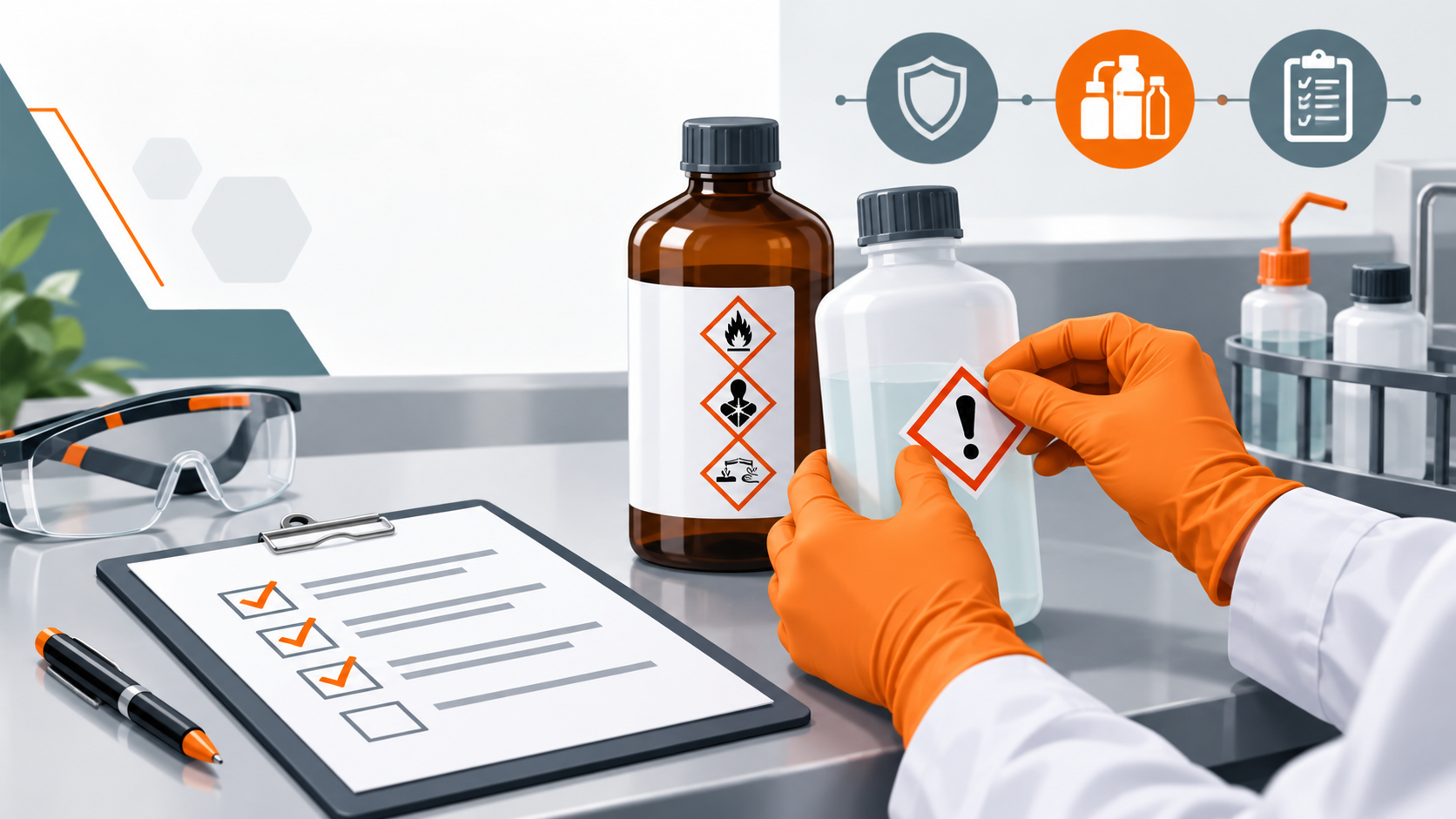
- A decanted chemical container should be identifiable throughout its use, with information that lets workers understand the contents, hazards and applicable workplace controls.
- Copying only a product name or using cap colour is weak control because similar products can have very different hazards and emergency measures.
- The original supplier label and current SDS are the authoritative sources; workplace labels should remain traceable to the exact product and assessment.
- Never put chemicals into food or drink containers, and quarantine any unlabelled container whose identity cannot be confirmed safely.
A decanted chemical container should remain clearly identifiable from filling to emptying or disposal. Its label should connect the contents to the correct product, hazards, safety data sheet and workplace controls, and the container must never be confused with food, drink or another chemical.
The exact label elements depend on whether the product is supplied to another party or used internally, but COSHH requires effective information, instruction and control in either case.
Why do decanted chemicals need labels?
Decanting separates a chemical from the supplier packaging that carries its product identifier, hazard pictograms, signal word, statements and supplier details. Without replacement information, a worker may select the wrong glove, mix incompatible products or give responders the wrong emergency information.
A label also protects the next person. “I know what is in it” is not a control once the container is left on a bench, passed to another shift or found after an incident.
HSE's COSHH assessment guidance says storage containers should be correctly labelled and incompatible materials separated.
What information should a workplace label include?
Select information from the assessment and supplier label. A practical label often includes:
- Exact product or substance identity.
- Supplier product code or internal identifier.
- Relevant hazard pictograms.
- Signal word where applicable.
- Key hazard information.
- Essential handling or precaution information.
- Dilution or concentration where the contents differ from the supplied product.
- Date prepared and expiry or discard date where relevant.
- Responsible person, department or batch reference where useful.
- A link, QR code or reference to the SDS and workplace procedure.
The label must be legible, durable and suitable for the container and environment. Condensation, solvents, abrasion, sunlight and cleaning can destroy an ordinary paper label.
Does every secondary container need a full supplier-style CLP label?
GB CLP governs classification, labelling and packaging when chemicals are placed on the market. Internal workplace transfer can engage different duties and context, including COSHH and the Health and Safety (Safety Signs and Signals) Regulations.
Do not assume that a minimal handwritten name is always enough, or that every temporary beaker needs a commercially printed supplier label. The employer should define a system that communicates hazards effectively for the duration, people and conditions of use.
If the chemical or mixture is supplied to another legal entity, department arrangement or contractor in a way that constitutes placing it on the market, obtain competent advice on the full supply obligations. Do not treat “internal label” as a route around CLP.
What about immediate-use containers?
Some procedures allow a limited immediate-use arrangement where one person decants and uses the contents without setting the container down or transferring control. This exception should be narrowly defined and should not become a reason for unlabelled bottles to accumulate.
A robust immediate-use rule states that the container:
- Remains in the control of the person who filled it.
- Is used during the same uninterrupted task.
- Is not stored, carried to another area or passed to someone else.
- Is emptied safely or labelled before the user leaves.
- Has a known compatible container and closure.
When doubt exists, label it. A small label is easier than reconstructing an unknown exposure.
How should diluted products be labelled?
A diluted product is not necessarily covered accurately by copying every element from the concentrate label. Its concentration, properties and use may differ, but it can remain hazardous.
Record the concentrate identity and the prepared concentration or mixing ratio in a way workers can understand. Link the label to the approved dilution procedure and COSHH assessment.
Do not write only “cleaner” or “10%”. State what product was diluted and what the percentage means where ambiguity is possible. Use a preparation or expiry date where stability or microbial growth matters.
Never top up a partly filled container with a new mixture unless the procedure confirms compatibility and identity. Residue can change the concentration or trigger a reaction.
Can you use colour-coded bottles or caps?
Colour coding can reinforce a label but should not replace written or pictorial identification. Colours are easily confused, inconsistently applied and inaccessible to some users.
If colours are used:
- Define them in a site standard.
- Use the same scheme across departments.
- Avoid conflict with hazard or pipe-identification schemes.
- Train users and provide a key.
- Keep the product label as the primary control.
A red cap cannot tell a responder whether the contents are flammable, corrosive, oxidising or simply part of a product range.
Which containers are suitable for decanting?
Use a container designed and compatible for the chemical, quantity, closure and task. Consider corrosion, permeation, brittleness, pressure, static electricity, light sensitivity and temperature.
Never use food or drink containers. A water bottle or mug creates a foreseeable ingestion risk even when marked with a hazard symbol.
Avoid open containers for storage. Use a secure closure and a design that minimises splashing and vapour release. For flammable liquids, the DSEAR assessment may also require bonding, earthing, ventilation or ignition control during transfer.
How should labels be produced and controlled?
Create labels from one controlled product record rather than retyping information each time. This reduces spelling errors and makes an SDS update easier to propagate.
A label template should lock the layout while allowing necessary fields such as concentration and preparation date. Test printing materials against the workplace conditions and ensure pictograms remain recognisable at the chosen size.
Safe Foundry's SDS workflow connects source information to assessment records. The feature overview and help centre explain the supporting product tools.
What should you do with an unlabelled container?
Stop work and isolate it in a controlled location. Do not smell it, taste it, pour it into another container or mix it with waste to identify it.
Follow a documented unknown-chemical process. Evidence may include the location, container type, recent work, purchasing records and analytical identification by a competent service. If identity cannot be confirmed, arrange disposal through the appropriate hazardous-waste route.
Record the incident and investigate why the labelling system failed. Common causes include labels kept too far from the decanting point, unsuitable adhesive, rushed temporary work and no clear owner.
How should workplace labels be inspected?
Include secondary containers in routine inspections:
| Check | Acceptable condition |
|---|---|
| Identity | Exact and traceable to a product or approved mixture |
| Hazard information | Matches the current source and assessment |
| Legibility | Readable without guessing |
| Durability | Attached and resistant to expected conditions |
| Container | Compatible, closed and undamaged |
| Dates | Preparation and expiry information valid where needed |
| Location | Stored in the assessed compatibility group |
| Records | Inventory and SDS link current |
What is the practical rule?
If someone unfamiliar with the task found the container, they should be able to identify it, understand the immediate hazards and locate the applicable controls without relying on memory. That is the standard a workable decanting label system should meet.
Frequently asked questions
Do decanted chemicals need a full CLP label?
The exact requirement depends on whether the container is being supplied or used internally and on other applicable law. Workplace information must still be clear enough for safe identification, handling and emergencies.
Can I write the chemical name with a marker?
Handwriting may be suitable only if it remains legible and the information is sufficient for the assessed use. A product name alone often omits essential hazards and traceability.
Do I need to label a container used immediately?
Avoid relying on memory even for short tasks. If immediate-use arrangements are permitted by your procedure, the container must stay under the control of the user and never be left for someone else.
What should I do with an unlabelled bottle?
Stop use, isolate it and follow the site procedure for identification or disposal. Do not smell, taste or casually mix the contents to work out what they are.
Learn how to assess process-generated dust and fumes without an SDS by defining the process, exposure routes, evidence and practical controls.
Chemical Stocktake Checklist: What to Record and CheckUse this chemical stocktake checklist to reconcile containers with your register, verify SDS links, find storage issues and assign follow-up actions.
Chemical Storage Inspection Checklist for UK WorkplacesUse this chemical storage inspection checklist to find container, label, segregation, quantity, spill-control and housekeeping problems early.