
Hazardous Area Zoning: Zones 0, 1, 2, 20, 21, 22
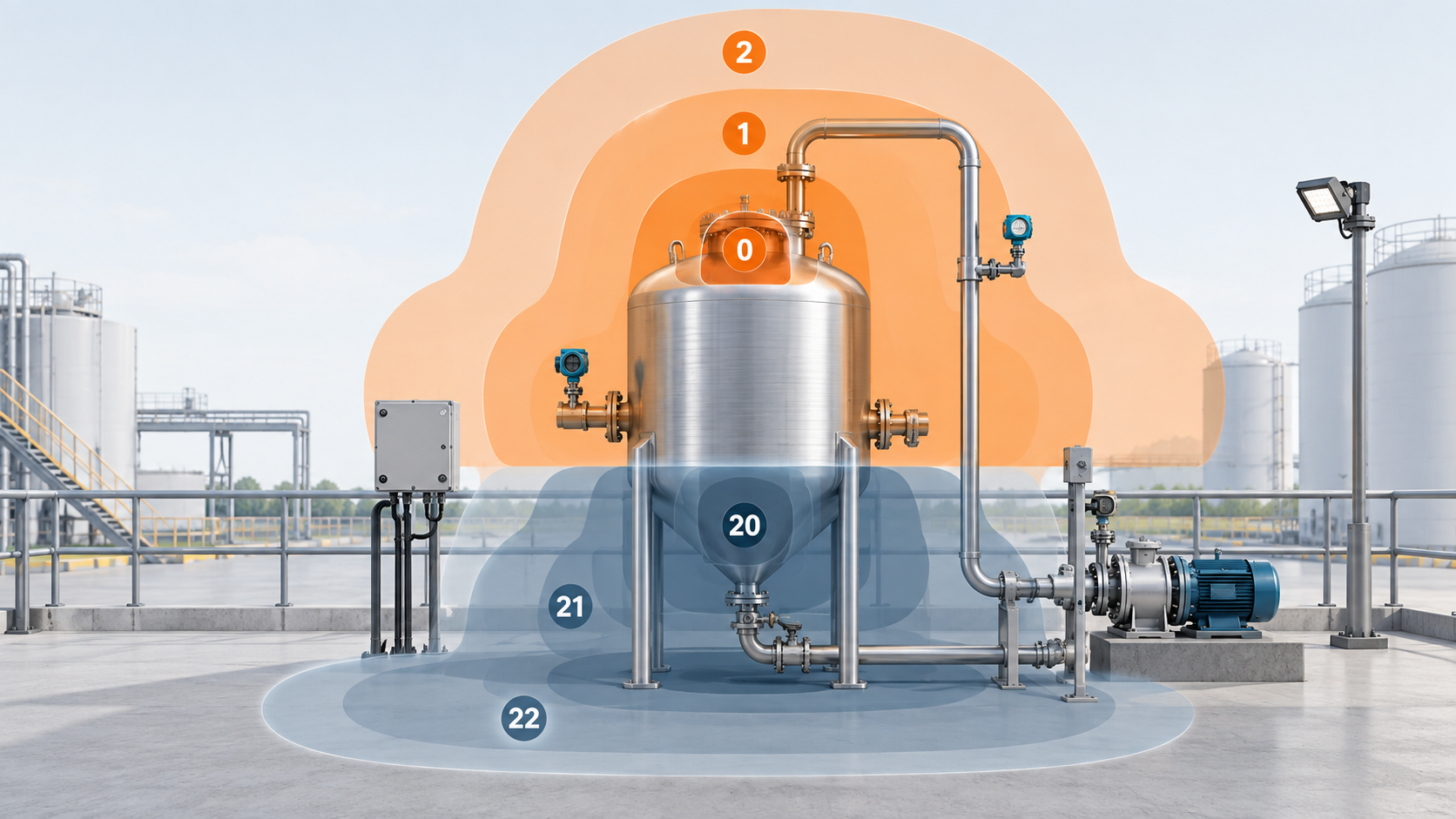
- Zones 0, 1 and 2 classify places where explosive gas, vapour or mist atmospheres may occur; Zones 20, 21 and 22 perform the same role for combustible dust.
- A lower zone number means the explosive atmosphere is expected more often or for longer, not that an explosion is more powerful.
- Zoning must be based on release sources, ventilation and persistence, and should follow efforts to eliminate or reduce the release.
- Equipment and protective systems used in a classified area must be suitable for the zone and the explosive atmosphere present.
Hazardous area zoning classifies places where an explosive atmosphere may occur so that ignition risks and equipment can be controlled. Zones 0, 1 and 2 apply to gas, vapour and mist; Zones 20, 21 and 22 apply to combustible dust. Zoning describes frequency and duration, not explosion severity.
What is hazardous area zoning?
Hazardous area zoning is the DSEAR classification of places where an explosive atmosphere may occur. The employer first assesses releases and ventilation, then assigns a zone where residual risk remains.
An explosive atmosphere is a mixture with air, under atmospheric conditions, of flammable gas, vapour, mist or dust in which combustion spreads after ignition. Zoning helps select suitable equipment and manage sources of ignition.
HSE guidance on explosive atmospheres places zoning within a wider duty to eliminate or reduce fire and explosion risk. A zone should never replace practical efforts to prevent release.
What do Zones 0, 1 and 2 mean?
Zones 0, 1 and 2 describe how often and for how long an explosive gas atmosphere is expected. They cover flammable gases, vapours and mists.
| Zone | Definition in practical terms | Typical example requiring assessment |
|---|---|---|
| Zone 0 | Present continuously, for long periods or frequently | Vapour space inside equipment containing a flammable liquid |
| Zone 1 | Likely to occur occasionally in normal operation | Area close to a routine filling or sampling point |
| Zone 2 | Not likely in normal operation and, if it occurs, persists only briefly | Area around a closed system where an infrequent leak is foreseeable |
Examples are illustrative. The actual classification depends on the release grade, substance, temperature, pressure and ventilation.
What do Zones 20, 21 and 22 mean?
Zones 20, 21 and 22 apply the same frequency concept to combustible dust clouds. Dust layers also matter because they can be disturbed into a cloud and may insulate hot equipment.
| Zone | Definition in practical terms | Typical example requiring assessment |
|---|---|---|
| Zone 20 | Present continuously, for long periods or frequently | Inside dust-handling equipment or a collector |
| Zone 21 | Likely to occur occasionally in normal operation | Near a powder filling or discharge point |
| Zone 22 | Not likely in normal operation and, if it occurs, persists only briefly | Around equipment where an abnormal dust escape is foreseeable |
A dust's explosibility cannot be judged from appearance. Particle size, moisture, composition and test data can materially change behaviour.
Does a lower zone number mean a bigger explosion?
No. The zone number indicates the likelihood and persistence of an explosive atmosphere, not the energy or consequence of an explosion. Consequence must be assessed separately.
A small Zone 0 volume inside equipment may have limited external consequence if robustly contained. A large Zone 2 release outdoors could still have serious consequences under adverse conditions. The risk assessment therefore considers both probability and outcome.
How are hazardous zones determined?
Hazardous zones are determined by identifying release sources, estimating release grade and evaluating ventilation. The process should be documented so assumptions can be reviewed.
Identify release sources
List openings, vents, seals, drains, flanges, filling points, sampling points, filters and foreseeable equipment failures. Separate releases expected in normal operation from rare faults.
Characterise the substance
Consider flashpoint, boiling point, vapour density, lower explosive limit, operating temperature and pressure. For dust, obtain appropriate explosibility and ignition data where needed.
Assess ventilation
Evaluate how quickly a release is diluted and removed. General room volume alone is not proof of effective ventilation. Dead spaces, pits, cupboards, roof voids and barriers can allow accumulation.
Estimate extent and persistence
Determine how far the explosive atmosphere may extend and how long it may remain. Include connected spaces and outdoor weather conditions where relevant.
Assign and document the zone
Draw the zone on an understandable plan and record the technical basis, operating conditions and assumptions. Revisit the classification if the process changes.
What is a release grade?
Release grade describes how often a source releases flammable material and is a key input to zoning. Common concepts are continuous, primary and secondary release.
- A continuous release occurs continuously, frequently or for long periods.
- A primary release is expected periodically or occasionally during normal operation.
- A secondary release is not expected in normal operation and, if it occurs, lasts briefly.
Release grade does not translate mechanically into a zone. Ventilation availability and effectiveness can change the result.
How does ventilation affect zoning?
Effective and reliable ventilation can reduce persistence and zone extent, but it must be supported by evidence. If safety depends on mechanical extraction, loss of ventilation may require alarm, shutdown or another protective response.
Assess:
- Extraction rate and capture position
- Discharge to a safe location
- Airflow around equipment and obstructions
- Natural ventilation variability
- Failure detection and maintenance
- Whether heavier-than-air vapour can collect low down
- Whether lighter gases can collect at high level
Commissioning and periodic checks should verify that the designed performance remains available.
What equipment can be used in a hazardous zone?
Equipment and protective systems in a classified area must be suitable for the zone, substance group and temperature conditions. This includes electrical and non-electrical ignition sources.
Suitability may involve equipment category, explosion-protection concept, gas or dust group, temperature class and environmental conditions. Installation, inspection and maintenance are as important as the original selection.
Portable devices, temporary lighting, cleaning equipment and contractors' tools must not be overlooked. Hot-work controls remain necessary even where permanent equipment is correctly selected.
What controls are needed beyond zoning?
Zoning is one part of a DSEAR control strategy, not the whole strategy. Higher-value measures prevent or limit the release before ignition control is needed.
Use the following order:
- Eliminate or substitute the dangerous substance where reasonably practicable.
- Minimise quantities.
- Enclose the process and prevent releases.
- Control releases at source.
- Provide effective ventilation.
- Remove or control ignition sources.
- Limit consequences through mitigation and emergency planning.
The DSEAR-related product workflow can organise substance and assessment records, while how Safe Foundry works explains the SDS-to-assessment process.
What should a hazardous-area drawing contain?
A useful drawing shows the three-dimensional extent of each zone and the basis for the boundary. A coloured circle without assumptions is difficult to maintain.
Record:
- Zone type and extent
- Release source
- Substance or dust
- Normal operating conditions
- Ventilation basis
- Equipment within the zone
- Openings and connected spaces
- Drawing revision and assessor
Use sections or elevations where vapour density, dust movement or floor pits make a plan view misleading.
When should zoning be reviewed?
Review zoning whenever releases, ventilation, substances, quantities, temperatures, pressures, equipment or layout change. Also review after a leak, alarm, near miss or evidence that assumptions were wrong.
Workers should understand where classified areas begin, what equipment restrictions apply and how to report defects. The help centre covers Safe Foundry record management; specialist hazardous-area advice remains essential where the classification is complex.
Frequently asked questions
What is the difference between Zone 1 and Zone 2?
In Zone 1 an explosive gas atmosphere is likely to occur occasionally in normal operation. In Zone 2 it is not likely in normal operation and, if it occurs, persists only briefly.
What is the dust equivalent of Zone 1?
Zone 21 is the dust classification broadly corresponding to an explosive dust atmosphere likely to occur occasionally in normal operation.
Does a flammable liquid automatically create a hazardous zone?
No. Zoning depends on credible release, evaporation, ventilation and persistence under the actual conditions, not the product classification alone.
Who should classify a hazardous area?
The person should be competent in DSEAR, the process, substance properties, ventilation and ignition control. Complex installations normally require specialist hazardous-area expertise.
Check that an SDS matches your chemical by comparing product identifiers, supplier, concentration, form, label classification and intended use.
Chemical Storage Inspection Checklist for UK WorkplacesUse this chemical storage inspection checklist to find container, label, segregation, quantity, spill-control and housekeeping problems early.
COSHH Assessment Review Checklist for UK WorkplacesUse this COSHH assessment review checklist to compare records with current tasks, products, exposure routes, controls and workplace evidence.