GHS Pictograms Explained: What Each of the 9 Means
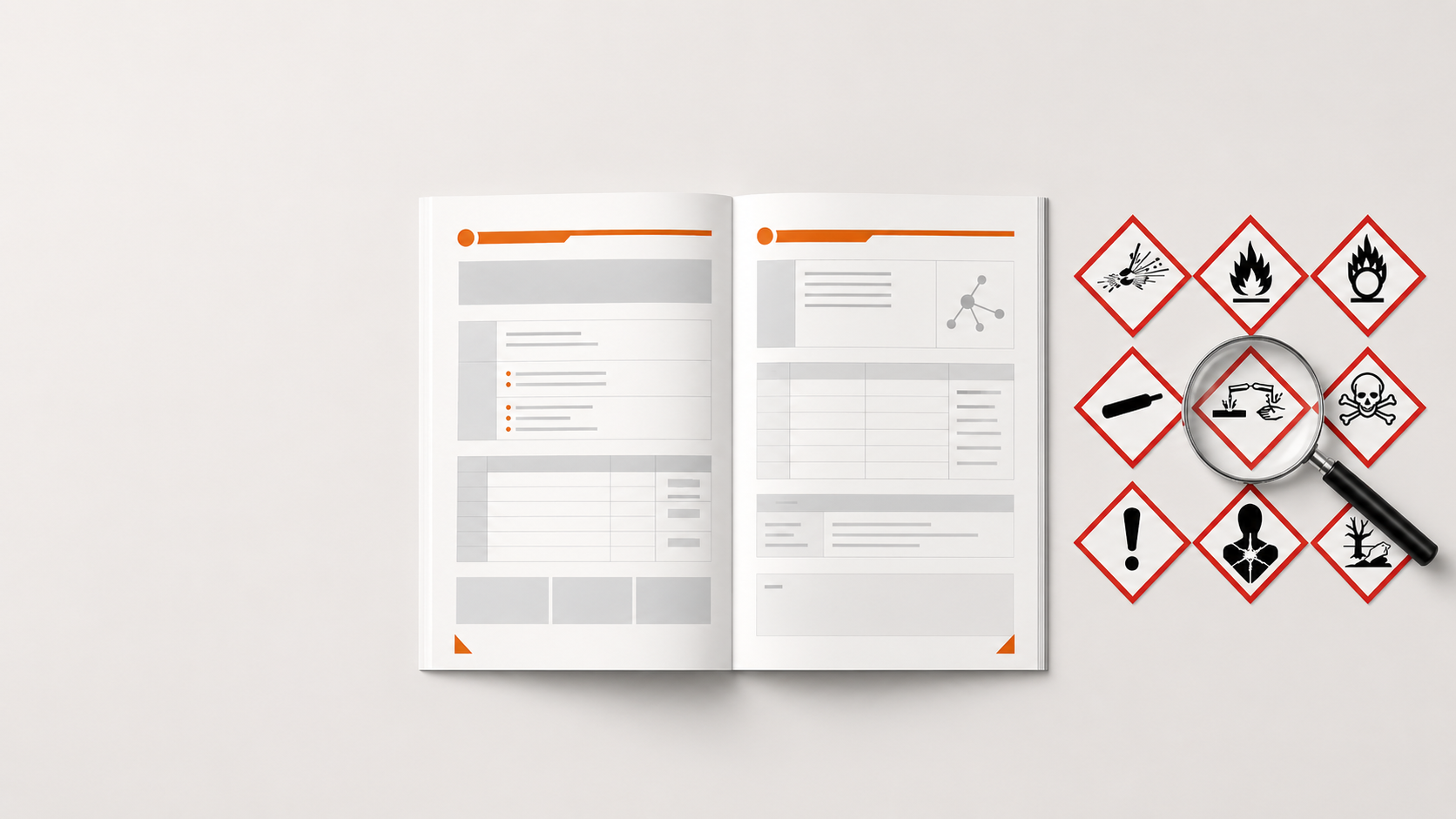
- There are nine GHS hazard pictograms, each a red-bordered diamond showing a black symbol on a white background, defined under the CLP Regulation (the GB and EU implementation of the UN's Globally Harmonized System).
- A GHS pictogram tells you the type of hazard — flammable, corrosive, acutely toxic, and so on — but not its severity; the signal word ("Danger" or "Warning") and the H-statements tell you how serious it is.
- On a safety data sheet, pictograms appear in Section 2, Hazard identification, next to the signal word and the hazard (H) and precautionary (P) statements.
- For a COSHH assessment the health-hazard pictograms matter most — skull and crossbones, corrosion, the health-hazard "starburst" figure, and the exclamation mark — because COSHH regulates risks to health, not fire or environmental risk.
- The health-hazard pictogram (a human silhouette with a white starburst on the chest) flags serious longer-term effects such as carcinogenicity, mutagenicity, reproductive toxicity, respiratory sensitisation and aspiration hazard.
There are nine GHS hazard pictograms. Each is a red-bordered diamond (a square set on one of its points) containing a black symbol on a white background, and each one signals a family of hazards — flammable, corrosive, toxic, and so on. They are defined by the CLP Regulation, the GB and EU implementation of the UN's Globally Harmonized System of Classification and Labelling of Chemicals (GHS), and on any safety data sheet they are your first clue to what a substance can do to people and property.
What are the GHS hazard pictograms?
A GHS hazard pictogram is a standardised warning symbol used on chemical labels and safety data sheets. Under CLP each supply pictogram is a red diamond frame with a black hazard symbol on a white centre, and there are nine of them in total. They replaced the older orange-square European symbols (such as the black "X" irritant and cross-and-bones designs) when CLP fully applied to mixtures. CLP became mandatory for mixtures on 1 June 2015.
A pictogram never appears alone. On a compliant label and in Section 2 of a safety data sheet it sits alongside a signal word — either "Danger" (more severe) or "Warning" (less severe) — and one or more hazard statements (H-codes, e.g. "H314 Causes severe skin burns and eye damage"). The picture tells you the hazard category family; the signal word and H-statements tell you the severity and specifics.
What does each GHS pictogram mean?
The table below summarises all nine. The final column flags why the symbol matters when you build a COSHH assessment — covered in more detail further down.
| Pictogram | Code | What it warns about | Relevance to health risk |
|---|---|---|---|
 Exploding bomb Exploding bomb | GHS01 | Explosives, self-reactive substances, organic peroxides | Physical hazard (fire/explosion) |
 Flame Flame | GHS02 | Flammable gases, aerosols, liquids and solids; pyrophoric, self-heating and water-reactive substances | Physical hazard (fire) |
 Flame over circle Flame over circle | GHS03 | Oxidising gases, liquids and solids (intensify fire) | Physical hazard (fire) |
 Gas cylinder Gas cylinder | GHS04 | Gases under pressure (compressed, liquefied, refrigerated, dissolved) | Physical hazard |
 Corrosion Corrosion | GHS05 | Skin corrosion, serious eye damage, and corrosive to metals | Health hazard (skin/eye) |
 Skull and crossbones Skull and crossbones | GHS06 | Acute toxicity (severe) — can be fatal or toxic in small amounts | Health hazard (acute) |
 Exclamation mark Exclamation mark | GHS07 | Acute toxicity (harmful), skin/eye irritation, skin sensitisation, respiratory irritation, narcotic effects; also harmful to the ozone layer | Health hazard (lower severity) |
 Health hazard (starburst figure) Health hazard (starburst figure) | GHS08 | Carcinogenicity, mutagenicity, reproductive toxicity, respiratory sensitisation, target-organ toxicity, aspiration hazard | Health hazard (serious/chronic) |
 Environment (dead tree and fish) Environment (dead tree and fish) | GHS09 | Hazardous to the aquatic environment | Environmental, not a health hazard |
It helps to group the nine into three families:
- Physical-hazard symbols — the exploding bomb, flame, flame-over-circle and gas cylinder (GHS01–GHS04). These warn about fire, explosion and pressure.
- Health-hazard symbols — corrosion, skull and crossbones, exclamation mark and the starburst figure (GHS05–GHS08). These warn about harm to the body, from an immediate acid burn to a long-latency cancer risk.
- The environmental symbol — GHS09, which flags aquatic toxicity.
The two most often confused are the exclamation mark (GHS07) and the health-hazard figure (GHS08). The exclamation mark covers lower-severity, generally shorter-term effects: irritation, mild acute toxicity and sensitisation. The starburst figure is reserved for the serious, often chronic effects — carcinogens, mutagens, reproductive toxicants, respiratory sensitisers and aspiration hazards. If you see the figure with the white starburst on its chest, treat the substance as one that can cause lasting harm.
Which pictograms actually matter for a COSHH assessment?
This is where the pictograms earn their keep — and where a lot of generic guidance stops short. The Control of Substances Hazardous to Health Regulations 2002 (COSHH) deal with risks to health, not with fire, explosion or environmental damage. So the pictograms do not map one-to-one onto a COSHH assessment.
- The health-hazard symbols (GHS05–GHS08) are the ones that directly drive a COSHH assessment: corrosion, acute toxicity, irritation/sensitisation and the serious chronic hazards.
- The physical-hazard symbols (GHS01–GHS04) — bomb, flame, flame-over-circle and gas cylinder — point mainly to a different regime: the Dangerous Substances and Explosive Atmospheres Regulations 2002 (DSEAR). A flammable solvent can, of course, also be harmful to breathe, in which case it carries a health pictogram too.
- The environment symbol (GHS09) is generally outside COSHH altogether; aquatic-hazard controls sit under environmental legislation.
It's also worth knowing what COSHH does not cover even where health is involved: asbestos, lead and radioactive substances each have their own dedicated regulations rather than falling under COSHH. This is general guidance, not a definitive ruling on any specific substance — always work from the classification on the actual product's safety data sheet.
Where do pictograms appear on a safety data sheet — and why aren't they enough?
A safety data sheet follows a standard 16-section structure, and the pictograms live in Section 2, Hazard identification, together with the signal word and the full list of H- and P-statements.
Here's the practical catch: a pictogram alone can't populate a COSHH assessment. The corrosion symbol appears whether a substance causes reversible irritation or permanent, irreversible skin destruction — you only know which from the H-statement and signal word. To assess risk properly you also need the exposure route, the tasks involved, quantities and frequency, existing controls, and any workplace exposure limit (HSE publishes these in EH40). The picture starts the conversation; Sections 2, 8 and 11 of the SDS finish it.
This is precisely the gap that turns a quick label-glance into hours of transcription. Safe Foundry reads the classification data out of each SDS and drafts a structured COSHH assessment from it — you can see the full flow on our how it works page, and what's captured from Section 2 on the features page. If you'd rather just look up what a symbol or statement means, our help centre has short reference notes.
Do GHS pictograms tell you how dangerous a substance is?
No — not on their own. A pictogram indicates the kind of hazard, not the degree. Severity is communicated by two other elements on the label:
- The signal word: "Danger" for the more severe hazard categories, "Warning" for the less severe.
- The hazard statement: the H-code and its wording pin down the exact classification and category.
Two products can carry the identical corrosion diamond yet differ enormously in how quickly and how badly they injure skin. Reading the signal word and H-statement — not just counting the symbols — is what makes a hazard judgement defensible.
How do CLP pictograms differ from transport (ADR) labels?
They are separate systems and easy to confuse. CLP supply pictograms (the nine described here) go on the packaging a worker handles and on the safety data sheet. Transport labels, governed by the carriage-of-dangerous-goods rules (ADR and related regulations), are the diamond placards on drums, IBCs and vehicles, and they use their own class numbers and colours. There is visual overlap — a flame appears in both — but a substance's transport class is not the same thing as its CLP hazard class, and you should read each in its own context.
The practical bottom line
The nine GHS pictograms are a fast, universal shorthand for "what could this chemical do?" — but they are the headline, not the article. For a COSHH assessment, focus first on the health-hazard symbols, then read the signal word and H-statements that sit beside them, and remember that fire and environmental hazards are governed by other regulations. Get into the habit of reading Section 2 as a whole, and the pictograms become a reliable first filter rather than a false sense of certainty.
Frequently asked questions
How many GHS pictograms are there?
There are nine GHS hazard pictograms under the CLP Regulation, each shown as a black symbol inside a red-bordered diamond on a white background.
What's the difference between the "Danger" and "Warning" signal words?
"Danger" is used for the more severe hazard categories and "Warning" for the less severe ones; the same pictogram can appear with either, so the signal word is what tells you the relative severity.
Do I need a COSHH assessment for a substance that only has the environment pictogram?
The GHS09 environment symbol relates to aquatic hazard, which sits outside COSHH's remit for health risks, but many substances carry more than one pictogram — check whether any health-hazard symbols or hazard statements also apply before deciding. This is general guidance, not a compliance ruling.
Why does a chemical have two or three pictograms?
A substance is classified against every hazard class it meets, so it can legitimately show, for example, both a flame and a health-hazard symbol; each pictogram represents a distinct hazard the product presents.
Are the old orange-square hazard symbols still valid?
The former orange-square European symbols were superseded by the red-diamond CLP pictograms; you may still encounter old stock or documentation, but current labels and safety data sheets should use the GHS/CLP pictograms.
Learn how to assess process-generated dust and fumes without an SDS by defining the process, exposure routes, evidence and practical controls.
How to Check an SDS Matches the Chemical You UseCheck that an SDS matches your chemical by comparing product identifiers, supplier, concentration, form, label classification and intended use.
Chemical Stocktake Checklist: What to Record and CheckUse this chemical stocktake checklist to reconcile containers with your register, verify SDS links, find storage issues and assign follow-up actions.