
GB CLP Explained: UK Chemical Labelling After Brexit
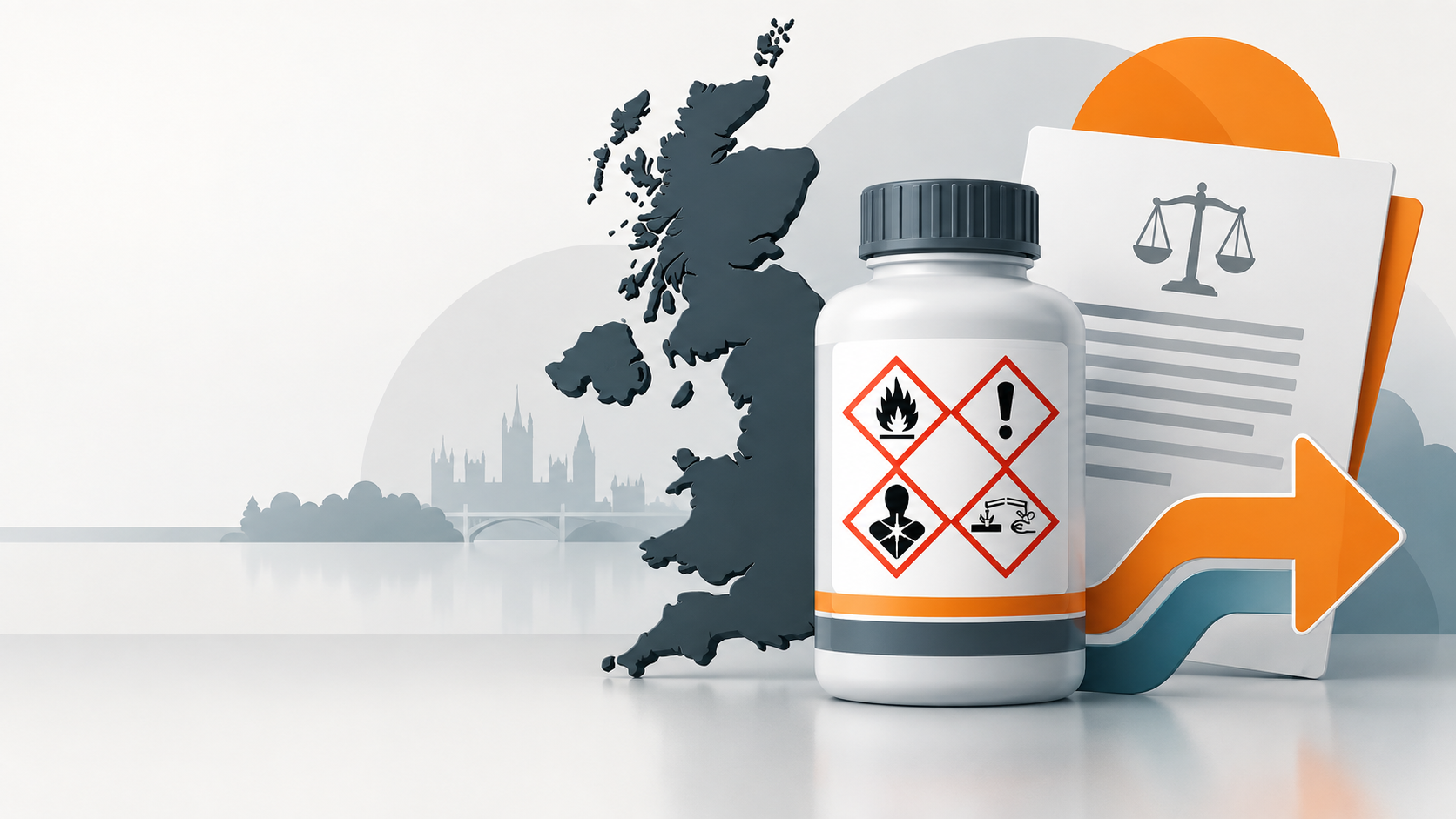
- GB CLP regulates classification, labelling and packaging of chemicals placed on the market in England, Scotland and Wales from 1 January 2021.
- Northern Ireland follows EU CLP under the Windsor Framework, so suppliers must identify the destination market before applying the regulatory route.
- GB suppliers must apply entries in the legally binding GB Mandatory Classification and Labelling List and self-classify hazards not covered by a mandatory entry.
- Workplace users should check incoming labels and SDS but must not confuse supplier classification with the separate duty to assess site-specific COSHH and DSEAR risks.
GB CLP is the chemical classification, labelling and packaging regime for substances and mixtures placed on the market in England, Scotland and Wales. It has applied since 1 January 2021, while Northern Ireland continues to use EU CLP under the Windsor Framework, so the destination market determines which regime applies.
This article gives a practical overview rather than legal or product-classification advice. Suppliers should check current HSE guidance for their exact role and supply chain.
What is GB CLP?
GB CLP is the Assimilated CLP Regulation (EC) No 1272/2008 as amended for Great Britain. It implements the UN Globally Harmonized System principles through rules for classifying hazards and communicating them on labels, packaging and safety data sheets.
HSE's official GB and NI overview confirms that GB CLP governs chemicals placed on the Great Britain market and that HSE acts as the GB CLP Agency.
The regime aims to ensure suppliers identify intrinsic physical, health and environmental hazards and communicate them consistently before supply. It does not assess the conditions at every customer's workplace.
Where does GB CLP apply?
| Market | Main classification and labelling regime |
|---|---|
| England | GB CLP |
| Scotland | GB CLP |
| Wales | GB CLP |
| Northern Ireland | EU CLP under the Windsor Framework |
| European Union | EU CLP |
“UK CLP” is sometimes used informally, but it can hide the GB and NI distinction. A business supplying both markets may need different regulatory checks even when the product formulation is identical.
A GB business importing from the EU or EEA and placing the product on the GB market becomes an importer for GB CLP purposes. The commercial relationship may look unchanged, but the regulatory role can change the supplier's duties.
Who has duties under GB CLP?
HSE identifies duties for GB-based manufacturers, importers, downstream users and distributors who place chemicals on the GB market, as well as certain NI-based suppliers directly supplying GB.
The detailed duty depends on the role:
- Manufacturers and importers classify substances and mixtures and provide compliant labels and packaging before placing them on the market.
- Downstream users, including formulators, may classify mixtures and pass information through the supply chain.
- Distributors should preserve compliant classification and labelling and must not supply products they know are non-compliant.
- Workplace users check received information and use it within their separate COSHH, DSEAR, training and storage processes.
A company can hold more than one role for different products. Buying a finished mixture from a GB supplier is different from importing it directly into GB.
How are chemicals classified under GB CLP?
There are two main routes: mandatory classification and self-classification.
The GB Mandatory Classification and Labelling List contains legally binding classifications for listed substances. A supplier must apply the relevant mandatory classification and use it when classifying mixtures that contain the substance, subject to the regulatory rules.
Self-classification applies to mixtures and to substances without a complete mandatory classification. A substance with a mandatory entry may still need self-classification for hazard classes not covered by that entry.
Classification is a technical evaluation of available evidence against regulatory criteria. It should not be guessed from a similar product, an old EU label or a database entry without checking its legal status for the GB market.
What must appear on a GB CLP label?
Applicable label elements can include:
- Product identifier.
- Supplier name, address and telephone number.
- Nominal quantity for packages supplied to the general public where required.
- Hazard pictograms.
- Signal word, either Danger or Warning, where assigned.
- Hazard statements.
- Precautionary statements.
- Supplemental information required for the product.
The exact combination follows the classification and precedence rules. Not every classified product carries every possible element, and the absence of a pictogram does not prove that COSHH is irrelevant.
Packaging must also meet applicable requirements, including design that prevents contents escaping under normal handling. Child-resistant fastenings or tactile warnings may be required for certain products supplied to the public.
Are GB CLP pictograms different from EU pictograms?
GB CLP continues to use the familiar GHS-style red diamond pictograms. A pictogram represents a hazard class or group of classes, not a complete risk assessment.
A flame, for example, indicates relevant physical hazards but does not state the quantity, ventilation or ignition sources at a customer's site. Those details are considered through DSEAR and workplace procedures.
Labels use the written hazard and precautionary statements assigned under the regulation. H-code and P-code references are useful identifiers, but the words communicate the meaning.
What changed after Brexit?
The most important operational change is regulatory separation. Great Britain can now make its own mandatory classification decisions, while Northern Ireland follows EU CLP changes through the Windsor Framework.
The GB Mandatory Classification and Labelling system is hosted and managed by HSE. HSE evaluates proposals and evidence, consults where required and makes recommendations through the GB process.
Over time, a substance can have different mandatory outcomes or implementation dates in GB and the EU. Suppliers serving several markets therefore need controlled regulatory sources rather than assuming automatic alignment.
From 21 May 2026, HSE moved certain technical notes formerly in Annex VI into the GB MCL List, which is another reason to use the live official list rather than a saved historical copy.
How is Northern Ireland different?
HSE states that EU CLP regulates classification of chemicals placed on the Northern Ireland market under the Northern Ireland Protocol and Windsor Framework. HSENI provides separate guidance for NI dutyholders.
A label acceptable for GB should not be assumed to satisfy NI or EU supply requirements. Confirm product destination, supplier role, poison-centre or notification duties and transition dates using the current authority guidance.
The distinction concerns placing chemicals on the market. Employers in every UK nation still need appropriate workplace risk management, but the applicable safety legislation and enforcement guidance should be checked for the location.
Does GB CLP replace COSHH or DSEAR?
No. GB CLP classifies and labels the product for supply. COSHH assesses risks to health from workplace exposure, while DSEAR addresses fire and explosion risks from dangerous substances.
A supplier label cannot know whether the product will be sprayed, heated, mixed or used in a confined space. Likewise, an SDS cannot know the people, quantities and control equipment at the site.
Use the label and SDS as inputs. Safe Foundry's SDS-to-assessment workflow shows how supplier information can become a structured starting point for site review, and the feature overview covers related chemical records.
What should workplace users check on receipt?
A goods-in check can identify obvious supply-chain problems:
- Does the product and supplier match the approved order?
- Is the label legible and suitable for the intended market?
- Does the SDS match the product code and supplier?
- Is the SDS revision current and in an appropriate language?
- Have classification, pictograms or statements changed?
- Does the change affect storage, COSHH, DSEAR or emergency information?
- Should the stock be quarantined pending review?
Do not relabel a supplier package casually to “fix” a discrepancy. Quarantine it and resolve the issue with the supplier or competent regulatory support.
For Safe Foundry product guidance, use the help centre or review the frequently asked questions.
How can suppliers stay current?
Subscribe to HSE's GB CLP updates, monitor the GB MCL List and maintain a market-specific regulatory change process. Record the source and date used for each classification decision.
Brexit did not remove the need for clear hazard communication. It made regulatory geography and controlled sources more important: know the market, know your role and verify the current rule set before supply.
Frequently asked questions
Does EU CLP still apply in Great Britain?
Chemicals placed on the Great Britain market are regulated by GB CLP. EU CLP applies in Northern Ireland under the Windsor Framework and may also matter to GB businesses exporting to the EU.
Who enforces GB CLP?
HSE is the GB CLP Agency and performs regulatory functions for Great Britain. Enforcement responsibilities can also depend on the product and supply setting.
Do GB CLP labels still use GHS pictograms?
Yes. GB CLP retains the familiar red-diamond hazard pictograms, together with applicable signal words, hazard statements, precautionary statements and supplier information.
Does a GB CLP label replace a COSHH assessment?
No. The label communicates supplied-product hazards; a COSHH assessment considers exposure and controls for the actual workplace activity.
Check that an SDS matches your chemical by comparing product identifiers, supplier, concentration, form, label classification and intended use.
COSHH Assessment Review Checklist for UK WorkplacesUse this COSHH assessment review checklist to compare records with current tasks, products, exposure routes, controls and workplace evidence.
Do Safety Data Sheets Expire? UK Update RulesDo safety data sheets expire in the UK? Learn how revision dates, supplier updates and workplace checks determine whether an SDS remains current.