
Flammable Storage Cabinet Rules in the UK
- UK law does not make a flammable storage cabinet a complete compliance solution; the cabinet must form part of a suitable DSEAR risk assessment and control system.
- Keep the quantity of flammable liquid in a workroom as low as reasonably practicable and place reserve stock in suitable dedicated storage.
- A suitable cabinet should protect containers, resist fire for its intended purpose, contain foreseeable leaks and be positioned away from ignition sources and escape routes.
- Cabinet ventilation, earthing and fire performance should follow the risk assessment and manufacturer information rather than a generic rule applied to every workplace.
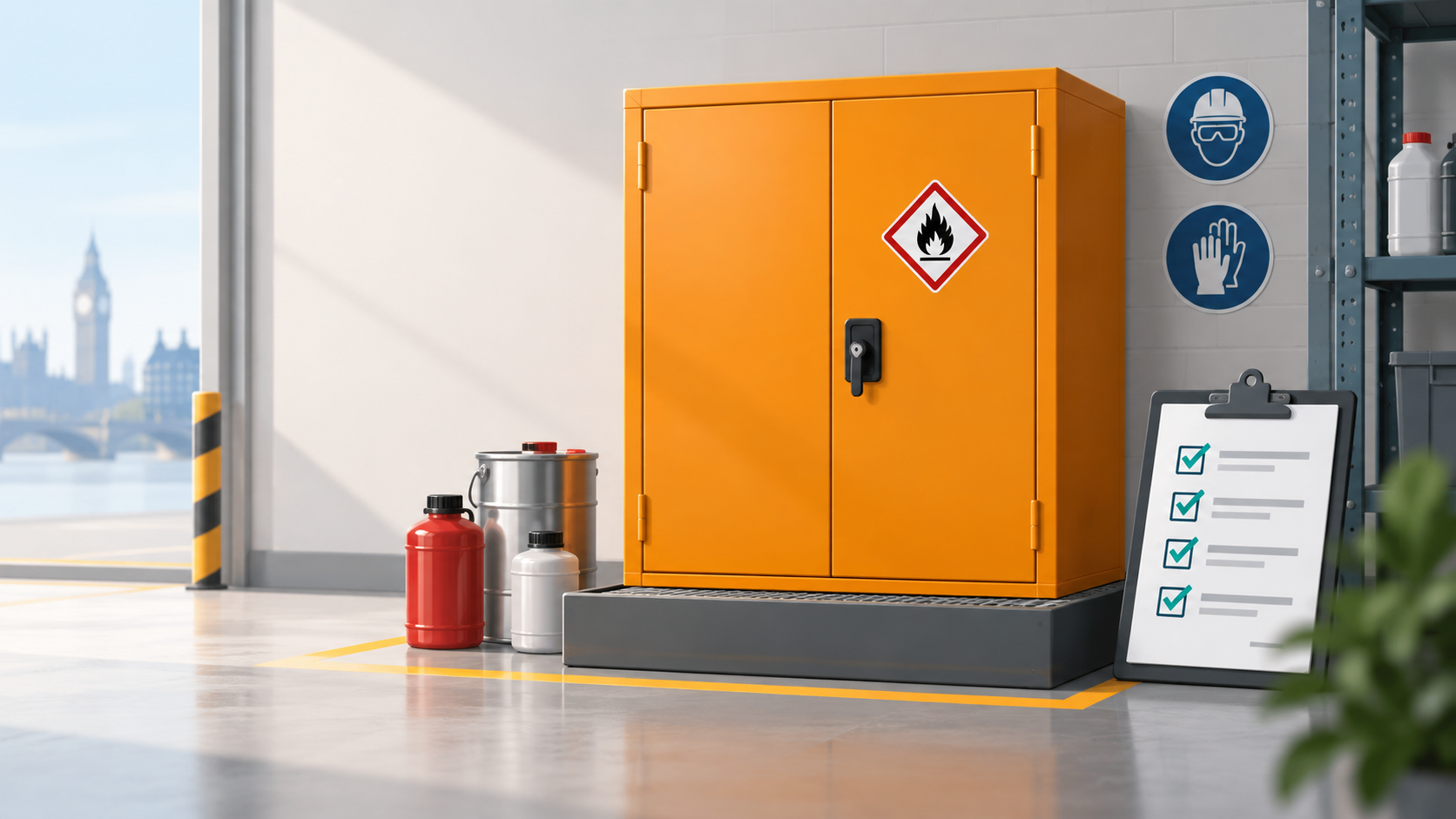
A flammable storage cabinet in a UK workplace must be suitable for the substances, quantities and conditions identified by the employer's risk assessment. There is no universal cabinet colour, capacity or ventilation rule that makes storage compliant by itself; the cabinet is one control within the DSEAR, fire-safety and chemical-management arrangements.
This is general guidance, not a specification for a particular site. Check the current SDS, cabinet instructions and competent fire and process-safety advice where needed.
What law applies to flammable storage cabinets in the UK?
The main workplace regulation is the Dangerous Substances and Explosive Atmospheres Regulations 2002 (DSEAR). HSE explains that DSEAR requires employers to assess and control risks to people from fire, explosion and similar events involving dangerous substances.
A cabinet may help reduce the likelihood that containers are damaged or exposed to a developing fire. It does not remove duties to reduce stock, prevent releases, control ignition, provide ventilation where needed, classify hazardous areas where applicable, train workers and plan for emergencies.
The broader fire-safety regime also applies to the premises. The responsible person should ensure the cabinet and its contents are reflected in the fire-risk assessment, evacuation arrangements and information for emergency responders.
Is there a legal maximum cabinet quantity?
DSEAR does not set one cabinet quantity that is safe for every industry and room. The employer should eliminate or reduce dangerous substances so far as is reasonably practicable, which normally means limiting workroom stock to what the activity needs and keeping reserve stock in a suitable store.
A defensible cabinet limit considers:
- Flash point, volatility and classification of the products.
- Container size, construction and closure.
- The cabinet's tested or declared performance.
- Room size, ventilation, occupancy and escape routes.
- Nearby processes and ignition sources.
- Spill containment and emergency response.
- Total fuel load, including stock outside the cabinet.
Do not treat the cabinet's physical volume as the permitted chemical volume. Filling every shelf can increase consequences and make inspection or safe removal difficult.
What construction and fire performance should a cabinet have?
Use a purpose-designed cabinet whose construction and evidence of performance suit the assessed risk. The employer should be able to identify what the manufacturer claims, the test or standard behind that claim, and any installation or use conditions.
A suitable cabinet is normally robust, stable and resistant to the stored liquids. Doors, hinges, catches, vents and seals should remain functional. Shelves must support the load without creating an easy spill path, and the enclosure should not be modified in a way that invalidates its fire performance.
A supplier's phrase such as “fire resistant” needs context. Check the claimed duration, test method and whether the whole installed arrangement meets the conditions of that evidence.
Where should a flammable cabinet be located?
Place the cabinet where it is protected from impact, heat and routine ignition sources and where a leak can be detected without obstructing escape. Avoid positioning that narrows a corridor, blocks a fire door or puts stored fuel directly on a sole escape route.
The best location also supports safe work. If staff must carry open containers across a busy room because the cabinet is inconveniently placed, the storage control may increase transfer risk elsewhere.
Assess proximity to:
- Flames, hot surfaces and hot-work areas.
- Electrical equipment and battery charging.
- Direct sunlight or other heat gain.
- Drains, basements and low points where vapour can collect.
- Vehicle or trolley routes.
- Oxidisers and other incompatible substances.
- Fire exits, stairs and assembly routes.
Does the cabinet need spill containment?
Storage should prevent a foreseeable leak spreading to ignition sources, drains or incompatible materials. Many cabinets include a sump or removable tray, but its capacity and material must suit the stock and credible container failure.
Keep the sump clear. Storing bottles, absorbents or tools in it reduces retention volume and can introduce incompatible materials. Inspect trays for corrosion, cracking and previous contamination.
A cabinet with one shared sump may be unsuitable for chemically incompatible liquids. Separate cabinets or independently contained compartments may be required even when all products are broadly described as hazardous or corrosive.
Should the cabinet be ventilated?
Cabinet ventilation is a risk-based engineering decision, not a default instruction. An unventilated cabinet may allow vapour to accumulate after a leak, but inappropriate ducting can spread vapour, create an ignition route or compromise the cabinet's tested fire resistance.
If extraction is required, it should discharge to a safe place, use equipment suitable for the classified risk and be maintained. Unused ventilation openings should be treated in accordance with the cabinet manufacturer's instructions.
Room ventilation still matters because vapour is often released while containers are opened or liquids are dispensed. A cabinet cannot control emissions from a task happening elsewhere.
Does the cabinet need earthing or bonding?
A metal cabinet is not automatically required to be earthed in every installation. Static risk is most relevant during liquid transfer, when charge can build up on containers, pipework or people.
Bonding and earthing arrangements should follow the DSEAR assessment, the conductivity of the liquid and containers, the transfer method and competent engineering advice. Do not improvise an earth connection or assume touching a container to the cabinet provides a reliable bond.
What may be stored in a flammable cabinet?
Store only products covered by the cabinet's purpose and the compatibility assessment. Keep oxidisers, reactive chemicals, compressed gases and combustible clutter out unless a competent assessment explicitly supports the arrangement.
Do not store:
- Paper records, cardboard packaging or cleaning cloths.
- Personal protective equipment that could become contaminated.
- Food, drink or personal items.
- Waste containers without an assessed, labelled arrangement.
- Unlabelled decanted products.
- Damaged or leaking containers awaiting uncontrolled disposal.
“Empty” containers can retain flammable vapour. Close, label and manage them under the site's procedure rather than treating them as harmless packaging.
What labels and signs are required?
The cabinet should be clearly identifiable to employees and emergency responders. Signage should communicate the relevant hazard and prohibitions without creating confusion with the labels required on individual containers.
Every stored product should retain a legible supplier label or an appropriate workplace label. A cabinet sign does not identify the contents of an unlabelled bottle.
The chemical register should record what is stored, where it is kept and which SDS version applies. Safe Foundry's chemical-safety features can help connect supplier information to assessments, while the physical controls remain a site responsibility.
How often should a cabinet be inspected?
Set an inspection frequency based on usage, stock turnover and consequence of failure. A busy decanting area may need a brief user check each shift and a more detailed recorded inspection at planned intervals.
Check:
| Area | What to look for |
|---|---|
| Containers | Leaks, corrosion, swelling, damaged caps and legible labels |
| Stock | Quantity within the assessed limit and obsolete products removed |
| Compatibility | Oxidisers and other incompatible substances absent |
| Cabinet | Damage, corrosion, stable shelves and working doors |
| Sump | Empty, clean, compatible and unobstructed |
| Location | Escape routes clear and ignition controls maintained |
| Records | Inventory, SDS and assessments current |
Review the assessment after a spill, fire, near miss, cabinet damage, changed product or increased quantity. The Safe Foundry help centre provides product guidance, and how the SDS-to-COSHH workflow works explains the document process.
What are the most common cabinet mistakes?
Common failures are simple but consequential: keeping excessive stock, leaving doors open, storing oxidisers beside solvents, using the sump as a shelf, ignoring empty containers and relying on the cabinet label instead of product labels.
The practical rule is to treat the cabinet as engineered risk control, not furniture. Specify it from the assessment, use it only as intended, inspect it and update the arrangement whenever the chemicals or work change.
Frequently asked questions
Is a yellow cabinet legally required for flammable liquids in the UK?
No particular cabinet colour is a universal legal requirement. What matters is that the storage is suitable, clearly identified and supported by the risk assessment and workplace procedures.
How much flammable liquid can I keep in a cabinet?
There is no single safe quantity for every workplace. Keep workroom quantities as low as reasonably practicable and decide the limit from the liquid, cabinet, room, occupancy and fire-risk assessment.
Does a flammable cabinet have to be ventilated?
Not automatically. Ventilation should be based on the DSEAR assessment and cabinet instructions because poorly designed extraction can spread vapour or undermine fire performance.
Can flammable liquids and aerosols share a cabinet?
Only if a specific assessment supports the arrangement. Aerosols introduce pressurised containers and may behave differently in a fire, so dedicated storage is often appropriate.
Check that an SDS matches your chemical by comparing product identifiers, supplier, concentration, form, label classification and intended use.
Chemical Storage Inspection Checklist for UK WorkplacesUse this chemical storage inspection checklist to find container, label, segregation, quantity, spill-control and housekeeping problems early.
COSHH Assessment Review Checklist for UK WorkplacesUse this COSHH assessment review checklist to compare records with current tasks, products, exposure routes, controls and workplace evidence.