
Signal Words: What "Danger" vs "Warning" Mean
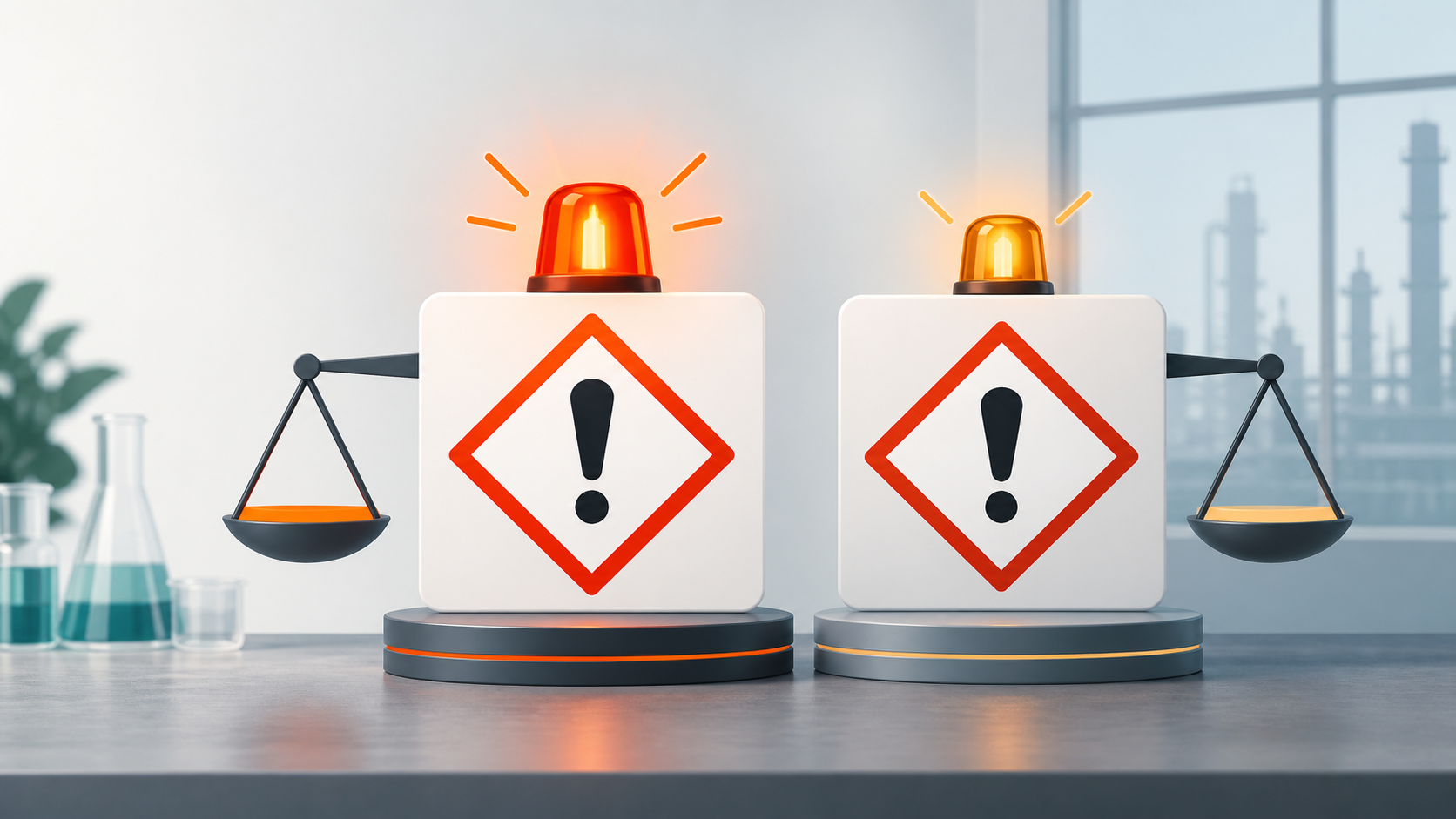
- Under GB CLP, Danger identifies more severe hazard categories than Warning within the applicable classification rules.
- A label uses only one signal word; when Danger is required, Warning is omitted.
- The signal word summarises relative severity but does not describe the hazard, route of harm or workplace risk, so read the hazard statements and SDS.
- A product without either signal word may still require COSHH assessment because some classifications do not assign one and workplace hazards extend beyond labelled products.
On a GB CLP chemical label, Danger is the signal word used for more severe hazard categories and Warning is used for less severe categories where a signal word is assigned. The label shows only one of them, but neither word explains the complete hazard or tells you the workplace risk.
Always read the pictograms, hazard statements, precautionary statements and SDS together. Then assess the actual task under COSHH or DSEAR where relevant.
What is a CLP signal word?
A signal word is a standard label element that alerts the reader to the relative severity of classified hazards. GB CLP uses two:
| Signal word | General meaning |
|---|---|
| Danger | Assigned to more severe hazard categories |
| Warning | Assigned to less severe hazard categories |
The word is selected by the classification rules, not by a supplier's preferred tone. It must not be replaced with marketing language such as “caution” or “handle carefully” when CLP requires the standard signal word.
Can a label contain both Danger and Warning?
No. When at least one classification requires Danger, the label does not also display Warning. The stronger signal word takes precedence.
That rule keeps the label concise, but it does not remove the less severe hazards. Their applicable pictograms and hazard statements still communicate them, subject to the detailed precedence rules.
A product classified for several hazards may therefore show Danger once and list multiple hazard statements covering health, physical and environmental effects.
Does Danger mean the product is always riskier?
Danger indicates a more severe assigned category, but it is not a universal risk score. Hazard describes the product's capacity to cause harm; risk depends on the likelihood and consequence of exposure in the actual circumstances.
A small sealed container marked Danger may present low exposure during normal storage, while frequent spraying of a product marked Warning can create significant workplace risk. Quantity, volatility, dustiness, temperature, duration, route of exposure and control reliability all matter.
Comparing two products by signal word alone can also be misleading because classifications may concern different endpoints. Acute toxicity, skin corrosion, flammability and reproductive toxicity are not interchangeable scales.
What should you read after the signal word?
Hazard pictograms
Pictograms provide a fast visual indication of hazard classes, such as flammability, corrosion or serious health effects. One pictogram can represent several distinct hazards, so it cannot be interpreted without the words.
Hazard statements
Hazard statements describe the nature and, where appropriate, degree of the hazard. The written statement matters; an H-code is a reference identifier, not a substitute for the label wording.
Precautionary statements
Precautionary statements describe recommended measures to minimise adverse effects during handling, response, storage or disposal. They are supplier communication, not a complete workplace procedure.
Supplemental information
Some products need additional statements that do not fit the main hazard classes. These can be important even where no signal word or pictogram is assigned.
Can a hazardous product have no signal word?
Yes. Not every CLP hazard class or category assigns Danger or Warning. Some hazards are communicated through statements or supplemental information without a signal word.
COSHH also covers more than labelled supplied chemicals. Process-generated dust, fume, vapour, mist, biological agents and substances with workplace exposure limits may require assessment even when there is no supplier label.
The absence of a signal word therefore means only that the applicable classification does not require one. It does not mean “safe”.
How does the signal word relate to pictograms?
Signal words and pictograms follow separate assignment and precedence rules. A Danger label may carry one or several pictograms, while the same pictogram can appear with different signal words for different hazard categories.
For example, the exclamation-mark pictogram covers several less severe health hazards and is not a generic symbol for every dangerous chemical. The health-hazard silhouette represents certain serious or chronic effects, but the specific hazard statement identifies which effect applies.
Use HSE's chemical classification and labelling guidance for the GB regulatory framework rather than guessing from symbol shape.
Does the signal word determine storage?
No. Storage compatibility depends on reactivity, physical properties and credible consequences of mixing. Two products both marked Danger may be compatible, while two marked Warning may react dangerously.
Check SDS Sections 7 and 10 for storage conditions and incompatible materials. Consider Section 9 for properties such as flash point and physical form, then apply site-specific quantity, containment and fire controls.
A colour-coded shelf based only on signal word would mix unrelated hazards and is not a sound segregation system.
Does Danger automatically trigger DSEAR?
No. DSEAR applies to dangerous substances capable of causing harm through fire, explosion or similar energetic events. Some Danger classifications concern health hazards rather than flammability.
Conversely, a flammable product marked Warning can still require DSEAR assessment. Read the classification and physical-property information rather than using the signal word as the trigger.
Does Warning mean ordinary PPE is enough?
No. CLP does not select workplace controls. Under COSHH, employers should prevent exposure where reasonably practicable or otherwise control it adequately, following the hierarchy rather than beginning with personal protective equipment.
The SDS may recommend protective equipment, but the workplace assessment must check the task, duration, fit, compatibility and other controls. HSE explains that an SDS is not a COSHH assessment.
How should signal words be recorded in chemical software?
Record the signal word as structured data tied to a particular SDS version. Do not use it as the sole risk rating or overwrite it with a local score.
When an SDS changes, compare the signal word alongside classification, hazard statements, ingredients, exposure controls and physical properties. A move from Warning to Danger is an obvious review trigger, but unchanged wording does not prove the formulation or controls are unchanged.
Safe Foundry's SDS workflow extracts supplier information into a structured starting point for review. The feature overview and help centre explain related workflows.
What is the practical reading order?
Use this sequence when a container arrives or a worker prepares a task:
- Confirm the product and supplier identity.
- Notice the signal word and pictograms.
- Read every hazard and precautionary statement.
- Check the current SDS for detail and limitations.
- Follow the site-specific assessment and procedure.
- Stop and report any mismatch, damage or missing label.
Danger and Warning are valuable attention signals. Their job is to make you read further, not to make the decision for you.
Frequently asked questions
Is Danger always more hazardous than Warning?
Danger represents the more severe signal-word level under CLP, but different hazard classes are not ranked by one simple scale. Read all hazard statements and product information.
Can a chemical label show both Danger and Warning?
No. Where Danger applies, Warning is not also shown because the stronger signal word takes precedence.
Does Warning mean a product is low risk?
No. Warning still indicates a classified hazard, and workplace risk depends on exposure, quantity, task and controls.
Can a hazardous chemical have no signal word?
Yes. Some hazard categories and supplemental hazards do not assign a signal word, and COSHH can apply to substances without CLP labels.
Check that an SDS matches your chemical by comparing product identifiers, supplier, concentration, form, label classification and intended use.
COSHH Assessment Review Checklist for UK WorkplacesUse this COSHH assessment review checklist to compare records with current tasks, products, exposure routes, controls and workplace evidence.
Do Safety Data Sheets Expire? UK Update RulesDo safety data sheets expire in the UK? Learn how revision dates, supplier updates and workplace checks determine whether an SDS remains current.