
Chemical Storage Segregation: A Practical HSG71 Guide
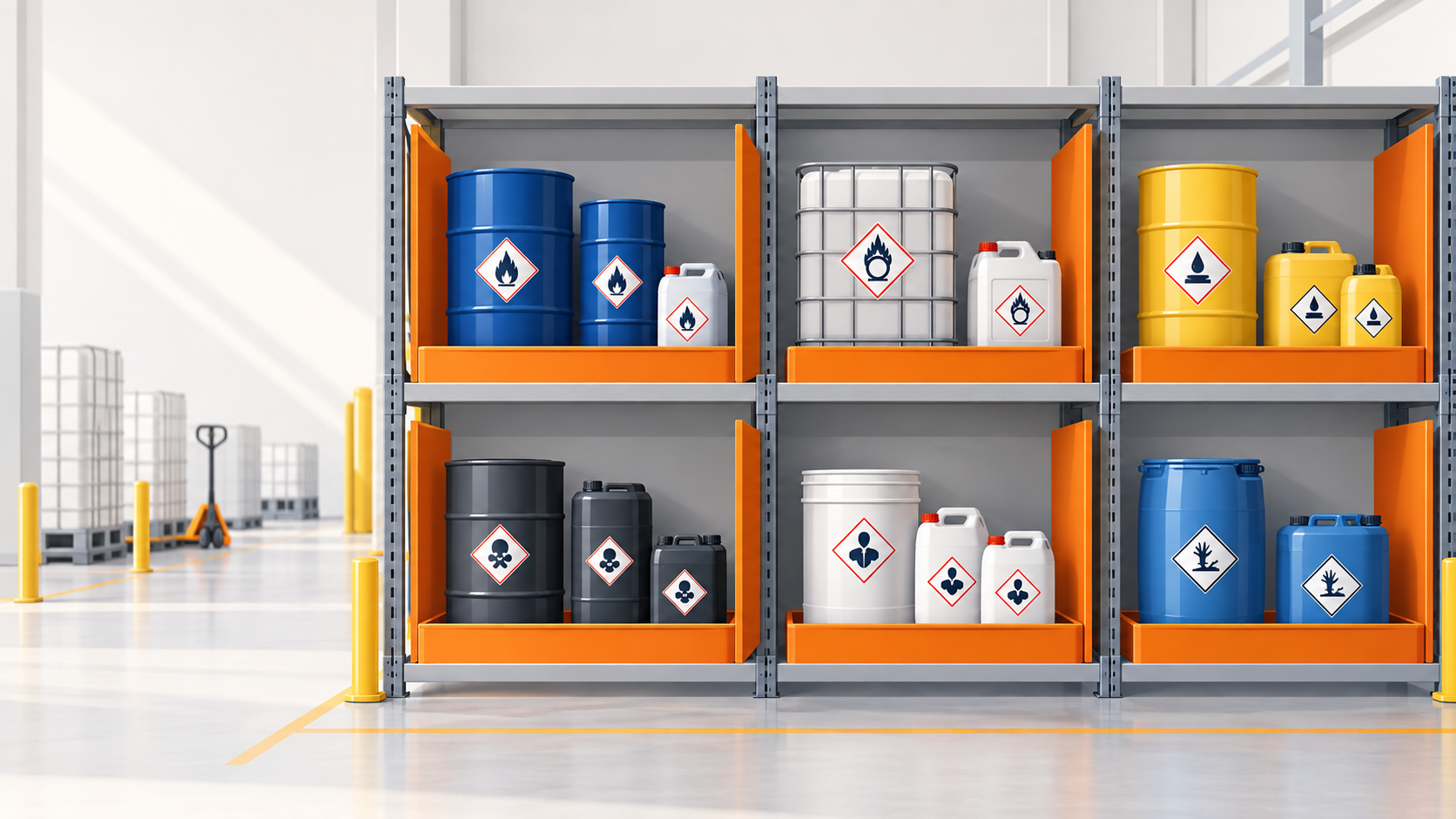
- Chemical storage segregation should be based on credible reactions between substances, not colour coding or alphabetic order alone.
- HSG71 is HSE guidance for storing packaged dangerous substances and explains different levels of separation, segregation and isolation.
- Safety Data Sheet sections on handling, storage, stability and reactivity are essential inputs, but supplier advice may still be needed for specific combinations.
- Corrosives are not automatically compatible with other corrosives, so acids, alkalis and other reactive products may need separate storage within the same broad hazard class.
Chemical storage segregation means keeping incompatible substances far enough apart, or within suitable compartments, so that a leak, damaged package or fire does not create a more dangerous reaction. HSG71 gives practical HSE guidance for packaged dangerous substances, but the correct arrangement must still be based on the products, quantities, building and work carried out at the site.
What is HSG71?
HSG71 is the Health and Safety Executive guide “Chemical warehousing: the storage of packaged dangerous substances”. It is aimed at anyone responsible for storing packaged dangerous substances, including warehouses, outdoor compounds, production sites and end users.
HSE's HSG71 publication page explains that the guide covers legal requirements, hazard identification, risk assessment, facility design, emergency arrangements, training and review. HSG71 is guidance rather than a standalone chemical storage law, so employers must identify which legal duties apply to their activities.
HSG71 is particularly useful because it turns a vague instruction to “store chemicals safely” into a structured assessment. It asks responsible people to consider package integrity, incompatible substances, fire spread, drainage, ventilation, security and emergency response together.
Why must incompatible chemicals be segregated?
Incompatible chemicals must be segregated because accidental mixing can create heat, fire, pressure, toxic gas or violent reaction. A storage arrangement should reduce the chance that one damaged container affects another incompatible product.
The reaction may start during a small leak rather than a dramatic incident. A split package can drain into a common bund, absorbent material can transfer contamination, or fire-fighting water can carry one substance towards another.
Segregation also supports safer emergency response. Clear groups and reliable labels help workers and emergency services understand what is stored, where it is located and which materials should not share containment.
Which chemicals should not be stored together?
There is no universal one-page list that can replace product-specific compatibility checks. HSG71 groups dangerous goods by hazard class, while individual substances within the same class may still react with each other.
The following table gives common starting points, not a complete compatibility matrix.
| Storage group | Keep away from | Why separation may be needed |
|---|---|---|
| Flammable liquids and solids | Oxidising substances, ignition sources and incompatible reactives | Oxidisers can intensify combustion, while ignition can turn vapour or dust into a fire or explosion hazard |
| Oxidising substances | Flammables, combustible packaging, reducing agents and organic materials | Contact may accelerate burning or initiate a vigorous reaction |
| Acids | Alkalis, cyanides, sulphides and products identified as incompatible by the supplier | Mixing can generate heat, splashing or toxic gas, depending on the substances |
| Alkalis | Acids and supplier-identified incompatibles | Neutralisation can release substantial heat and cause boiling or splashing |
| Water-reactive substances | Water sources, aqueous products and incompatible fire-fighting media | Contact with water may release heat or flammable or toxic gas |
| Organic peroxides | Most other dangerous substances and sources of heat or contamination | Some are thermally unstable and may require dedicated isolation |
| Toxic substances | Food, drink, medicines and incompatible chemicals | Separation limits contamination and harmful reaction pathways |
| Corrosive substances | Other corrosives unless compatibility is confirmed | “Corrosive” describes a hazard class, not a single chemical family |
Always check the current Safety Data Sheet and supplier information. Section 7 usually covers handling and storage conditions, while section 10 covers stability, reactivity and materials to avoid.
What do separation, segregation and isolation mean in HSG71?
HSG71 uses different terms because incompatible combinations require different levels of control. The precise design should follow the guide, fire strategy and site risk assessment.
| HSG71 concept | Practical meaning |
|---|---|
| Separation may not be necessary | The hazard classes do not automatically require separation, but individual products must still be checked with suppliers |
| Keep apart | Maintain a meaningful physical separation or suitable protective arrangement so an incident involving one group is less likely to involve the other |
| Segregate from | Use a separate building compartment or outdoor compound, with suitable fire-resistant construction or separation |
| Isolate | Use dedicated storage, typically for hazards needing the strongest separation, such as certain organic peroxides |
These terms should not be treated as interchangeable labels. The free HSG71 PDF contains the detailed recommendations and class matrix.
How should you use an SDS for storage segregation?
Use the SDS to identify hazards and incompatibilities, then verify that the advice matches the exact product and storage conditions. An SDS is a critical source, but it may not answer every question about combined storage.
Review at least:
- Section 2 for classification, label elements and principal hazards
- Section 5 for suitable and unsuitable extinguishing media and fire hazards
- Section 6 for spill precautions and containment
- Section 7 for handling, storage conditions and incompatibilities
- Section 9 for physical properties such as flashpoint
- Section 10 for stability, hazardous reactions and materials to avoid
- Section 13 for disposal considerations
If the SDS gives broad wording such as “keep away from incompatible materials”, ask the supplier for specific advice. Do not guess from a product name or pictogram.
A digital SDS management workflow can make documents easier to find and review, but storage decisions still require competent interpretation and local knowledge.
How do you create a chemical storage segregation plan?
A practical segregation plan starts with an accurate inventory and ends with a layout that can survive a foreseeable leak or fire. Use the following process.
1. Inventory every stored product
Record the product name, supplier, current SDS, hazard classifications, physical form, maximum quantity and storage location. Include waste, returned goods, maintenance products and substances held temporarily.
2. Identify credible incompatibilities
Use SDS sections 7 and 10, HSG71, supplier advice and relevant industry guidance. Consider reactions between stored products and also with water, air, heat, packaging, shelves, bund materials and spill absorbents.
3. Assign compatibility groups
Create groups that are meaningful for the site, such as flammables, oxidisers, acids, alkalis, water-reactives and toxic products. Do not assume that every member of a broad group is compatible.
4. Choose the required separation
Decide whether products can share a bay, need separate cabinets or bunds, must be placed in different fire compartments, or require dedicated isolation. Consider how leaked liquid could travel at floor level or through drains.
5. Design secondary containment
A common tray or bund must not collect incompatible liquids. Confirm that the containment material itself resists the stored chemicals and that inspection and safe emptying are planned.
6. Mark the arrangement clearly
Use durable location labels, shelf plans and a simple segregation matrix that workers can understand. Keep individual container labels visible and legible.
7. Inspect and review
Check package condition, leaks, unauthorised stock, expired products and changes to SDS information. Update the plan when products, quantities, packaging, processes or the building change.
The Safe Foundry workflow can help connect products and SDS information to workplace assessments, while the help centre explains how to maintain the underlying records.
What storage controls should be checked routinely?
Routine checks should confirm that the designed segregation still exists in practice. A correct plan can fail when deliveries are placed in the nearest space or when waste containers accumulate.
A useful inspection covers:
- Containers are closed, undamaged and correctly labelled
- Products are in the assigned compatibility group
- Incompatible liquids cannot drain into a shared tray or bund
- Shelving and containment materials remain suitable
- Flammables are controlled in line with the fire and DSEAR assessment
- Oxidisers are separated from combustible stock and packaging
- Emergency equipment and spill materials are appropriate for the chemicals
- Access routes, ventilation and fire protection are unobstructed
- Stock quantities remain within the assessed limits
- SDS versions and supplier instructions are current
Chemical storage segregation is a continuing management process, not a one-time shelving exercise. Where quantities, reactions or building design make the consequences significant, seek competent fire, chemical or process-safety advice.
Frequently asked questions
Does HSG71 apply to a small chemical store?
HSG71 is addressed to people responsible for storing packaged dangerous substances regardless of facility size, although controls should remain proportionate to the hazards, quantities and site.
Can acids and alkalis be kept in the same cabinet?
They should not share containment where a leak could allow them to mix. Check each product's SDS and supplier guidance, then use separate compatible cabinets or compartments where the assessment requires it.
Should chemicals be stored alphabetically?
Alphabetical order is useful only after compatibility has been established. Hazard class, reactivity, physical form, containment and supplier instructions should determine the storage group first.
Is a flammable storage cabinet enough to comply with DSEAR?
No single cabinet proves that DSEAR duties have been met. The wider assessment must consider quantities, releases, ventilation, ignition sources, location, handling and emergency arrangements.
Check that an SDS matches your chemical by comparing product identifiers, supplier, concentration, form, label classification and intended use.
Chemical Storage Inspection Checklist for UK WorkplacesUse this chemical storage inspection checklist to find container, label, segregation, quantity, spill-control and housekeeping problems early.
COSHH Assessment Review Checklist for UK WorkplacesUse this COSHH assessment review checklist to compare records with current tasks, products, exposure routes, controls and workplace evidence.