
Which Chemicals Can't Be Stored Together? A Guide
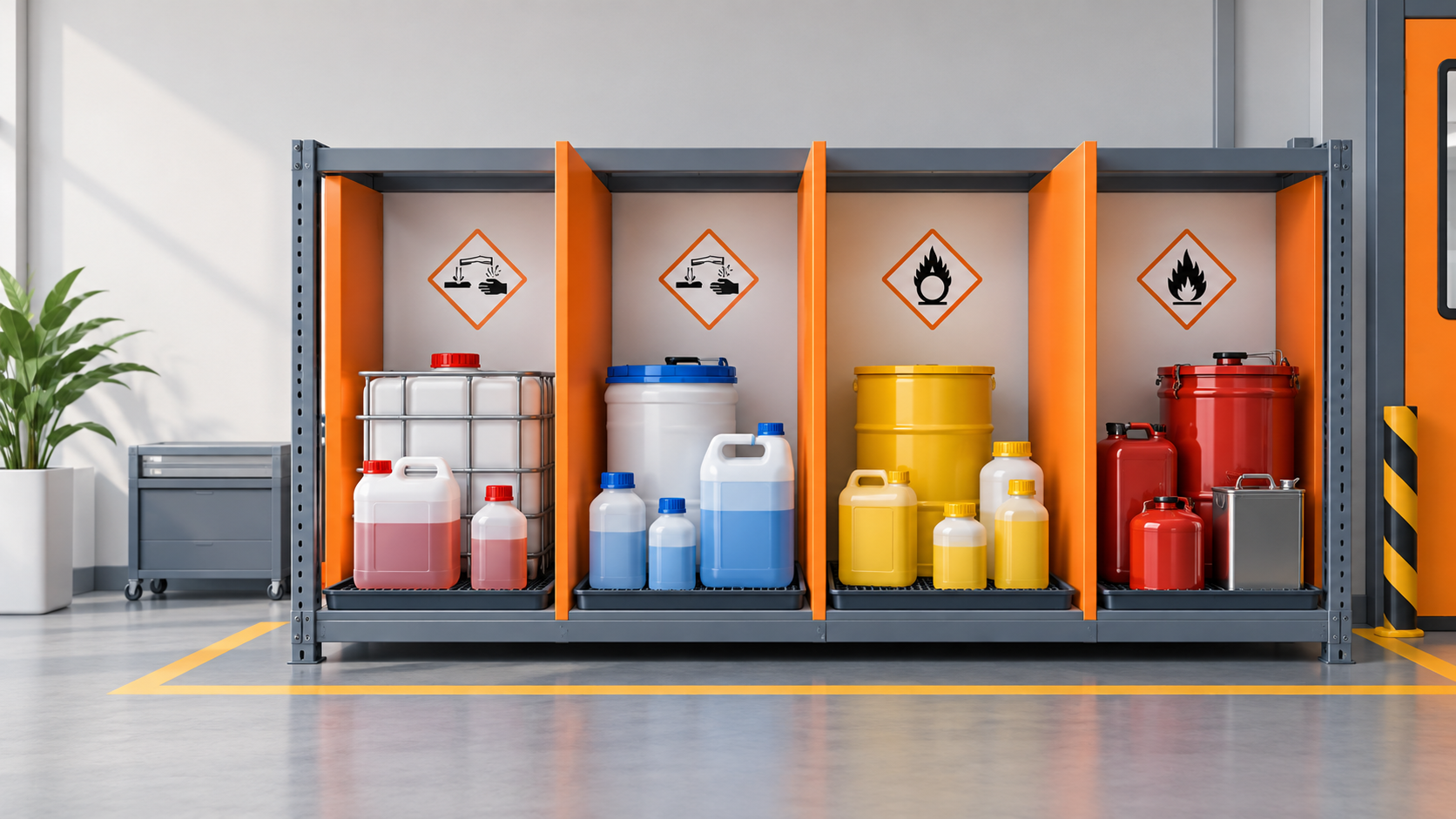
- Chemical compatibility is determined by the credible consequences of substances mixing, not by product names, shelf space or alphabetical order.
- Common high-consequence conflicts include acids with alkalis, oxidisers with flammables, acids with cyanides or sulphides, and water-reactive chemicals with water.
- Safety data sheet Sections 7 and 10 are useful starting points for storage conditions and incompatible materials, but site-specific quantities and containment still require assessment.
- Separate spill containment is essential because chemicals stored on different shelves can still mix after a leak, fire or sprinkler discharge.
Chemicals should not be stored together when a foreseeable leak, spill or fire could make them react dangerously. The most important conflicts include oxidisers with flammables, acids with alkalis, acids with cyanides or sulphides, and water-reactive substances with water, but each product must be checked using its current safety data sheet and a site-specific assessment.
This guide is a screening aid, not a universal compatibility ruling. Concentration, quantity, packaging, temperature and containment can change the risk.
Which chemical combinations commonly need separation?
The table below summarises common incompatibilities and the main consequence to assess. It deliberately uses broad groups, so it should lead to a product-level check rather than a final storage decision.
| Chemical group | Keep away from | Why mixing can be dangerous |
|---|---|---|
| Flammable liquids | Oxidisers, ignition sources | Fire can start more readily or burn more intensely |
| Oxidising agents | Flammables, oils, paper, organic materials, reducing agents | Heat, fire or violent reaction may occur |
| Acids | Alkalis, cyanides, sulphides, some metals | Heat, splashing, toxic gas or flammable hydrogen may be produced |
| Alkalis | Acids, some metals | Heat, boiling and corrosive splashing may occur |
| Cyanides | Acids | Highly toxic hydrogen cyanide gas may be released |
| Sulphides | Acids | Highly toxic and flammable hydrogen sulphide gas may be released |
| Water-reactive substances | Water, aqueous solutions, damp areas | Heat, fire or flammable gas may be generated |
| Organic peroxides | Contamination, heat, incompatible combustibles | Accelerating decomposition, fire or explosion may occur |
| Compressed oxidising gases | Fuel gases, oils and greases | Fire can be initiated or greatly intensified |
| Pyrophoric substances | Air and moisture unless specifically controlled | Spontaneous ignition may occur |
A broad group can contain important exceptions. For example, not every acid reacts with every metal in the same way, and product concentration can materially affect the outcome. Use the table to identify questions, then verify them against authoritative product information.
Why is alphabetical chemical storage unsafe?
Alphabetical storage puts unrelated hazards beside each other solely because their names begin with neighbouring letters. That can place an oxidiser next to a solvent or an acid above an incompatible compound.
Alphabetical order can still be used within an established compatible storage group. First assign each product to an assessed group, such as flammable liquids, oxidisers or corrosive acids, then organise that group in a way that helps staff locate stock without creating new incompatibilities.
Trade names also make alphabetical storage unreliable. A cleaner, resin or laboratory reagent may have a brand name that gives no useful indication of its chemistry or reactivity.
Which parts of the SDS help with compatibility?
A current safety data sheet (SDS) is the first product-specific source to check. Relevant information is commonly distributed across several sections:
- Section 2 identifies the hazard classification and label elements.
- Section 5 describes firefighting considerations.
- Section 6 covers accidental release measures.
- Section 7 gives handling and storage conditions, including incompatibilities where applicable.
- Section 9 provides physical and chemical properties.
- Section 10 addresses stability, hazardous reactions and incompatible materials.
- Section 13 provides disposal considerations.
Do not rely on a single phrase such as “store in a cool place”. Read the sections together and check whether the document matches the exact supplier, product and formulation in use.
HSE explains that an SDS provides information rather than a workplace risk assessment. The employer still needs to consider quantities, operations, people, storage layout and foreseeable incidents.
What do separation, segregation and isolation mean?
HSE's HSG71 chemical warehousing guidance uses different levels of control for incompatible materials. In practical terms, the controls become stronger as the substances are moved from simple distance to separate containment or a dedicated building.
| Control concept | Practical meaning | When it may be considered |
|---|---|---|
| Keep apart | Provide distance or an intervening compatible product | Lower-consequence interactions where mixing remains unlikely |
| Segregate | Use a physical barrier, separate compartment or separate bund | Where a spill or firefighting water could otherwise bring products together |
| Isolate | Use a detached or specially separated area | Where interaction could have severe or rapidly escalating consequences |
The correct level cannot be selected from a generic chart alone. The assessment should consider the maximum inventory, package failure, fire conditions, drainage and emergency response.
Why does secondary containment matter?
Incompatible chemicals can mix even when their unopened containers are on different shelves. A dropped bottle, corroded drum, failed intermediate bulk container or sprinkler discharge can carry material into a shared sump or drain.
Separate, chemically compatible containment is therefore central to segregation. Check that:
- The tray, bund or sump material is compatible with the stored chemical.
- Incompatible groups do not drain into common containment.
- Shelf lips do not direct a leak onto containers below.
- Stored items do not occupy the space intended to retain spills.
- The credible release volume has been considered.
- Spill response will not introduce another incompatible material.
A cabinet labelled “corrosives” is not automatically suitable for every acid and alkali. If the cabinet has one shared sump, a leak can defeat the visual separation provided by different shelves.
How should acids, alkalis, cyanides and sulphides be arranged?
Acids and alkalis can react exothermically, causing rapid heating, boiling and corrosive splashing. They should not be able to drain into the same containment.
Acid contact with cyanides can release hydrogen cyanide gas, while acid contact with sulphides can release hydrogen sulphide. These combinations warrant particularly careful control because a relatively small spill can create a serious inhalation hazard.
Use dedicated, labelled storage locations and verify compatibility at product level. Do not assume that a locked poisons cupboard is enough if its contents can react with each other.
How should oxidisers and flammables be stored?
Oxidisers can cause combustible material to ignite more readily or make a fire burn more intensely. They should be kept away from flammable liquids, fuel gases, oils, paper, wood, packaging and other readily combustible materials.
Housekeeping is part of compatibility control. Cardboard cartons, wooden pallets and absorbent materials can create an avoidable fuel load around oxidising stock.
Flammable liquids also need control under DSEAR where they can create a fire or explosion risk. Storage compatibility and DSEAR assessment overlap, but neither replaces the other. One asks what may happen if materials meet; the other addresses the wider risks from dangerous substances and explosive atmospheres.
What about water-reactive and air-reactive chemicals?
Water-reactive chemicals may generate heat, corrosive products or flammable gas on contact with water. Store them away from sinks, wet processes, sprinkler discharge where relevant, damp floors and aqueous spill kits unless a competent assessment establishes suitable controls.
Air-reactive or pyrophoric products require their specified protective atmosphere, container and handling arrangements. Moving them into a generic “flammables” cabinet can be dangerous if the required exclusion of air or moisture is not maintained.
These substances often demand specialist procedures, training and emergency planning. Follow the supplier's current instructions and obtain competent advice where the consequences are uncertain.
How do you build a compatibility matrix for your site?
Start with the products actually present rather than copying a generic wall chart.
- Create or update the chemical register. Record product, supplier, location, maximum quantity and current SDS revision.
- Identify the storage group. Use classification, ingredients, physical properties and reactivity information.
- Screen each group against the others. Record the possible reaction and evidence used.
- Map credible spill paths. Include shelves, doorways, drains, bunds and firefighting water.
- Select a control level. Keep apart, segregate or isolate according to consequence and likelihood.
- Label locations and train users. A correct plan fails if stock is returned to the wrong place.
- Inspect and review. Reassess when products, formulations, quantities or layouts change.
Digital records can make this easier by connecting each product to its SDS and assessments. The Safe Foundry feature overview shows how centralised chemical information can support that workflow, and the help centre covers practical product use.
What should you check during a storage inspection?
A useful inspection follows the path from delivery to disposal:
- Is the delivered product the same formulation and supplier listed in the register?
- Is the container legible, closed, undamaged and within its intended storage conditions?
- Is the product in the correct compatibility group?
- Could it leak into an incompatible group above, below or nearby?
- Are sumps empty, compatible and separate where required?
- Are cupboards being used for unrelated paper, tools or personal protective equipment?
- Are oxidisers free from combustible contamination?
- Are water-reactive materials protected from credible water contact?
- Are quarantine and waste areas segregated to the same standard as usable stock?
- Do staff know how to report a leak, damaged label or unexpected delivery?
For more on converting supplier information into task-specific controls, see how the SDS-to-assessment workflow works.
When should compatibility decisions be reviewed?
Review the arrangement when a new product arrives, a supplier reformulates a mixture, the SDS changes, quantities rise, packaging changes or the storage area is modified. A spill, near miss, fire or unexplained container damage should also trigger review.
Compatibility is not a one-time classification exercise. It is a maintained link between the current product, the physical store and the foreseeable ways chemicals could meet.
Frequently asked questions
Can acids and bases be stored in the same cabinet?
They should not share containment where a leak could allow them to mix. A compatibility assessment may require separate cabinets, compartments or bunds depending on the substances and quantities.
Can flammable liquids be stored with oxidisers?
Generally no. Oxidisers can initiate or intensify combustion, so they should be kept apart from flammable liquids and other combustible materials.
Is an SDS compatibility chart enough for chemical storage?
No. A chart is a screening tool; the decision should also use product-specific SDS information, concentration, quantity, packaging, spill paths and the consequences of mixing.
Can incompatible chemicals be stored on different shelves?
Different shelves may be insufficient if a leak can run or drip into the same sump. Effective segregation should prevent contact during credible container failures and emergency conditions.
Learn how to assess process-generated dust and fumes without an SDS by defining the process, exposure routes, evidence and practical controls.
Chemical Storage Inspection Checklist for UK WorkplacesUse this chemical storage inspection checklist to find container, label, segregation, quantity, spill-control and housekeeping problems early.
COSHH Assessment Review Checklist for UK WorkplacesUse this COSHH assessment review checklist to compare records with current tasks, products, exposure routes, controls and workplace evidence.