
What Is DSEAR? A Plain-English Guide for UK Employers
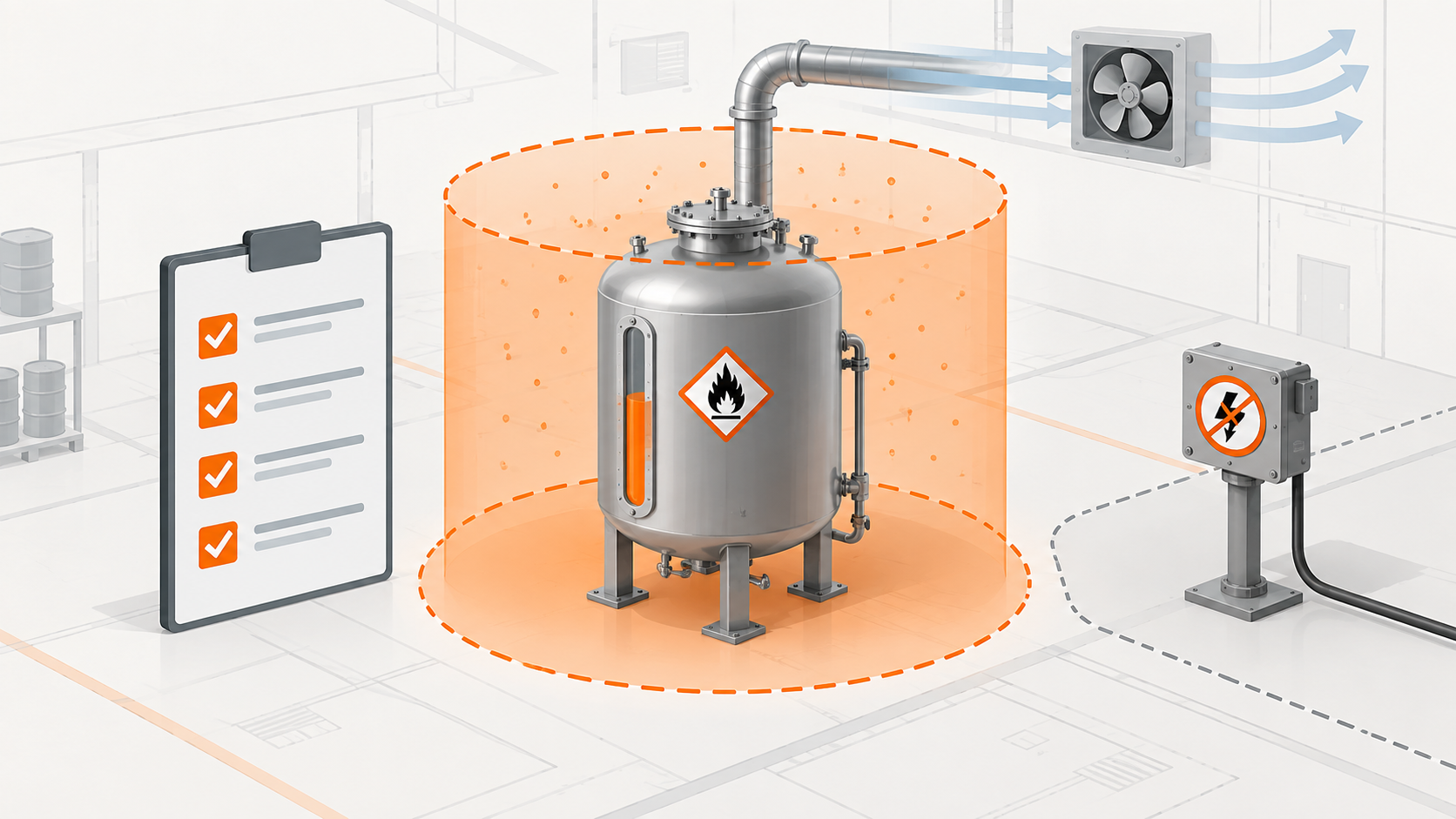
- DSEAR requires employers to assess and control workplace safety risks from dangerous substances that could cause fire, explosion or similar energetic events.
- DSEAR and COSHH can both apply to the same product because DSEAR addresses safety risks while COSHH addresses risks to health.
- A Safety Data Sheet is an important source for a DSEAR assessment, but it cannot account for the quantities, processes, ventilation or ignition sources at a particular workplace.
- Employers with five or more employees must record the significant findings of a DSEAR risk assessment.
DSEAR is the UK framework for controlling workplace risks from dangerous substances that can cause fires, explosions and similar energetic events. Employers must identify those substances, assess how the work could create danger, and eliminate or reduce the risk so far as is reasonably practicable. This is general guidance, not a substitute for competent advice on a particular site.
What does DSEAR mean?
DSEAR means the Dangerous Substances and Explosive Atmospheres Regulations 2002. The regulations apply in Great Britain and place duties on employers and self-employed people where dangerous substances are present, used or produced at work.
The Health and Safety Executive's DSEAR guidance describes DSEAR as the main legislation for controlling workplace fire and explosion risks from dangerous substances. Since 2015, its scope also includes gases under pressure and substances that are corrosive to metals.
DSEAR is not limited to obvious industrial explosives. A dangerous substance may be a liquid, gas, vapour or dust that can create a safety risk because of its properties and the way it is present or used.
Common examples include:
- Solvents, fuels and other flammable liquids
- Flammable gases and aerosols
- Combustible dusts such as flour, wood dust or some metal dusts
- Substances that can react violently or undergo thermal runaway
- Gases stored under pressure
- Substances classified as corrosive to metals
A product label is a useful starting point, but DSEAR also covers substances that become dangerous because of the process. A liquid with a relatively high flashpoint, for example, may present a greater fire risk when heated.
When does DSEAR apply to a workplace?
DSEAR applies where a dangerous substance is, or is liable to be, present at work and could create a risk to employees. This can include factories, laboratories, workshops, warehouses, construction sites, vehicles and other places used for work.
The practical trigger is the risk created by the substance in the real activity. An employer should consider normal work, storage, transfer, cleaning, maintenance, foreseeable faults and emergencies.
A small container does not automatically mean that DSEAR is irrelevant. The assessment should consider whether a release could form a flammable atmosphere, whether an ignition source could be effective, and how serious the outcome could be. Equally, HSE guidance says that no further DSEAR action is required where there is no safety risk or the risk is trivial.
What risks does DSEAR cover?
DSEAR covers safety risks from fire, explosion and other dangerous energetic events. It is concerned with immediate physical harm from events such as ignition, pressure release, rapid chemical reaction and metal corrosion that weakens containment.
A useful way to structure the assessment is to ask three questions:
- What dangerous substances are present or could be produced?
- How could the work release, heat, mix or ignite them?
- Who could be harmed, and how severe could the consequences be?
The assessment should not stop at the substance name. The same solvent may create very different risks when used in a closed cleaning machine, wiped onto a small component, sprayed in an enclosure or poured near an unprotected electrical source.
What must a DSEAR risk assessment consider?
A suitable and sufficient DSEAR assessment must connect substance information with the circumstances of the work. Regulation 5 requires employers to consider the substance's hazardous properties, supplier information, work processes, quantities, interactions, storage, transport and waste arrangements.
The assessment should also consider:
- Activities such as maintenance that may create an unusually high risk
- The effect of existing and proposed controls
- Whether an explosive atmosphere could occur and how long it could persist
- Whether ignition sources, including electrostatic discharge, could become effective
- The likely scale of a fire or explosion
- Connected spaces into which a dangerous atmosphere could travel
- Information needed for safe handling, storage and emergency planning
The Safety Data Sheet often provides essential evidence, particularly in sections covering hazards, handling and storage, physical properties, stability and reactivity, and fire-fighting measures. However, the SDS describes the product in general. It does not know the workplace layout, process temperature, amount in use, ventilation or people at risk.
Safe Foundry's SDS-to-assessment workflow can help teams organise source information, but responsible people must still check that the assessment reflects the actual task and site.
How should employers control DSEAR risks?
DSEAR requires employers to eliminate the risk where reasonably practicable and otherwise reduce it so far as is reasonably practicable. Controls should follow the findings of the assessment rather than rely on a generic checklist.
HSE sets out a practical priority order that includes:
- Keep the quantity of dangerous substances to the minimum needed
- Avoid or minimise releases
- Control releases at source
- Prevent a dangerous atmosphere from forming
- Collect, contain and remove releases safely, including by suitable ventilation
- Remove or control ignition sources
- Avoid temperatures, pressures or other conditions that could lead to danger
- Keep incompatible substances apart
Mitigation is also important because prevention cannot remove every foreseeable failure. Depending on the risk, mitigation may include reducing the number of people exposed, preventing fire or explosion from spreading, providing explosion relief or suppression, and preparing suitable emergency arrangements.
Personal protective equipment may protect an individual from some consequences, but it does not prevent a flammable atmosphere from forming or stop an ignition source. DSEAR controls therefore need to address the process and environment.
When is hazardous area classification required?
Where an explosive atmosphere may occur, the employer may need to classify hazardous places into zones and select suitable equipment and protective systems. The classification reflects how often an explosive atmosphere is likely to occur and how long it may persist.
Gas, vapour and mist hazards use Zones 0, 1 and 2. Combustible dust hazards use Zones 20, 21 and 22. Zoning should follow a competent assessment of release sources, ventilation and substance properties. It should not be assigned from a pictogram alone.
Areas where explosive atmospheres may occur also require appropriate identification at entry points where necessary. Equipment in classified areas must be suitable for the zone and the type of explosive atmosphere.
Must a DSEAR assessment be written down?
Employers with five or more employees must record the significant findings of the DSEAR risk assessment. The record should show the controls, demonstrate that the workplace and processes are designed and operated with safety in mind, and document hazardous-area classification where relevant.
Recording is useful for smaller employers too. A clear record supports training, maintenance, emergency planning and review, and helps explain why particular controls were selected.
The assessment must be reviewed regularly and kept up to date. Review it sooner if there is reason to think it is no longer valid or if there is a significant change to substances, quantities, equipment, processes, premises or organisation.
What is the difference between DSEAR and COSHH?
DSEAR controls safety risks from dangerous substances, while COSHH controls risks to health from substances hazardous to health. The same product and activity can fall under both regimes.
| Question | DSEAR | COSHH |
|---|---|---|
| Main concern | Fire, explosion, pressure and related safety events | Ill health caused by exposure |
| Typical evidence | Physical hazards, flashpoint, release conditions, ignition sources and interactions | Health hazards, exposure routes, duration, frequency and workplace exposure limits |
| Typical controls | Containment, ventilation, ignition control, segregation and mitigation | Substitution, enclosure, local exhaust ventilation, safe systems and suitable PPE |
| Can an SDS replace the assessment? | No | No |
For example, a solvent vapour may create an explosive atmosphere under DSEAR and also cause harmful inhalation or skin exposure under COSHH. Combining the evidence in one management system can reduce duplication, but each set of risks must be addressed clearly.
You can explore the wider chemical-safety features or use the help centre for practical product guidance.
What should a simple DSEAR action plan contain?
A useful DSEAR action plan turns each material finding into an owner, control and review point. A short assessment that drives action is more valuable than a long document that does not reflect the workplace.
Include:
- The dangerous substance and activity
- The credible release and ignition scenarios
- People and areas that could be affected
- Existing controls and evidence that they work
- Further actions, owners and target dates
- Emergency arrangements and training needs
- Inspection, maintenance and review intervals
DSEAR decisions should be proportionate to the risk and supported by competent judgement. Where the process could create a significant explosive atmosphere, specialist advice may be needed for zoning, ventilation calculations, equipment selection or explosion protection.
Frequently asked questions
Do I need a DSEAR assessment for small quantities of flammable liquid?
Quantity matters, but it is not the only factor. Consider the substance, how it is used, whether vapour can accumulate, possible ignition sources and the consequences of an incident before deciding whether risk is trivial.
Does a COSHH assessment cover DSEAR as well?
Not automatically. A COSHH assessment focuses on harm to health, while a DSEAR assessment focuses on fire, explosion, pressure and related safety events, so both may be needed.
Is an SDS enough for a DSEAR assessment?
No. An SDS describes the product's hazards and handling information, but the employer must assess the actual workplace activity, quantity, storage, releases, interactions and ignition sources.
Who can carry out a DSEAR risk assessment?
The person carrying out the assessment should have enough knowledge, skills and experience for the substances, processes and risks involved. Complex explosive-atmosphere classification may require specialist competence.
Learn how to assess process-generated dust and fumes without an SDS by defining the process, exposure routes, evidence and practical controls.
How to Check an SDS Matches the Chemical You UseCheck that an SDS matches your chemical by comparing product identifiers, supplier, concentration, form, label classification and intended use.
Chemical Storage Inspection Checklist for UK WorkplacesUse this chemical storage inspection checklist to find container, label, segregation, quantity, spill-control and housekeeping problems early.