
Segregating Acids, Bases and Oxidisers Safely
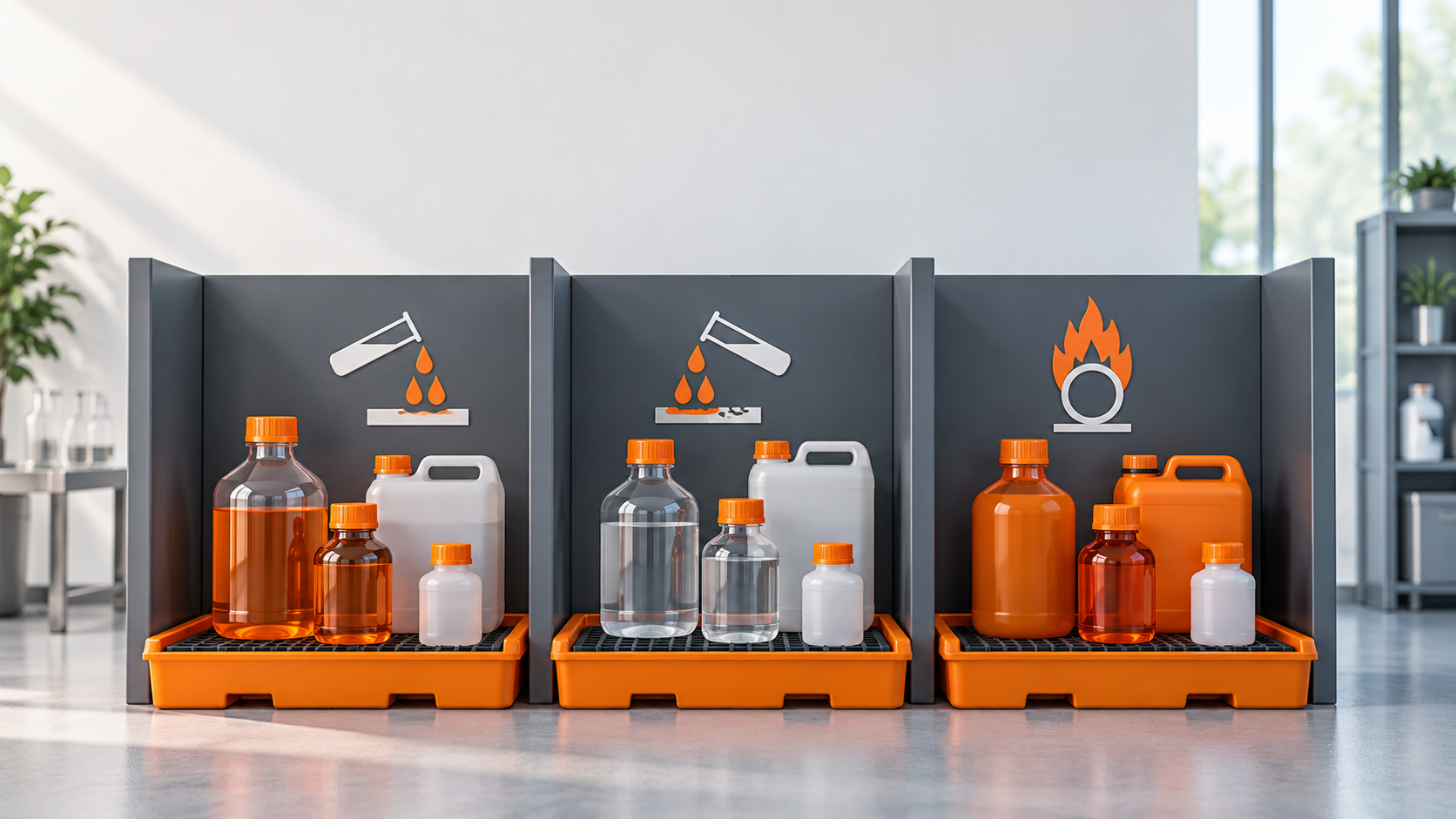
- Acids, bases and oxidisers should be assigned to assessed storage groups because a shared corrosives cabinet can allow dangerous reactions after a leak.
- Acids and bases can react with rapid heat and splashing, while oxidisers can initiate or intensify fire when they contact fuels or organic materials.
- Separate spill trays or bunds are as important as separate shelves because leaked chemicals can travel into a common sump.
- Product-specific SDS information, concentration, quantity and credible spill paths should determine segregation rather than broad labels alone.
Acids, bases and oxidisers should be stored in assessed compatibility groups with containment that prevents them mixing during a leak, fire or sprinkler discharge. A cabinet labelled corrosives is not automatically suitable for all three groups, because acids and bases can react violently and oxidisers can intensify combustion.
This is general guidance. Check each product's current SDS and obtain competent advice where reactivity or emergency controls are uncertain.
Why should acids and bases be segregated?
Mixing an acid and an alkali can release considerable heat. Depending on concentration and quantity, the reaction can cause rapid boiling, corrosive splashing and failure of nearby containers.
Different shelves in one cabinet may not provide effective segregation. A leaking bottle can drip downwards or drain into a shared sump, bringing the chemicals together when people are already responding to an incident.
Use separate, chemically compatible trays, compartments or cabinets where the assessment requires them. Store heavy containers where they can be handled without reaching or lifting above a safe working height.
Why do oxidisers need their own storage group?
Oxidising substances can cause other materials to burn more readily or make a fire more intense. Keep them away from flammable liquids, reducing agents, oils, greases, paper, wood, cloth and other combustible or organic materials.
Some familiar acids also have important oxidising properties. Nitric acid, for example, should not be placed automatically with every other mineral acid. The exact concentration and supplier information matter, so use the SDS rather than a broad colour-coded rule.
Good housekeeping is a control. Cardboard cartons and absorbent pads stored beside oxidisers can become an avoidable fuel source or contaminant.
Which SDS sections should you check?
The safety data sheet provides product-specific evidence across several sections:
- Section 2: hazard classification and label elements.
- Section 5: firefighting information.
- Section 6: accidental release measures.
- Section 7: handling and storage conditions.
- Section 9: physical and chemical properties.
- Section 10: stability, hazardous reactions and incompatible materials.
- Section 13: disposal considerations.
Read the sections together. A general storage phrase in Section 7 may be qualified by a specific incompatibility in Section 10.
HSE notes that an SDS is not itself a workplace risk assessment. It does not know your inventory, shelving, drains, work practices or people at risk.
How should a storage plan be organised?
Begin with a current chemical register and assign each product to a storage group based on its actual formulation and reactivity.
| Storage group | Typical separation concern | Practical control question |
|---|---|---|
| Non-oxidising acids | Bases, cyanides, sulphides, reactive metals | Could a leak reach an incompatible container or sump? |
| Bases | Acids and some metals | Is containment independent and chemically resistant? |
| Oxidising acids | Organics, flammables, reducing agents, many other acids | Does the product need a dedicated compartment or cabinet? |
| Other oxidisers | Fuels, organic materials and reducing agents | Are combustibles and contamination excluded? |
These are screening groups, not a complete compatibility chart. Hydrofluoric acid, perchloric acid and other specialist reagents can require controls that a generic acids cabinet does not provide.
Alphabetical organisation can be used only within a group already shown to be compatible. It should never decide which products share containment.
What should secondary containment achieve?
A tray or bund should retain the credible release, resist the chemical and prevent drainage into an incompatible group. It should remain empty and available for that purpose.
Check that:
- Shelf lips do not direct liquid onto lower containers.
- Trays cannot overflow into one another.
- The containment material is compatible with the product.
- Staff can remove a damaged container without unsafe handling.
- Spill-kit materials will not react with the chemical.
- Drainage, door thresholds and floor falls have been considered.
The largest container is an obvious scenario, but simultaneous failures during a fire may also be credible. Select the scenario through the site risk assessment.
Where should the cabinets be located?
Locate storage away from likely impact, excessive heat, ignition sources and escape routes. Oxidisers should not be beside flammable-liquid cabinets simply because both need controlled storage.
The location should make correct use convenient. If staff routinely leave bottles on benches because returning them is difficult, the intended segregation is not working in practice.
Ventilation decisions should consider the substance, cabinet design and room. Inappropriate cabinet extraction can spread vapour or compromise fire performance, so follow the assessment and manufacturer instructions.
How should decanted and waste chemicals be managed?
Decanted containers need durable identification that enables users to understand the contents and hazards. Do not rely on cap colour, handwriting that can rub off or a cabinet sign to identify individual bottles.
Waste is not automatically compatible because it is awaiting disposal. Unknown waste, mixed residues and contaminated absorbents may present greater uncertainty than usable stock. Give waste streams defined containers, labels, locations and accumulation limits.
Never return surplus decanted chemical to the original container unless an approved procedure prevents contamination. A small amount of incompatible material can destabilise an entire container.
What should staff do during an inspection?
A practical inspection looks for both chemical and behavioural failures:
- Containers in the correct assessed group.
- Labels legible and matched to the register.
- No leaks, corrosion, crystallisation, swelling or damaged caps.
- Separate sumps clean and unobstructed.
- No cardboard, rags or unrelated equipment with oxidisers.
- No unapproved stock left on floors or benches.
- Quantities within the assessed limits.
- Spill equipment present and compatible.
- Quarantine and waste areas subject to equivalent segregation.
Record defects and assign an owner and timescale. A recurring misplaced product usually indicates a layout, labelling or training problem rather than an isolated mistake.
When should segregation be reviewed?
Review the arrangement whenever a product, supplier, formulation, concentration, quantity, package or location changes. Also review after a leak, near miss, unexpected reaction or updated SDS.
HSE's HSG71 chemical warehousing guidance provides a framework for keeping materials apart, segregating them or isolating them according to risk. The correct level depends on the real inventory and consequences.
A connected document system reduces the chance that a new SDS is separated from the storage decision. See how Safe Foundry processes SDS information, review the chemical-safety feature set, or use the help centre for product guidance.
The aim is not simply three tidy cupboards. It is an arrangement that still prevents incompatible contact when a container fails and normal conditions have already broken down.
Frequently asked questions
Can acids and bases go in the same corrosives cabinet?
Only where separate, compatible containment prevents contact and the assessment supports it. A single shared sump can allow acids and bases to mix after a leak.
Should nitric acid be stored with other acids?
Nitric acid is also a strong oxidiser, so a generic acids group may be unsuitable. Follow the product SDS and a product-specific compatibility assessment.
Can oxidisers be stored in wooden cabinets?
Combustible cabinet materials may add fuel to an oxidiser incident. Use storage whose construction and performance are suitable for the specific oxidiser and assessed risk.
Do acids have to be stored below eye level?
Storage should minimise dropping and splashing and allow safe handling. Shelf height is one design factor, but it does not replace suitable containment, compatibility and access controls.
Learn how to assess process-generated dust and fumes without an SDS by defining the process, exposure routes, evidence and practical controls.
Chemical Storage Inspection Checklist for UK WorkplacesUse this chemical storage inspection checklist to find container, label, segregation, quantity, spill-control and housekeeping problems early.
COSHH Assessment Review Checklist for UK WorkplacesUse this COSHH assessment review checklist to compare records with current tasks, products, exposure routes, controls and workplace evidence.