
SDS vs MSDS: What Changed and Why It Matters
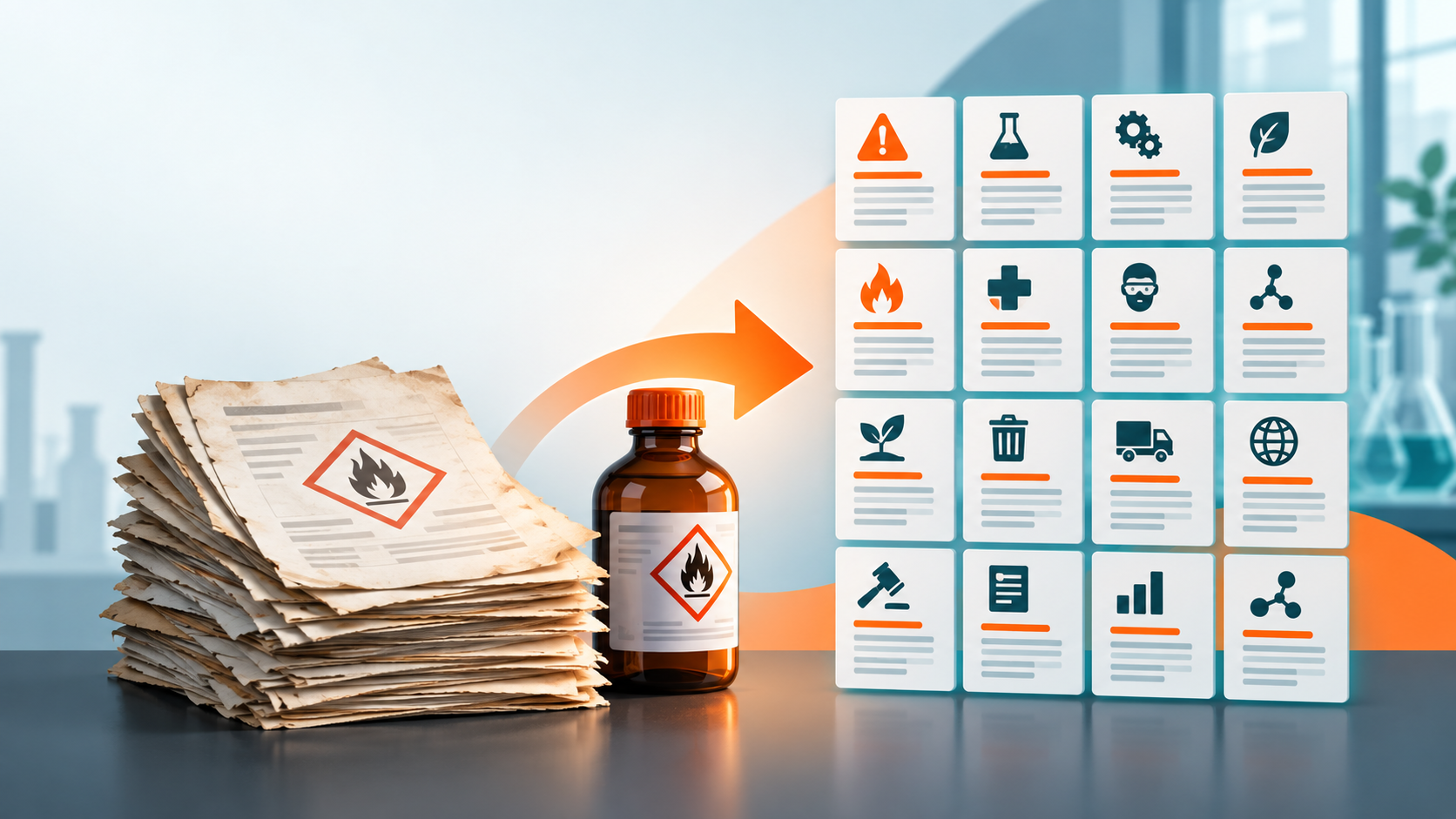
- SDS is the current standard term for a safety data sheet; MSDS is an older name that may refer to a legacy or non-standard document.
- A modern SDS follows a structured 16-section format, which makes key hazard, handling, exposure and transport information easier to find.
- Renaming a file from MSDS to SDS does not make it current; verify the supplier, product identifier, market, language and revision date.
- Neither an SDS nor an MSDS is a COSHH assessment because supplier information does not evaluate the actual workplace task and exposure.
SDS and MSDS both refer to documents that communicate chemical safety information, but SDS is the current standard term and uses a structured 16-section format. An MSDS may be a legacy document, so UK employers should verify its product match, supplier, market and revision rather than relying on the filename.
Neither document is a COSHH assessment. Supplier information must still be applied to the actual task, exposure and controls.
What do SDS and MSDS stand for?
SDS means safety data sheet. MSDS means material safety data sheet, an older term used before international and regional requirements converged around a more standard structure.
People still say MSDS out of habit, and some global suppliers use the term in portals or filenames. The important question is not the extra word “material”; it is whether the document is current, complete and applicable to the exact product and market.
What changed from MSDS to SDS?
Older MSDS varied widely in structure, headings and detail. The modern SDS organises information into 16 numbered sections, making it easier for users and emergency responders to locate comparable information across suppliers.
| Section | Main subject |
|---|---|
| 1 | Identification of substance or mixture and supplier |
| 2 | Hazard identification |
| 3 | Composition and ingredient information |
| 4 | First-aid measures |
| 5 | Firefighting measures |
| 6 | Accidental release measures |
| 7 | Handling and storage |
| 8 | Exposure controls and personal protection |
| 9 | Physical and chemical properties |
| 10 | Stability and reactivity |
| 11 | Toxicological information |
| 12 | Ecological information |
| 13 | Disposal considerations |
| 14 | Transport information |
| 15 | Regulatory information |
| 16 | Other information, including revision details |
The structure improves navigation, but it does not guarantee that every entry is correct or current. A well-formatted sheet can still be for the wrong formulation.
Is every document called MSDS obsolete?
Not necessarily, but the term is a warning to check. A supplier may retain MSDS in a filename while providing the current required content, or the file may genuinely pre-date major classification and format changes.
Review:
- Exact product and catalogue code.
- Supplier or manufacturer identity.
- Intended country or market.
- Language.
- Revision or issue date.
- Current classification and label elements.
- Presence and quality of all 16 sections.
- Consistency with the physical container label.
If the document is doubtful, obtain the current SDS from the supplier. Do not copy information from a similar product to fill gaps.
Why does the 16-section format matter?
Consistent sections reduce search time and support repeatable review. A storage lead can go directly to Sections 7 and 10, while an occupational hygienist may focus on Sections 8, 9 and 11.
The sections should still be read together. A glove material in Section 8 may depend on concentration and breakthrough time, while a storage statement in Section 7 may be qualified by an incompatibility in Section 10.
An empty-looking section is not always an error because some information may be unavailable or not applicable, but the reason should be clear under the regulatory format.
Is an SDS legally required for every chemical?
No. Supply duties depend on classification, composition, customer type and the applicable chemical regime. Certain non-classified mixtures can require information on request or because they contain particular hazardous substances.
Conversely, some workplace hazards are not supplied products and have no supplier SDS, including process-generated dust or fume. The absence of an SDS does not remove the COSHH duty to assess hazardous exposure.
HSE's safety data sheet guidance explains how SDS help users make workplace assessments.
Why is an SDS not a COSHH assessment?
The SDS describes the supplied product under anticipated conditions, but it does not know your task. It cannot account for spraying, heating, duration, quantity, enclosure, local exhaust ventilation, worker competence or other substances present.
| SDS | COSHH assessment |
|---|---|
| Prepared for supply-chain hazard communication | Prepared for a workplace activity |
| Product-focused | Task and exposure-focused |
| Describes intrinsic hazards and supplier precautions | Selects and verifies site controls |
| Common across customers | Specific to people, place and process |
| Revised by supplier | Reviewed by employer after change |
Copying Section 2 and Section 8 into a form is not sufficient if the assessor has not observed the work and evaluated all routes of exposure.
How should SDS versions be controlled?
Maintain one clearly current operational version linked to the product and archive superseded versions separately. Record the supplier, product code, revision date, date received and reviewer.
When a revision arrives:
- Confirm it is for the same product.
- Compare classifications and label elements.
- Review composition, exposure controls, properties and reactivity.
- Identify every stock location and assessment affected.
- Update labels, training, storage and emergency information where necessary.
- Mark the previous sheet superseded without erasing the historical link.
A changed date does not always mean reformulation, and an unchanged classification does not prove nothing relevant changed.
What should you do with a folder full of old MSDS?
Triage it systematically:
- Match each file to the current chemical register.
- Quarantine documents that cannot be matched confidently.
- Request current SDS from suppliers for active products.
- Remove superseded files from the operational view.
- Retain historical versions under the record policy.
- Identify containers with no reliable supplier information.
- Review assessments that relied on uncertain documents.
Do not delete first and investigate later. An old sheet may be important evidence of a historical formulation or exposure.
Can software extract information from an SDS?
Structured extraction can speed up identification of hazards, ingredients, controls and storage information, but the output should remain traceable to the source and reviewed by a person. Scans, poor tables and supplier variation can create errors.
Safe Foundry's SDS workflow turns an uploaded sheet into a structured assessment starting point. The feature overview explains the wider controls, and the help centre covers product operation.
What is the practical difference for UK teams?
Treat MSDS as a legacy label and SDS as the current controlled format. The safest response is not a bulk filename change; it is a product-by-product verification that the document matches what is physically present and supports the current workplace assessments.
Frequently asked questions
Is an MSDS still valid in the UK?
The title alone does not decide validity. Check whether the document is current, matches the product and supplier, and contains the information required for the applicable UK supply regime.
How many sections does an SDS have?
A standard SDS has 16 numbered sections covering identification, hazards, composition, response, handling, controls, properties, reactivity and other regulatory information.
Do I need to replace every file called MSDS?
Review each one. Request an up-to-date SDS from the supplier where the document is old, incomplete, for another market or does not match the product.
Is an SDS the same as a COSHH assessment?
No. The SDS describes the supplied product, while a COSHH assessment evaluates exposure and controls for the work your organisation actually performs.
Learn how to assess process-generated dust and fumes without an SDS by defining the process, exposure routes, evidence and practical controls.
How to Check an SDS Matches the Chemical You UseCheck that an SDS matches your chemical by comparing product identifiers, supplier, concentration, form, label classification and intended use.
COSHH Assessment Review Checklist for UK WorkplacesUse this COSHH assessment review checklist to compare records with current tasks, products, exposure routes, controls and workplace evidence.