
Managing SDS When Suppliers Reformulate Products
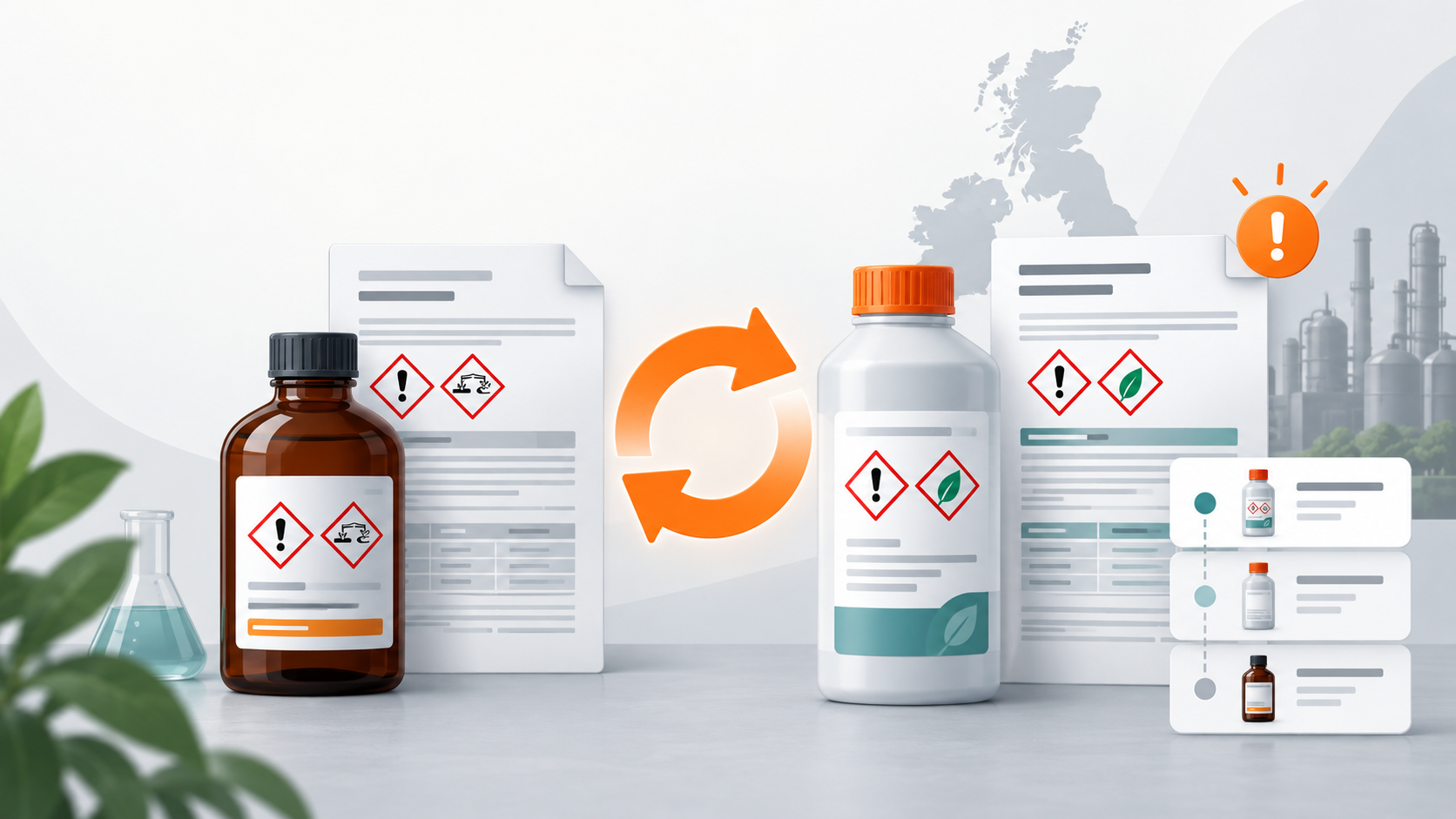
- A familiar trade name does not prove that a product's formulation, hazards or controls are unchanged, so supplier and product identifiers must be tracked with the SDS version.
- When a revised SDS arrives, compare classification, composition, exposure controls, physical properties and reactivity before replacing the operational copy.
- A formulation change should trigger impact assessment across stock locations, COSHH and DSEAR assessments, labels, storage compatibility, training and waste procedures.
- Keep superseded SDS clearly archived so historical use and exposure can be reconstructed without staff confusing old guidance with the current version.
When a supplier reformulates a chemical product, treat it as a controlled change rather than silently replacing the SDS file. Confirm the product identity, compare the old and new SDS, identify affected stock and activities, then review assessments, labels, storage, controls and training before closing the change.
The trade name may stay the same while ingredients, concentrations or hazards change. Version control is therefore a safety control, not an administrative nicety.
How can you tell whether a product was reformulated?
A new SDS revision does not always mean the formulation changed. Suppliers also revise documents after regulatory updates, new evidence, contact-detail changes or formatting corrections.
Look for several signals:
- A changed product or catalogue code.
- A supplier notice, technical bulletin or statement of reformulation.
- Different classification, hazard statements or pictograms in Section 2.
- Changed ingredients or concentration ranges in Section 3.
- New physical properties in Section 9.
- Different stability or incompatibility information in Section 10.
- Revised exposure controls or protective equipment in Section 8.
- A new use restriction or emergency instruction.
If the significance is unclear, ask the supplier what changed and whether old and new stock can be mixed or used under the same controls.
Why is the product name not enough?
Trade names are marketing identifiers, not reliable formulation keys. A supplier may improve performance, substitute an ingredient or change concentration while keeping the familiar name and packaging style.
Record at least:
| Identifier | What it helps distinguish |
|---|---|
| Supplier or manufacturer | Same-named products from different sources |
| Product or catalogue code | Supplier's specific formulation or pack |
| SDS revision or issue date | Document version used for decisions |
| Batch or lot where relevant | Stock affected by a time-limited change |
| Receipt date and location | Old and new stock present simultaneously |
Do not merge records merely because names match. Equally, avoid creating a wholly disconnected record for every trivial SDS formatting revision; preserve identity and version history so the relationship remains clear.
Which SDS sections should be compared first?
Start with high-impact sections, then complete the review:
- Section 1: product identity, supplier and recommended uses.
- Section 2: classification, label elements and other hazards.
- Section 3: hazardous ingredients and concentration ranges.
- Sections 5 and 6: fire and spill response.
- Section 7: handling and storage.
- Section 8: exposure controls, limits and PPE information.
- Section 9: physical and chemical properties.
- Section 10: stability, reactions and incompatibilities.
- Sections 11 and 12: toxicological and ecological information.
- Sections 13 to 15: disposal, transport and regulatory information.
A changed ingredient does not automatically make the product more hazardous, and an unchanged classification does not prove that all controls remain suitable. Changes in viscosity, volatility or dustiness can alter exposure during a task without adding a new pictogram.
HSE explains that an SDS supports but does not replace the workplace risk assessment.
How should the impact be assessed?
Trace the product through every place and process that relies on it. The review should answer:
- Which locations hold old stock, new stock or both?
- Which activities and COSHH assessments reference the product?
- Could the change affect DSEAR classification, vapour release or ignition risk?
- Does storage compatibility or secondary containment need to change?
- Are workplace labels or decanted-container instructions still accurate?
- Do control equipment, gloves, RPE or emergency arrangements remain suitable?
- Are waste streams and spill absorbents still compatible?
- Does training need an update before the new version is used?
Assign each impact an owner. “Assessment reviewed” is weak evidence if nobody records what was compared and why no change was needed.
What should happen when old and new stock overlap?
Quarantine or clearly distinguish the new stock until the change review is complete. Do not assume it can be poured into a bulk tank or combined with old stock.
Where both versions will be used during transition:
- Record their locations and quantities separately.
- Preserve the SDS that applies to each version.
- Use labels or batch controls that workers can follow.
- Define which assessment and procedure applies.
- Decide whether return, run-down or disposal is safer than parallel use.
- Brief affected staff before release.
The transition ends only when the old physical stock has been used or removed and the inventory confirms that state.
When must a COSHH assessment be updated?
Review every SDS revision for impact. Update the COSHH assessment when new information suggests the existing assessment may no longer be valid, including changed hazards, exposure potential, work method, limits or controls.
HSE says COSHH assessments should be reviewed regularly and when workplace changes could create new risks. A reformulation is a clear review trigger, but the result may be a documented conclusion that the existing controls remain suitable.
One product may appear in several assessments. A central product-to-activity link prevents the reviewer updating the spray assessment while missing the cleaning or maintenance task.
What about labels and decanted containers?
Supplier containers should arrive with the correct current label. Workplace or decanted labels must also remain accurate enough for safe identification and use.
Locate containers already decanted from the older formulation. If their identity cannot be tied confidently to a batch or version, quarantine them rather than guessing from appearance.
Update shelf labels, compatibility-group signs and emergency inventories where the change affects them. A new SDS in a folder does not correct a bottle, cabinet or spill plan.
How should superseded SDS be archived?
Move the old SDS out of the current operational view and mark it superseded, with the date and replacement version. Keep the link to historical stock, assessments and incidents under your retention policy.
A useful version log records:
- Previous and new revision dates.
- Date received and person reviewing.
- Supplier explanation, if provided.
- Material differences found.
- Affected locations and assessments.
- Actions, owners and completion evidence.
- Date new stock was approved for use.
- Date old stock left the inventory.
The Safe Foundry SDS workflow supports structured review, and the feature overview describes linked chemical records. For product operation, use the help centre.
How can procurement prevent missed changes?
Require approved product and supplier identifiers on purchase requests. Ask goods-in staff to compare received labels and SDS revisions against the register, not simply confirm the delivery quantity.
Supplier-update emails need a monitored owner and fallback. Staff turnover or a changed email address should not break the only notification route.
Periodic checks still matter because updates may arrive late or be missed. Sample high-risk and high-use products directly against supplier sources and physical labels.
What does good reformulation control look like?
Good control leaves an auditable chain from the supplier's revision to the decision made at each affected task and location. It keeps old evidence without letting old instructions appear current.
The practical test is simple: if a product changes on Monday, can you identify every container, user, assessment and control that needs attention before Tuesday's work begins?
Frequently asked questions
Does a new SDS always mean the product was reformulated?
No. A supplier may revise an SDS for regulatory, formatting or information reasons without changing the mixture, so compare the changed sections and ask the supplier where necessary.
Can a product keep the same name after reformulation?
Yes. Trade names may remain unchanged even when ingredients, concentrations or classification change, which is why supplier product codes and SDS revision data matter.
Do I need a new COSHH assessment after every SDS update?
Every update should be reviewed for impact. Revise the assessment when the new information affects hazards, exposure, controls, emergencies or the validity of the existing decision.
Should I delete the old SDS after an update?
Do not present it as current, but retain it under your document policy where it evidences the formulation and advice that applied during historical use.
Learn how to assess process-generated dust and fumes without an SDS by defining the process, exposure routes, evidence and practical controls.
COSHH Assessment Review Checklist for UK WorkplacesUse this COSHH assessment review checklist to compare records with current tasks, products, exposure routes, controls and workplace evidence.
COSHH Control Measures: How to Go Beyond PPELearn how to choose COSHH control measures beyond PPE by controlling exposure at source, using a worked activity example and review checklist.