
Laboratory COSHH Assessment: From Reagent to Task in UK Labs
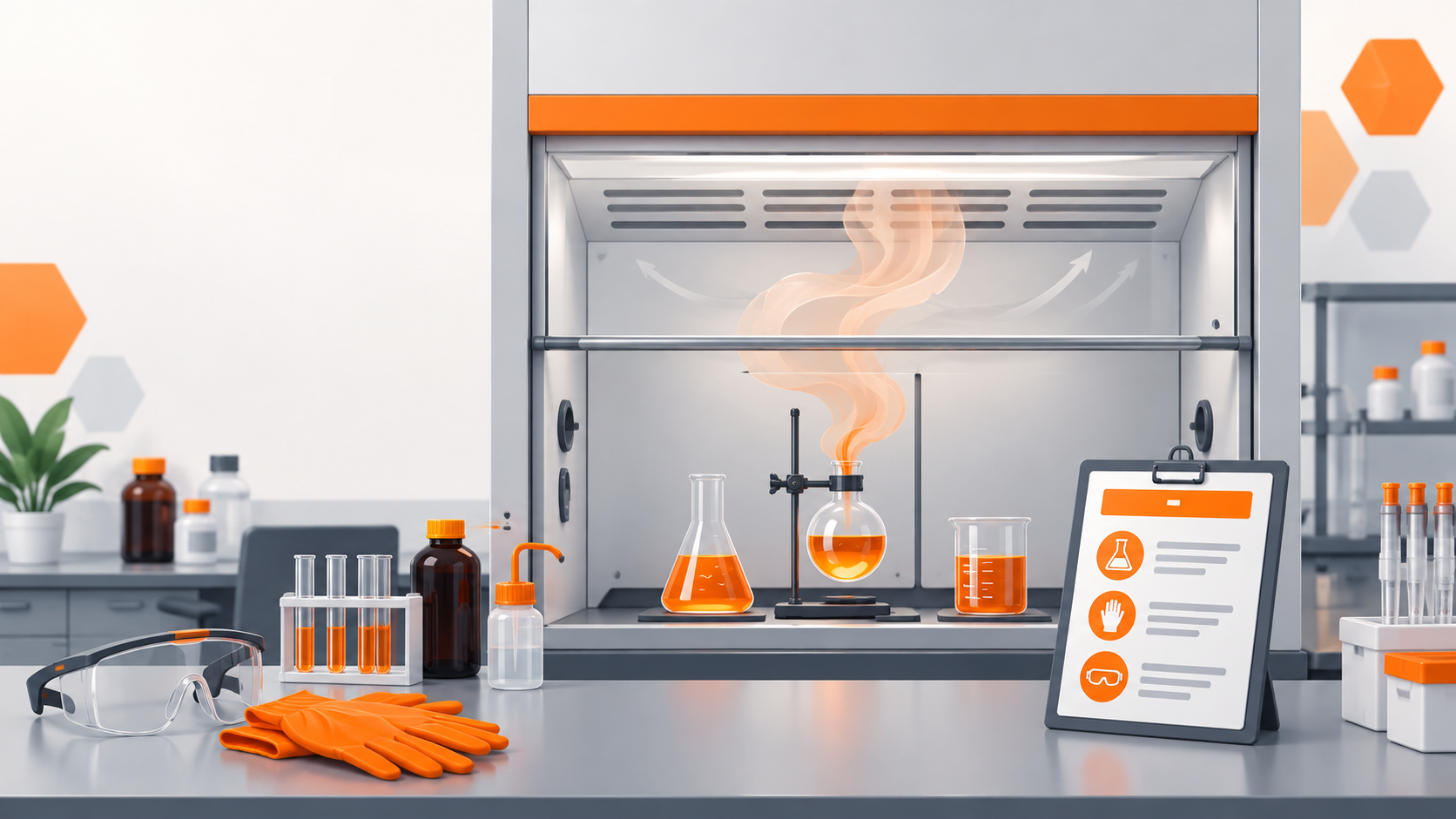
- A laboratory COSHH assessment should describe the procedure, scale and exposure points rather than only list reagents.
- Reaction products, heated materials and waste may create hazards that a starting reagent's SDS does not describe.
- Shared benches and fume cupboards require clear responsibility for setup, checks and changes.
- A small quantity does not remove the need to assess a hazardous route of exposure.
A laboratory COSHH assessment follows the experiment from preparation through reaction, clean-up and waste. The reagent safety data sheets (SDS) help identify hazards, but the assessor must also consider what the procedure creates, how much material is handled and who shares the laboratory. A task-based record makes controls easier to check when the method changes.
Why is a reagent list not enough?
Two experiments can use the same substance but create different exposure. One may pipette a small liquid volume in a closed setup; another heats, sprays or transfers it in an open vessel. The Health and Safety Executive (HSE) asks assessors to consider how people might breathe in, contact or swallow substances, how often and how long they work, and who else may be exposed. See HSE's COSHH assessment guidance.
Map the sequence: receiving and storage, measuring, mixing, heating or cooling, sampling, cleaning and disposal. Identify points where a cap is open, a vessel is pressurised, dust is produced or a contaminated tool is handled. The starting reagent's SDS may not describe reaction products, decomposition, aerosols or residues made by the method. HSE explains that an SDS is information for assessment, not the assessment itself.
Record scale and change limits. “Small-scale” is too vague to control a procedure if different researchers use different vessel sizes. The assessment should specify the intended range and require review before a major increase or change of chemistry. Include visiting researchers, students, cleaners and maintenance staff where they could be exposed.
How should controls be selected for the procedure?
Consider whether a less hazardous reagent, lower concentration or different method can achieve the result. Then choose enclosure, a suitable fume cupboard or local extraction and a way of working that minimises open handling. HSE's control principles emphasise preventing release and choosing measures proportionate to the health risk. Gloves, eye protection and lab coats address residual exposure; they do not make an uncontrolled release acceptable.
State what the fume cupboard is expected to contain and how users check it before work. The sash position, equipment layout and whether several users crowd the opening may affect performance. A cupboard that passed a test is not permission to block airflow with apparatus. Name the person who checks defects and decides whether the procedure may continue.
For glove selection, consider the exact substances and handling time, including contact with mixed material or solvent-wet tools. For spills, state which scale a trained lab user may manage and when to withdraw and escalate. Avoid a universal lab rule that assumes every bottle and reaction responds to the same kit.
What about shared spaces and simultaneous work?
Shared laboratories create interfaces. A neighbouring experiment may introduce a vapour, ignition source or incompatible waste stream. A researcher who changes a method can affect others at the bench or extraction system. Before starting, identify where the work is carried out, what other activities may occur nearby and how access is controlled during a higher-risk step.
Use a pre-start check for unusual procedures: current reagent identity and SDS, approved scale, equipment condition, waste container, emergency route and supervisor approval where required. The check should complement, not replace, the underlying assessment. If a reagent is substituted or an unexpected product forms, pause and reassess rather than editing the record after the experiment.
Keep storage and waste integrated with the procedure. A reaction may leave contaminated glassware or a mixture that needs separate containment. Label intermediate material clearly enough to prevent mistaken handling by the next user. Do not infer waste compatibility from a container's colour alone.
How should the assessment be reviewed?
Review after changes in scale, reagents, process steps, equipment, room layout or users, and after spills, symptoms or near misses. Ask the people doing the work whether the controls remain practical. HSE advises keeping COSHH assessments current and checking that controls work.
Link current SDS versions, the approved method and location to the record. The Safe Foundry feature overview shows ways to organise product and document information; the assessment workflow can help structure a review. The final question is whether another competent lab user could understand the exact permitted method and its stop points without relying on the original author's memory.
What would a procedure-specific record show?
Take a small synthesis that uses two reagents and a heated solvent. The record identifies the starting materials and quantities, how they are measured, when the vessel is open, what is heated and the expected products or residues. It names the fume cupboard and its pre-use check, the controls for adding one reagent to another, and the clean-up and waste route. A reviewer can then see where the procedure creates exposure that neither reagent SDS describes on its own.
Define the approved scale and the boundary of the assessment. If a researcher doubles the batch, changes solvent or moves to another room, the task may need reassessment before work. A line stating “standard lab PPE” is insufficient if the new method creates a different splash or airborne route. The record should state who can authorise a variation and where that decision is saved.
How can shared lab controls be tested?
Observe the procedure on a normal working day. Is the fume cupboard crowded by storage bottles? Does another researcher need to open the sash while the reaction is running? Are waste containers clearly distinguished from usable reagents? Can a cleaner identify which surfaces may be contaminated? These questions test whether the written controls survive shared use.
Keep emergency arrangements specific enough to be actionable. A spill of a starting reagent, an unexpected reaction and a leak from a waste bottle may require different decisions. The procedure should tell users how to stop, alert others and seek competent help without asking them to improvise a clean-up beyond their training. When an incident occurs, review the method and shared-space arrangements as well as the immediate response.
How should a lab handle a one-off experiment?
Novel work still needs a defined method and boundaries before it begins. The researcher can record the objective, starting materials, intended scale, expected transformations, available hazard evidence and the uncertainties that require specialist advice. The assessment should identify what will be observed during the first run, who supervises it and which unexpected condition stops the experiment. It should not assume that small quantity alone makes uncertainty acceptable.
After the first run, compare what happened with what was predicted. Did the reaction release gas, leave residue, require a longer open step or create more waste? Update the method before repeating it. If the process is adopted by other lab users, convert the lessons into a clear routine instruction and train them on the revised controls.
This record is particularly useful when personnel change. A new researcher should be able to see why a certain scale, fume cupboard or order of addition was chosen. Retain the evidence behind the decision instead of relying on a handwritten note whose author has left the laboratory.
The most useful review often happens at the bench with the current user. Ask them to point to the exact step where a substance could escape and to demonstrate the control. A procedure that only its author can interpret is not ready for wider use.
Frequently asked questions
Can one COSHH assessment cover several lab experiments?
It may cover genuinely similar activities where hazards, scale, exposure and controls are comparable; significant differences need their own analysis.
Is a small reagent amount automatically low risk?
No. Exposure route, potency, method and who may be affected still need assessment.
Does a fume cupboard remove the need for gloves?
Not necessarily. It mainly addresses airborne release; skin contact and splashes need separate consideration.
What if a reaction produces an unexpected material?
Stop and seek competent advice before continuing, then update the assessment and instructions as appropriate.
Workplace exposure limits in EH40 help assess airborne exposure in Great Britain. Learn what the figures mean, what they miss and how to review controls.
Spray Painting COSHH: Assessing Mist and Controls at WorkSpray painting COSHH assessments must consider aerosol mist, other workers and the whole paint task. Learn how to review booths, RPE and clean-up controls.
SDS Section 9: Physical Properties That Change RiskSDS Section 9 lists physical and chemical properties. Learn which values affect workplace exposure, storage and spill planning, and how to use them.