
Is a Safety Data Sheet the Same as a COSHH Assessment?
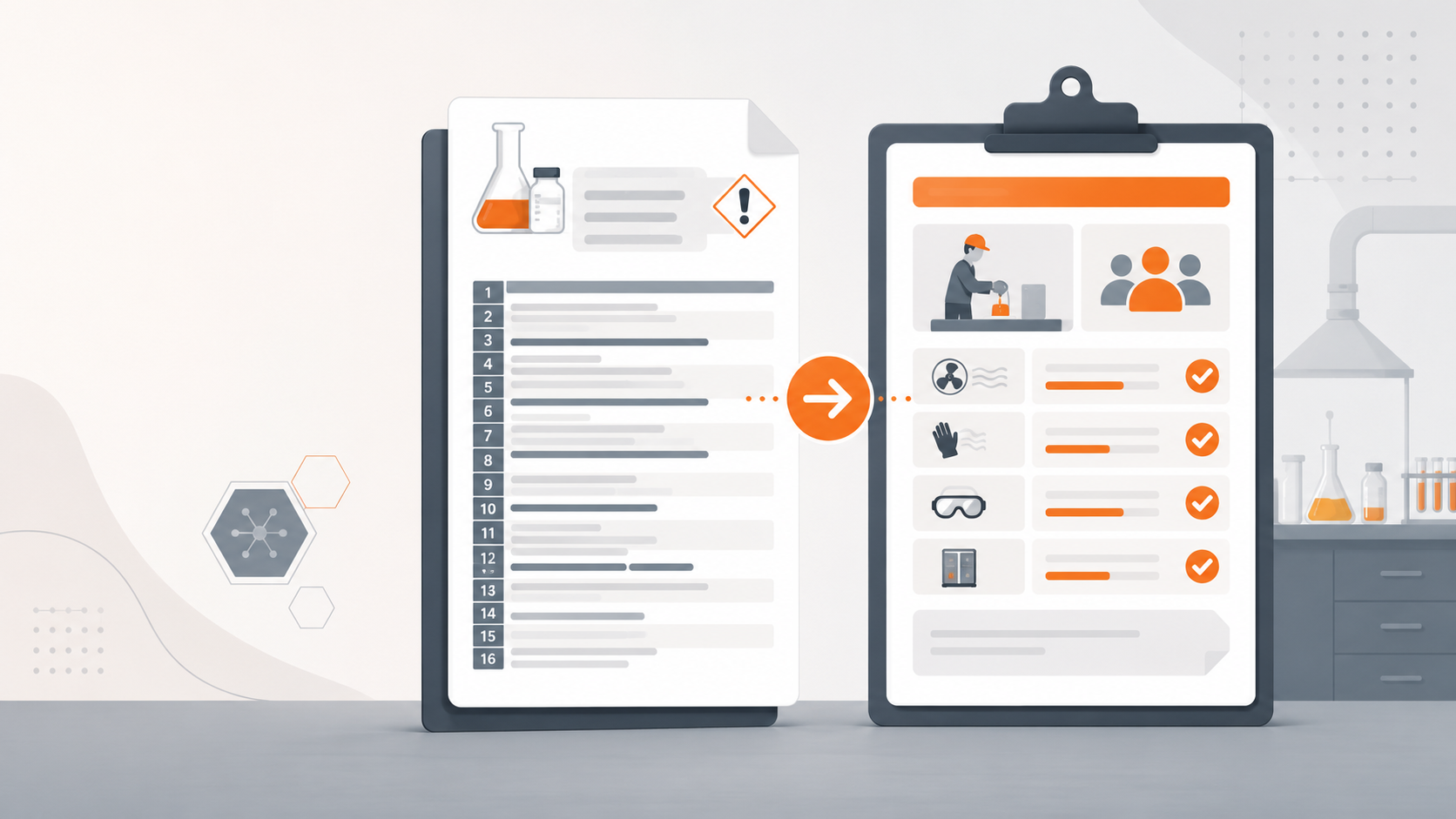
- No, a safety data sheet is not the same as a COSHH assessment: an SDS describes a substance's hazards, while a COSHH assessment evaluates the risk of how that substance is used in a specific workplace.
- A safety data sheet is supplied by the manufacturer or supplier and follows a standard 16-section format; a COSHH assessment is produced by the employer for their own tasks and conditions.
- An SDS is a key input to a COSHH assessment — Sections 2 (hazards) and 8 (exposure controls) in particular — but it cannot tell you who is exposed, how much, or for how long in your workplace.
- Relying on the safety data sheet alone is a common COSHH shortcoming because the same substance can present very different risks depending on the task, quantity, frequency and ventilation.
- Under COSHH, the employer is legally responsible for producing a suitable and sufficient assessment, whereas the supplier's duty ends at providing accurate hazard information.
No — a safety data sheet is not the same as a COSHH assessment, and treating one as the other is a common compliance gap. A safety data sheet (SDS) is supplied by the manufacturer and describes a substance's hazards in general terms; a COSHH assessment is produced by the employer and evaluates the risk of how that substance is actually used in your workplace, then sets out the controls. The SDS is one of the most important inputs to a COSHH assessment, but it is a starting point rather than a finished assessment.
What is the difference between a safety data sheet and a COSHH assessment?
The core difference is authorship and purpose: the supplier writes the SDS to describe the product, and you write the COSHH assessment to manage the risk of your task. An SDS is generic to the substance and identical for every customer; a COSHH assessment is specific to your process, quantities and people.
| Safety data sheet (SDS) | COSHH assessment | |
|---|---|---|
| Produced by | The manufacturer or supplier | The employer / the person doing the work |
| Purpose | Describe the substance's inherent hazards | Evaluate and control the risk in actual use |
| Scope | Generic to the product | Specific to your task, quantity and conditions |
| Format | Standard 16-section structure | No fixed format; must be "suitable and sufficient" |
| Answers | What are the hazards? | Who is at risk here, and what will we do about it? |
What is a safety data sheet (SDS)?
A safety data sheet is a standardised document that a supplier must provide for a hazardous product, setting out its hazards and advice on safe handling. It follows a fixed 16-section format, and a few sections do most of the work for risk assessment:
- Section 2 – Hazard identification: the hazard classification and hazard statements, aligned to GHS/CLP labelling.
- Section 8 – Exposure controls / personal protection: any workplace exposure limit and recommended controls and PPE.
- Sections 3, 7 and 11 – composition, handling and storage, and toxicological information for a fuller picture.
Crucially, the SDS describes the substance as shipped. It does not know how much you use, how you use it, or who is standing nearby — so it cannot, by itself, tell you whether your exposure is adequately controlled.
What is a COSHH assessment?
A COSHH assessment is the employer's evaluation of the health risks from hazardous substances at work, together with a record of the controls needed to prevent or adequately control exposure. COSHH stands for the Control of Substances Hazardous to Health Regulations 2002, enforced in Great Britain by the Health and Safety Executive (HSE).
The assessment is workplace-specific: it considers the actual task, the quantity and concentration, how often and for how long the work is done, the ventilation, and who could be exposed and by what route (inhalation, skin or eye contact, or ingestion). Two businesses using the identical product can legitimately reach different COSHH conclusions because their tasks and controls differ.
Why isn't a safety data sheet enough on its own?
Because risk is not a property of the substance alone — it depends on exposure, and exposure is created by how the substance is used. A solvent wiped on with a cloth in a well-ventilated bay is a different risk from the same solvent sprayed in a small enclosed room, even though the SDS is word-for-word the same.
This is why filing the SDS and calling it a COSHH assessment leaves out the very information that determines real-world risk. The SDS supplies the hazard; you still have to supply the context and the decision. Under COSHH, that decision — the suitable and sufficient assessment — is the employer's legal responsibility, and you should record its significant findings so controls can be implemented and checked. The current HSE position on when written records are strictly required: employers with five or more employees must record the significant findings.
What does a safety data sheet give you for a COSHH assessment?
The SDS is the fastest route to the hazard information you need, and it feeds several parts of the assessment directly.
What the SDS provides
- The hazard classification and hazard statements (Section 2).
- Any Workplace Exposure Limit (WEL) and recommended controls (Section 8). WELs are published by HSE in EH40/2005 as long-term (8-hour time-weighted average) and short-term (15-minute) limits; note that not every substance has a WEL.
- Handling, storage, first-aid and spill information to inform your procedures.
What the SDS cannot provide
- Who in your workplace is exposed, and how.
- The quantity, frequency and duration of your specific task.
- Whether your existing ventilation and controls are adequate.
- Substances created by your process — such as dust, fume or vapour — that never arrive with an SDS at all.
How do you turn a safety data sheet into a COSHH assessment?
In outline: extract the hazard data from the SDS, add your workplace context, evaluate the exposure, decide controls using the hierarchy of control, then record and review. The hierarchy matters — you should try to eliminate or substitute the substance, then apply engineering controls such as local exhaust ventilation (LEV), and treat PPE as the last resort rather than the first move.
This extraction step is where a tool can save time. Safe Foundry reads the SDS and structures the hazard data so your team can focus on the workplace-specific judgement — you can see how the SDS-to-COSHH workflow works and what the tool pulls from each safety data sheet. It does not remove the employer's duty to assess; it removes the manual transcription so the human decisions get more attention. If you have process-specific questions, the help centre covers common COSHH and SDS scenarios in more detail.
This article is general guidance, not legal or compliance advice; check current HSE guidance and your own circumstances before acting.
Frequently asked questions
Can I use a safety data sheet as my COSHH assessment?
No — the SDS is an input, not the assessment. You can attach it to your COSHH paperwork as supporting evidence, but you still need a separate assessment that covers how the substance is used in your workplace and what controls you apply.
Who provides the safety data sheet, and who writes the COSHH assessment?
The manufacturer or supplier provides the safety data sheet for a hazardous product, while the employer is responsible for producing the COSHH assessment. These are two different duties held by two different parties.
How many sections does a safety data sheet have?
A safety data sheet follows a standard 16-section format, with Section 2 (hazard identification) and Section 8 (exposure controls and personal protection) being the most useful for building a COSHH assessment.
Do I still need a COSHH assessment if the safety data sheet says the product is low hazard?
Generally yes, if the product is classified as hazardous to health and your use could expose someone. A low-hazard classification usually means simpler controls, but the assessment is what confirms that your specific use is adequately controlled.
Learn how to assess process-generated dust and fumes without an SDS by defining the process, exposure routes, evidence and practical controls.
How to Check an SDS Matches the Chemical You UseCheck that an SDS matches your chemical by comparing product identifiers, supplier, concentration, form, label classification and intended use.
COSHH Assessment Review Checklist for UK WorkplacesUse this COSHH assessment review checklist to compare records with current tasks, products, exposure routes, controls and workplace evidence.