
What Information Do You Need for a DSEAR Assessment?
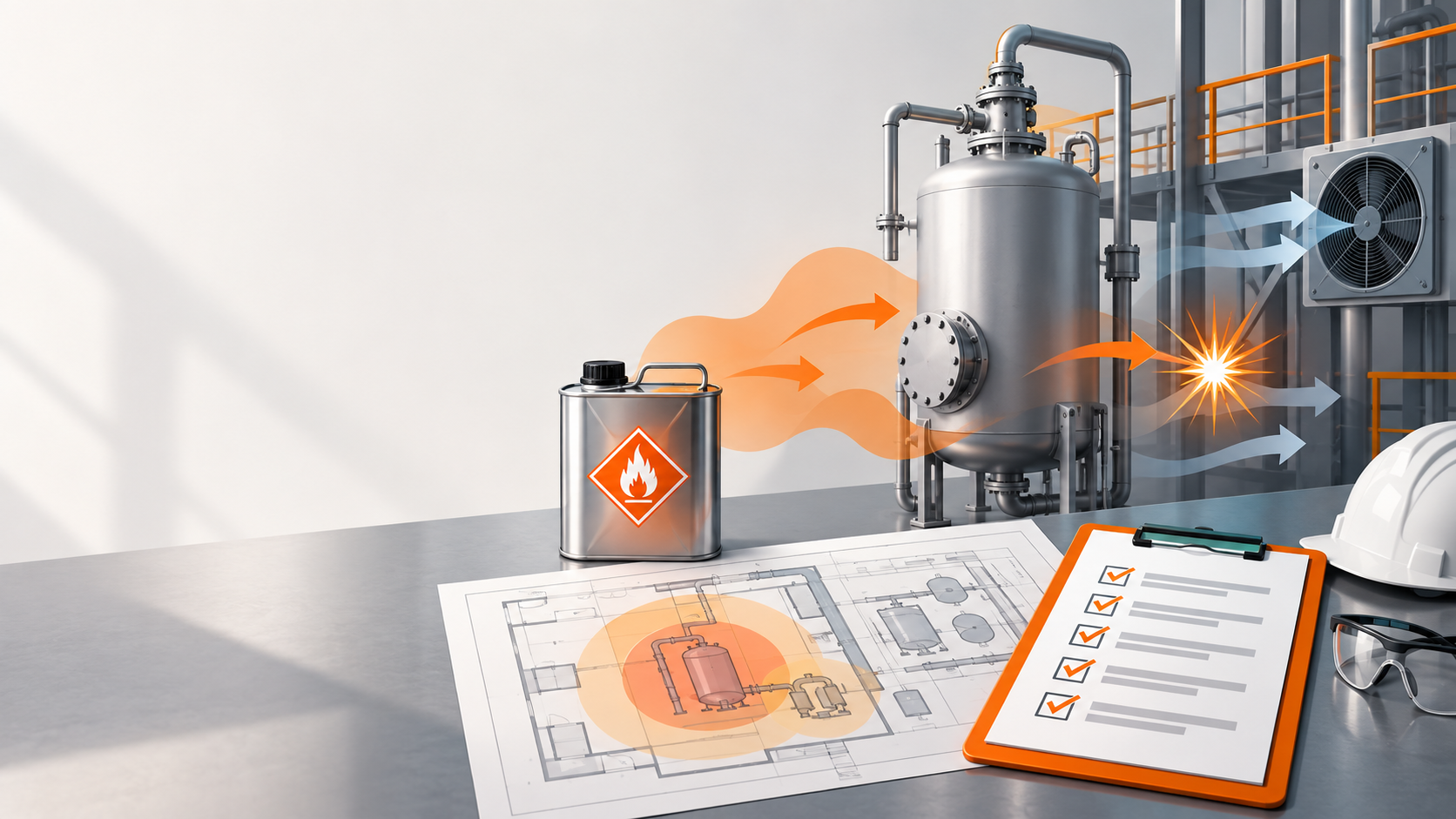
- A DSEAR assessment needs process and workplace evidence in addition to safety data sheets, including quantities, temperatures, releases, ventilation and ignition sources.
- The assessment should cover normal operation, foreseeable failures, maintenance, cleaning, storage, waste and emergency scenarios.
- Substance properties must be matched to where and how a dangerous atmosphere or other fire, explosion, pressure or metal-corrosion risk could arise.
- Existing controls need evidence of condition and performance, with clear actions where information is missing or assumptions are uncertain.
A DSEAR assessment needs more than a folder of safety data sheets. Gather an accurate dangerous-substance inventory, maximum and normal quantities, physical properties, process conditions, release scenarios, ventilation, ignition sources, people at risk, existing controls, maintenance evidence and emergency arrangements. The assessor must connect each property to the real workplace scenario.
What does a DSEAR assessment need to establish?
The assessment must identify dangerous substances, the work involving them and the ways the substances and activities could harm people. HSE describes the Dangerous Substances and Explosive Atmospheres Regulations 2002 (DSEAR) as the main legislation controlling workplace risks from fire and explosion caused by dangerous substances. Since 2015, DSEAR also covers gases under pressure and substances corrosive to metals (HSE DSEAR in detail).
The assessment should support decisions about eliminating the risk or reducing it so far as reasonably practicable, controlling and mitigating remaining risk, emergency arrangements, information and training, and any places where an explosive atmosphere requires classification.
This article is a preparation checklist. Complex processes, explosive-atmosphere modelling and hazardous-area classification may require specialist competence. See Safe Foundry's DSEAR assessment workflow for how the evidence can be organised around the assessment.
Which substances and materials should be listed?
Build an inventory of anything that could contribute to fire, explosion, pressure or metal-corrosion risk in the work. Do not limit the list to products carrying a flame pictogram.
Include, where relevant:
- flammable gases, liquids, vapours, mists and aerosols;
- combustible dusts produced or handled by the process;
- oxidising substances and mixtures;
- substances that can react dangerously or decompose;
- gases under pressure;
- substances corrosive to metals;
- fuels, wastes, residues and cleaning materials;
- intermediate materials and process-generated atmospheres;
- incompatible substances that may meet accidentally.
Record product name, supplier, physical form, concentration, classification, normal and maximum quantity, location, container or system, and current SDS. Separate product information from location-specific stock so the assessor can see both total holdings and quantities at each point of use.
Which properties should you extract from the SDS?
Extract properties that affect whether a dangerous event can occur, then verify their relevance to the operating conditions. Useful SDS sections often include Section 2 for classification, Section 5 for firefighting, Section 7 for handling and storage, Section 9 for physical and chemical properties, and Section 10 for stability and reactivity.
Depending on the substance and scenario, gather:
| Property or information | Why it matters |
|---|---|
| Flash point | Helps indicate when a liquid may produce ignitable vapour under stated test conditions |
| Boiling point or range | Helps assess volatility and behaviour when heated |
| Vapour pressure | Informs how readily vapour may be generated at relevant temperatures |
| Lower and upper explosive limits | Helps evaluate flammable concentration ranges for gases or vapours |
| Autoignition temperature | Informs assessment of hot surfaces and process temperature |
| Minimum ignition energy or temperature | May be relevant for gases, vapours or combustible dusts |
| Density and vapour density | Helps anticipate where released material may collect |
| Particle size and dust characteristics | Affects dust dispersion and explosion behaviour |
| Reactivity and incompatibilities | Identifies runaway, gas-generation or heat-release scenarios |
| Pressure and container information | Supports assessment of gases under pressure and loss of containment |
An SDS may omit specialist fire and explosion data or provide a broad value that does not describe the mixture, dust or process condition. Record missing and uncertain data rather than filling gaps with assumptions. Ask the supplier, use authoritative technical information or obtain specialist input.
HSE states that an SDS provides important chemical information but is not itself a risk assessment (HSE safety data sheets).
What process information is needed beyond the SDS?
Describe how the substance is received, stored, transferred, used, generated and removed. The same solvent can create very different risks in a sealed system, an open tray and a heated spray process.
For each step, record:
- normal and maximum quantity present;
- batch or flow rate;
- temperature and pressure range;
- open or closed handling;
- transfer method, hose and connection details;
- mixing, agitation, spraying, atomisation or drying;
- duration and frequency;
- cleaning, sampling, maintenance and waste handling;
- shutdown, startup and foreseeable operator interventions;
- indoor or outdoor location and room geometry;
- drains, pits, voids or low points where releases could collect.
Use process diagrams, layout plans, equipment lists, photographs and a walk-through with operators. Check that “maximum quantity” includes connected pipework, day tanks, open containers and temporary holdings, not only nominal batch size.
Which release scenarios should be documented?
Assess releases in normal operation and foreseeable abnormal events. HSE's laboratory guidance distinguishes routine or primary releases from releases caused by foreseeable equipment failure or operator error, and notes that release quantity and ventilation strongly affect the result (HSE laboratory DSEAR guidance).
Document:
- displacement vapour during filling;
- open pouring, mixing, coating or cleaning;
- dust from tipping, milling, sanding, conveying or filter cleaning;
- leakage from seals, valves, hoses and connections;
- spills from dropped or punctured containers;
- overfilling, overheating or loss of cooling;
- ventilation failure;
- incompatible mixing or decomposition;
- cylinder, regulator or pressure-system leaks;
- residues released during maintenance;
- waste accumulation and contaminated materials.
For each scenario, state the likely source, material, rate or quantity, duration, direction, detection and response. Avoid a single generic “spill” row when small routine releases and a full-container failure have different controls and consequences.
What ventilation and dispersion information is required?
Record how releases are prevented, captured, diluted or allowed to disperse. Include enclosure, local exhaust ventilation, general mechanical ventilation and natural ventilation.
Gather design information, airflow or commissioning data where available, supply and extract locations, discharge points, interlocks, alarms, maintenance and examination records. Note obstructions, pits, ceiling voids and adjoining spaces. Establish what happens during power loss or when doors and windows are closed.
Do not treat “well ventilated” as evidence. The assessor needs enough information to decide whether a release could form a dangerous atmosphere and how far it could extend. Where a conclusion depends on assumed airflow, record and verify the assumption.
Which ignition sources should be included?
List electrical and non-electrical ignition sources for normal work, faults and temporary activities. HSE warns that electricity can create hot surfaces or sparks and that static discharge must be considered in potentially explosive atmospheres (HSE explosive atmospheres).
Consider:
- fixed and portable electrical equipment;
- hot surfaces, heaters, ovens and process equipment;
- flames, smoking and hot work;
- mechanical sparks, friction and impact;
- static electricity from transfer, clothing, containers and people;
- vehicles, charging equipment and batteries;
- spontaneous heating and exothermic reaction;
- lightning for exposed installations;
- contractor tools and temporary equipment.
Record equipment type, location, temperature rating or explosion-protection details where relevant, inspection status and controls over temporary ignition sources. A “no ignition sources” statement is rarely credible without a systematic survey.
What existing controls and evidence should be gathered?
Document controls in DSEAR's priority order and bring evidence that they work. HSE lists reducing quantity, minimising releases, controlling releases at source, preventing dangerous atmospheres, safely collecting or removing releases, avoiding ignition, avoiding adverse conditions and separating incompatible substances.
Provide:
- substitution or process-elimination decisions;
- quantity limits and stock records;
- closed-transfer, containment and extraction designs;
- inspection, testing and preventive-maintenance records;
- bonding, earthing and antistatic arrangements;
- equipment certification and hazardous-area drawings where applicable;
- operating procedures, permits and contractor controls;
- storage segregation and secondary containment;
- alarms, shutdowns, fire protection, explosion relief or suppression;
- training, drills and supervision evidence.
The Safe Foundry chemical safety workflow can help keep these records connected to substances, locations and assessment revisions.
Who and what else must the assessment cover?
Identify everyone who could be affected and how an event could spread. Include operators, maintenance staff, cleaners, contractors, visitors, neighbours and emergency responders where relevant. Consider occupancy, escape routes, vulnerable work areas and simultaneous activities.
Map escalation paths: release to ignition, fire spread, explosion overpressure, pressure-system failure, projectile risk, corrosive attack on containment and involvement of incompatible stock. Review domino effects between the process, storage, waste and neighbouring equipment.
Gather emergency plans, alarm arrangements, isolation points, spill and firefighting strategy, evacuation information and liaison with emergency services. HSE says emergency arrangements should be proportionate to the risk and relevant information must be available to emergency services where needed.
How should you package the information for the assessor?
Give the assessor an indexed evidence pack and access to the workplace and knowledgeable people. Include:
- dangerous-substance and quantity register;
- current SDS set and missing-data log;
- process descriptions, flow diagrams and layouts;
- release-scenario table;
- ventilation information and test records;
- ignition-source survey;
- control, maintenance and equipment records;
- incident, alarm and near-miss history;
- existing COSHH, fire and process-risk assessments;
- emergency, training and contractor arrangements.
Mark assumptions and unresolved gaps. A transparent gap is safer than precise-looking invented data. Use the help centre for support organising the records before assessment.
The assessment should finish with significant findings, required controls, responsibilities, deadlines and review triggers. If you employ five or more people, HSE says the significant findings must be recorded. The evidence pack then becomes the baseline for checking whether changes to substance, quantity, process, ventilation or equipment require review.
Frequently asked questions
Is an SDS enough for a DSEAR assessment?
No. An SDS describes product hazards and properties, while DSEAR also requires workplace information such as quantity, process conditions, releases, ventilation, ignition sources, people and controls.
Do small quantities need to be included in a DSEAR assessment?
Include them in the initial consideration. Whether risk is trivial depends on the substance, release, location, ignition and consequences; there is no single universal small-quantity exemption for every scenario.
Who can carry out a DSEAR assessment?
The assessor needs competence proportionate to the hazards and complexity. Specialist input may be required for combustible dust, hazardous-area classification, dispersion, explosion protection or reactive chemistry.
When should a DSEAR assessment be reviewed?
Review it when there is reason to suspect it is no longer valid or after significant change, and use a planned interval suited to the risk and likelihood of change.
Learn how to assess process-generated dust and fumes without an SDS by defining the process, exposure routes, evidence and practical controls.
How to Check an SDS Matches the Chemical You UseCheck that an SDS matches your chemical by comparing product identifiers, supplier, concentration, form, label classification and intended use.
Chemical Storage Inspection Checklist for UK WorkplacesUse this chemical storage inspection checklist to find container, label, segregation, quantity, spill-control and housekeeping problems early.