
How to Read a Safety Data Sheet (SDS), Section by Section
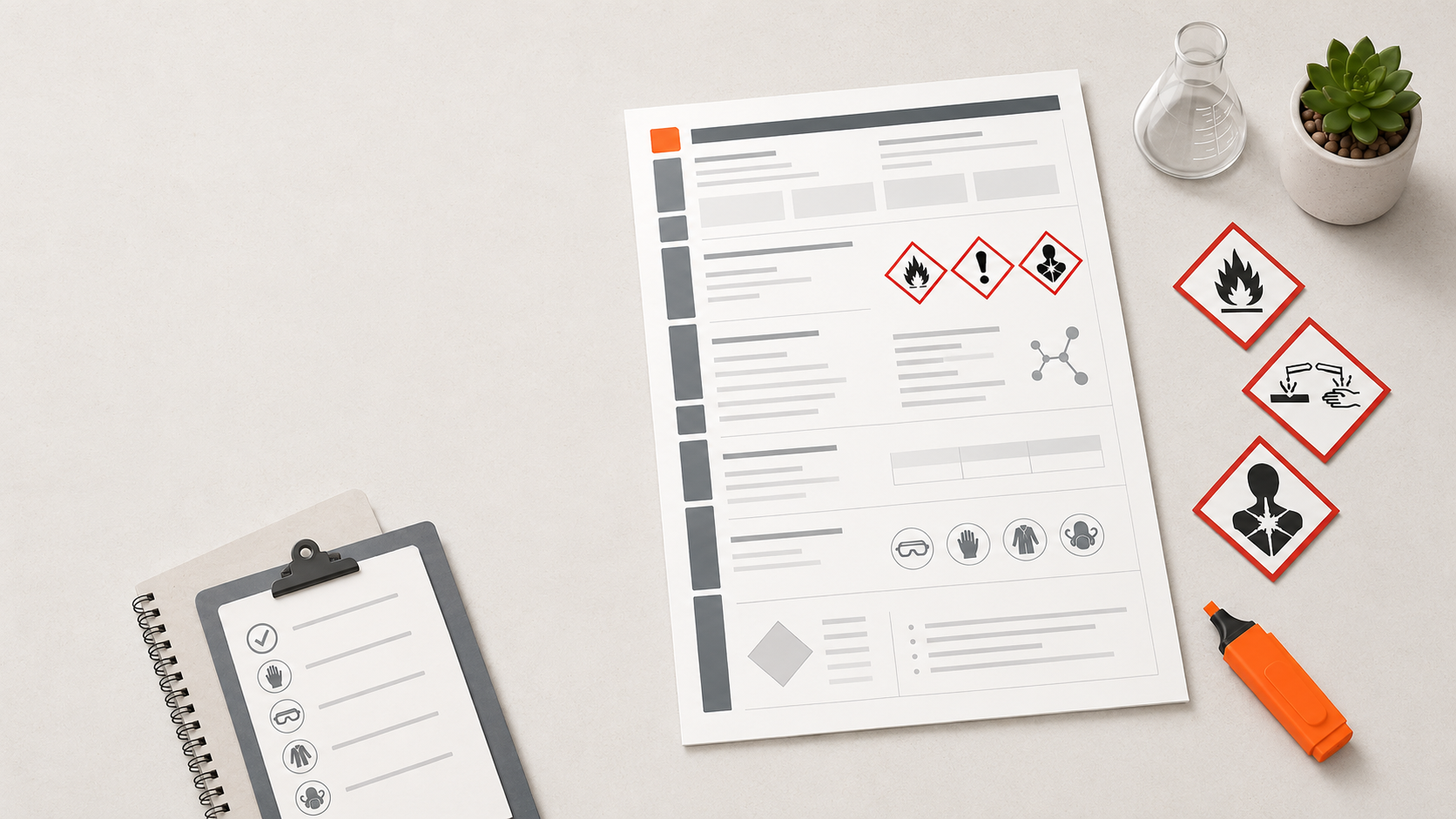
- A safety data sheet (SDS) is a standardised 16-section document that a supplier must provide for a hazardous chemical, following the fixed format set out in REACH Annex II.
- The three SDS sections that carry most of the workplace risk information are Section 2 (hazards identification), Section 3 (composition) and Section 8 (exposure controls and PPE).
- A safety data sheet is not a COSHH risk assessment; HSE guidance is that you use the SDS information to make your own assessment based on how the substance is used.
- Section 8 lists occupational exposure limits, which in Great Britain are published by HSE in EH40/2005 and are legally binding under COSHH.
- Reading an SDS well means checking its hazard and exposure data against the actual task, quantity and control measures in your workplace, not just filing the sheet.
A safety data sheet (SDS) is a standardised, 16-section document that sets out the hazards of a chemical and how to handle, store and control it safely. To read one quickly, go straight to Section 2 (hazards), Section 3 (composition) and Section 8 (exposure controls), because those three carry most of the information you need for a COSHH risk assessment. The remaining sections cover first aid, firefighting, spillage, transport and disposal, and you consult them when the task calls for it.
What is a safety data sheet, and why does it matter under COSHH?
A safety data sheet is a document a supplier provides to communicate the hazards of a substance or mixture and the precautions for using it safely. In Great Britain, suppliers of hazardous chemicals must supply an SDS, and its structure follows a fixed 16-section format set out in REACH Annex II. For anyone managing chemical safety, the SDS is the starting point for meeting the Control of Substances Hazardous to Health Regulations 2002 (COSHH), which require employers to assess and control the risks from hazardous substances.
One point is easy to get wrong. HSE is explicit that a safety data sheet is "not a risk assessment" (HSE, Chemical safety data sheets). You use the information it contains to make your own COSHH assessment, judged against how the substance is actually used on your site. Treating the sheet itself as the assessment is one of the most common compliance gaps.
What are the 16 sections of a safety data sheet?
A safety data sheet always has the same 16 numbered sections, in the same order, whoever the supplier is. That consistency is the practical value: once you know what lives in each section, you can find any single fact in seconds. The table below summarises all 16 and flags where each is most useful.
| Section | What it covers | Most useful for |
|---|---|---|
| 1. Identification | Product name, supplier details, emergency phone number, recommended use | Confirming you have the right sheet for the right product |
| 2. Hazards identification | GHS/CLP classification, pictograms, signal word, hazard (H) and precautionary (P) statements | The headline risk picture |
| 3. Composition / ingredients | Hazardous components, concentration ranges, CAS/EC numbers | Knowing what the hazard actually is |
| 4. First aid measures | Response by exposure route, symptoms, when to get medical help | Emergency planning |
| 5. Firefighting measures | Suitable extinguishing media, hazardous combustion products | Fire risk and emergency plans |
| 6. Accidental release measures | Spill containment, clean-up, personal precautions | Spillage procedures |
| 7. Handling and storage | Safe handling advice, incompatibilities, storage conditions | Day-to-day controls |
| 8. Exposure controls / personal protection | Occupational exposure limits, engineering controls, PPE | The core of a COSHH assessment |
| 9. Physical and chemical properties | Appearance, odour, pH, flashpoint, vapour pressure | Judging how a substance behaves |
| 10. Stability and reactivity | Conditions and materials to avoid, hazardous reactions | Storage and process safety |
| 11. Toxicological information | Health effects by route, acute and chronic data | Understanding harm to health |
| 12. Ecological information | Environmental effects and persistence | Environmental risk |
| 13. Disposal considerations | Waste treatment and disposal methods | Waste handling |
| 14. Transport information | UN number, class, packing group | Moving the substance |
| 15. Regulatory information | Safety, health and environmental regulations specific to the product | Wider compliance |
| 16. Other information | Full text of H-statements, revision date, version | Checking the sheet is current |
Which SDS sections matter most for a COSHH assessment?
For a COSHH assessment, the sections that do most of the work are Section 2, Section 3 and Section 8. The rest supports emergency planning and specialist decisions, but these three tell you what the hazard is, how much of it is present, and what the accepted controls are.
Section 2: Hazards identification
Section 2 is the summary of how the product is classified under GHS/CLP. It lists the pictograms, the signal word ("Danger" or "Warning"), and the hazard statements (the H-codes) that describe each hazard. Read this first to see whether you are dealing with something corrosive, a respiratory sensitiser, a carcinogen, a flammable, or a combination. A single product often carries several hazard statements, so do not stop at the first one.
Section 3: Composition and ingredients
Section 3 lists the hazardous components in the product, usually with a concentration range and a CAS or EC number for each. This matters because the "product" you buy may be a mixture, and the meaningful hazard often comes from one component present at a few per cent. Section 3 is also what lets you look up an ingredient's exposure limit or toxicology independently rather than relying only on the supplier's summary.
Section 8: Exposure controls and personal protection
Section 8 is the heart of a COSHH assessment. It sets out any occupational exposure limits for the components, the engineering controls the supplier expects (for example local exhaust ventilation), and the recommended personal protective equipment. In Great Britain, workplace exposure limits are published by HSE in EH40/2005, and the limits listed there are legally binding under COSHH. Treat the PPE advice in Section 8 as a generic supplier baseline, then decide what your specific task actually needs.
How do you turn a safety data sheet into a COSHH assessment?
You turn an SDS into a COSHH assessment by mapping the sheet's hazard data onto the reality of the task: who does it, how often, in what quantity, and with what controls already in place. The SDS supplies the hazard information; your assessment supplies the context that decides the risk. A practical order looks like this:
- Identify the substance and check the sheet is current using Sections 1 and 16 (product identity and revision date).
- Read the hazards in Section 2 to understand what harm the substance can cause.
- Confirm the hazardous components in Section 3, because the risk usually traces to specific ingredients.
- Compare exposure limits and controls in Section 8 against how the task is actually done, and check any limits against the current EH40/2005 list.
- Decide and record the controls for your workplace: ventilation, containment, PPE, training and health surveillance where relevant.
- Repeat for every substance in the task. One job can involve several products, each with its own SDS, and the risks can combine.
This mapping is exactly the step teams find slow, because a busy workplace can hold hundreds of sheets, and each assessment means re-reading and cross-referencing. This is the problem Safe Foundry is built to shorten: it reads the SDS, extracts the hazard, composition and exposure data, and drafts a COSHH assessment you review rather than write from a blank page. The judgement about your task stays with you; the transcription and cross-checking does not. If you want worked examples of the section-by-section process, the help centre sets them out in more detail.
What is the difference between an SDS and an MSDS?
An SDS and an MSDS are essentially the same kind of document, and the difference is largely one of era. "MSDS" (material safety data sheet) is the older term, used before the Globally Harmonised System standardised the format. Under GHS and CLP, the document is now called a safety data sheet and follows the fixed 16-section structure described above. If a supplier still hands you an "MSDS", treat it as an SDS, but check the revision date, because the older label can signal an out-of-date sheet.
What are common mistakes when reading a safety data sheet?
The frequent errors are less about misreading a section and more about how the sheet is used:
- Treating the SDS as the COSHH assessment. It is an input, not the finished assessment.
- Working from an out-of-date sheet. Suppliers revise sheets when classifications change, so check the version and revision date in Section 16.
- Accepting the PPE list at face value. Section 8 gives a generic baseline; your task may need more or different protection.
- Stopping at Section 2. The real hazard often sits in a single component listed in Section 3.
- Ignoring the exposure limits. A substance with a WEL needs that limit checked against EH40/2005 and against likely exposure, not just noted.
- Assuming a "Warning" label means low risk. Signal words rank hazard severity, not the risk of your specific task, which depends on quantity, frequency and control. You can see how these questions recur across products in our frequently asked questions.
Read the whole sheet once, then return to Sections 2, 3 and 8 whenever you assess a task. Done consistently, that habit is what keeps a COSHH file accurate as products and limits change.
Frequently asked questions
Is a safety data sheet required for every chemical?
No. A supplier must provide an SDS for substances and mixtures classified as hazardous (and in certain other cases), but everyday products that are not classified as hazardous may not come with one. However, under GB REACH, an SDS must still be provided upon request for non-hazardous mixtures if they contain substances with UK workplace exposure limits or trace amounts of specific hazardous ingredients.
How do I know if a safety data sheet is out of date?
Check the version number and revision date, usually shown in Section 16, and compare it with the supplier's latest sheet. A revised classification or a change to exposure limits can supersede an older version even if the product itself has not changed.
Is there a separate "COSHH data sheet" I need from the supplier?
No. There is no distinct "COSHH data sheet"; people usually mean the safety data sheet. The supplier provides the SDS, and you use it to produce your own COSHH assessment for the way you use the product.
What do the signal words "Danger" and "Warning" mean on an SDS?
They are GHS signal words that rank hazard severity. "Danger" indicates the more severe hazard categories and "Warning" the less severe ones, and both appear in Section 2 alongside the hazard statements.
Learn how to assess process-generated dust and fumes without an SDS by defining the process, exposure routes, evidence and practical controls.
How to Check an SDS Matches the Chemical You UseCheck that an SDS matches your chemical by comparing product identifiers, supplier, concentration, form, label classification and intended use.
COSHH Assessment Review Checklist for UK WorkplacesUse this COSHH assessment review checklist to compare records with current tasks, products, exposure routes, controls and workplace evidence.