
How to Do a COSHH Assessment: A Step-by-Step Guide
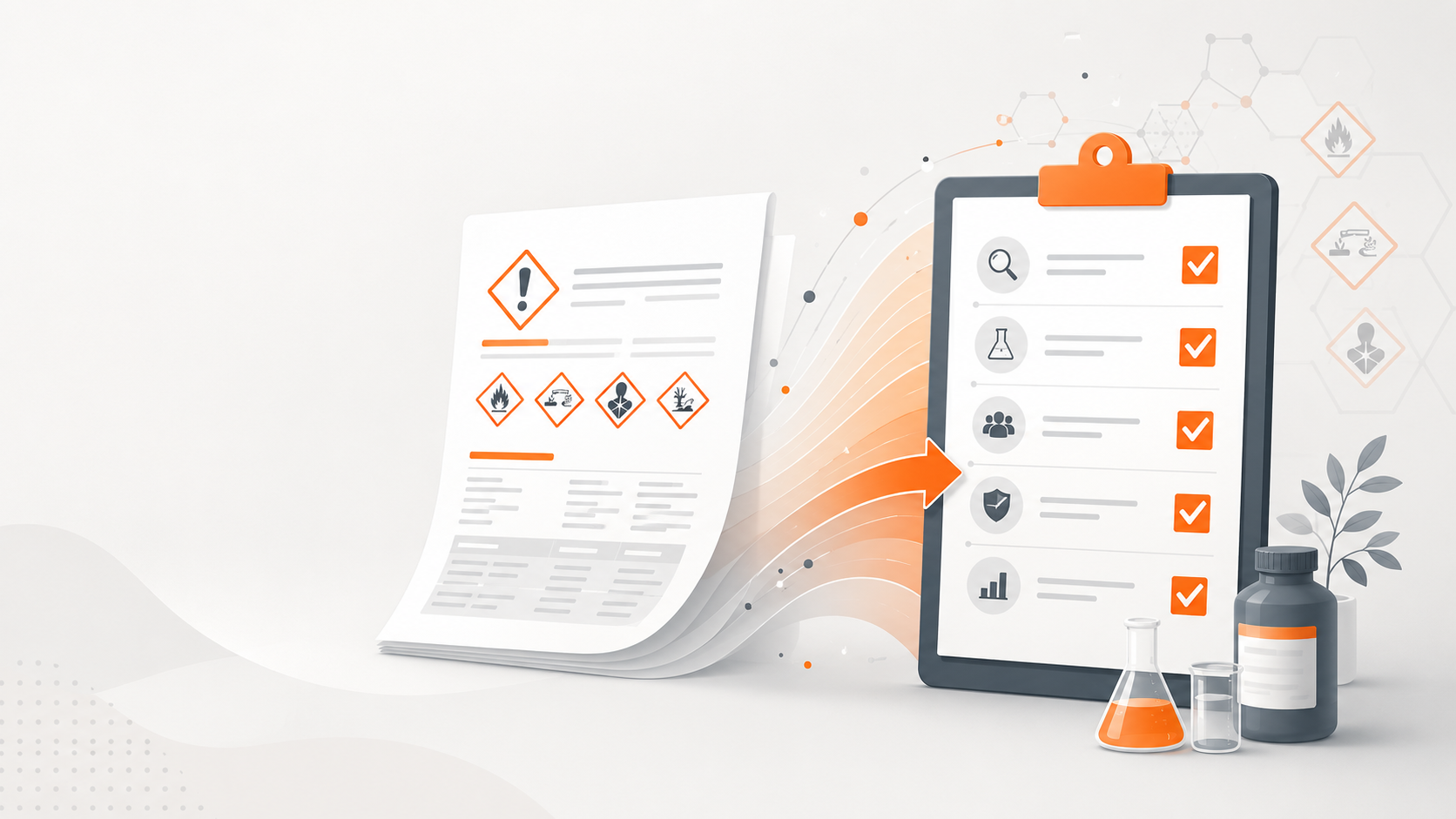
- A COSHH assessment identifies the substances hazardous to health in your workplace and the control measures needed to protect people, as required by the Control of Substances Hazardous to Health Regulations 2002.
- COSHH covers chemicals, fumes, dusts, vapours, mists, gases and biological agents, but not asbestos, lead or radioactive substances, which have their own regulations.
- The safety data sheet for each product is the primary source of the hazard information you need to complete an assessment.
- Control measures should follow the hierarchy of control, with personal protective equipment as a last resort rather than a first choice.
- A COSHH assessment must be reviewed regularly and whenever a substance, process or working condition changes.
A COSHH assessment is a structured evaluation of the substances hazardous to health in your workplace and the measures needed to control exposure to them. In practice it means identifying every hazardous substance a task involves, judging who could be harmed and how, and recording the controls that keep that exposure adequately controlled — before the work begins.
This guide walks through what COSHH covers, the steps involved, and the records you need to keep.
What is a COSHH assessment?
COSHH stands for the Control of Substances Hazardous to Health Regulations 2002, the law that requires employers in Great Britain to control substances that are hazardous to health. A COSHH assessment is how you demonstrate that control: it links each hazardous substance to the tasks that use it, the people exposed, and the measures that reduce the risk.
It is not the same as a safety data sheet. A safety data sheet describes a product's hazards in general terms; a COSHH assessment applies that information to your specific tasks, quantities, and working conditions — the step Safe Foundry automates, as you can see in how it works.
What does COSHH cover?
COSHH applies to a wide range of substances hazardous to health, including:
- Chemicals and products containing chemicals
- Fumes, dusts, vapours, mists and gases
- Biological agents (bacteria and other micro-organisms)
- Germs that cause disease
Some hazardous materials are excluded because they have their own specific regulations, notably:
- Asbestos
- Lead
- Radioactive substances
If you are unsure whether a substance falls under COSHH, its label and safety data sheet are the first place to check.
How do you carry out a COSHH assessment?
There is no single official form, but a sound assessment works through the same logical steps.
1. Gather the safety data sheets
Collect the safety data sheet (SDS) for every hazardous product in scope. The SDS is your primary source of hazard information — it lists the hazard classifications, health effects, and recommended handling and control measures.
2. Identify the hazards and who is at risk
For each substance, note the health hazards and identify everyone who could be exposed — not only the person doing the task, but nearby workers, cleaners, contractors, and anyone else affected.
3. Evaluate how exposure happens
Consider how people are exposed: breathing it in, skin or eye contact, swallowing, or injection through the skin. The route of exposure shapes which controls are appropriate.
4. Decide on control measures
Follow the hierarchy of control — eliminate or substitute the substance where you can, then apply engineering controls (such as ventilation or enclosure), then safe systems of work, and only then personal protective equipment as a last line of defence.
5. Record the assessment
Write down the significant findings: the substances, the risks, and the controls you have put in place. A clear record is what an inspector, a manager, or a new employee will rely on.
6. Review it regularly
A COSHH assessment is a living document. Review it if a substance, quantity, process, or working practice changes, if there is an incident, or if there is any reason to think it is no longer valid.
What controls count as "adequate"?
Control is considered adequate when exposure is prevented, or where prevention is not reasonably practicable, reduced so far as is reasonably practicable. Personal protective equipment has its place, but it sits at the bottom of the hierarchy — it protects the individual wearing it rather than removing the hazard, and it should not be relied on where a higher-level control is feasible.
Common COSHH mistakes to avoid
- Treating the safety data sheet as the assessment. The SDS informs the assessment; it does not replace it.
- Assessing the substance but not the task. The same chemical can carry very different risks depending on how much is used, how, and where.
- Never reviewing it. An assessment written once and filed away drifts out of date as processes change.
- Defaulting straight to PPE. Reach for elimination, substitution and engineering controls first.
Where a tool can help
Pulling hazard data out of dozens of safety data sheets by hand is slow and error-prone. Safe Foundry reads the SDS for each product and drafts a structured COSHH assessment from it, so your team starts from the substance data rather than a blank page — then reviews, adjusts, and signs off. See pricing or how it works to get started.
This article is general guidance, not legal or compliance advice; check current HSE guidance and your own circumstances before acting.
Frequently asked questions
Is a COSHH assessment a legal requirement?
Yes. Under the Control of Substances Hazardous to Health Regulations 2002, employers in Great Britain must assess the risks from substances hazardous to health before that work starts.
Who is responsible for carrying out a COSHH assessment?
The employer holds the legal duty. They can delegate the practical work to a competent person who understands the substances and processes involved, but the responsibility remains with the employer.
How often should a COSHH assessment be reviewed?
There is no fixed interval. Review it regularly, and always after a change to the substances, quantities, processes or people involved, or following an incident that suggests it may no longer be valid.
Do I need a COSHH assessment for cleaning products?
If a cleaning product is classified as hazardous to health, then yes. Check the product label and its safety data sheet — everyday products can still require assessment depending on how they are used.
What is the difference between a safety data sheet and a COSHH assessment?
A safety data sheet describes a product's hazards in general. A COSHH assessment applies that information to your specific workplace, tasks, quantities and the people who could be exposed.
Learn how to assess process-generated dust and fumes without an SDS by defining the process, exposure routes, evidence and practical controls.
How to Check an SDS Matches the Chemical You UseCheck that an SDS matches your chemical by comparing product identifiers, supplier, concentration, form, label classification and intended use.
COSHH Assessment Review Checklist for UK WorkplacesUse this COSHH assessment review checklist to compare records with current tasks, products, exposure routes, controls and workplace evidence.