
How Often Should You Review a COSHH Assessment?
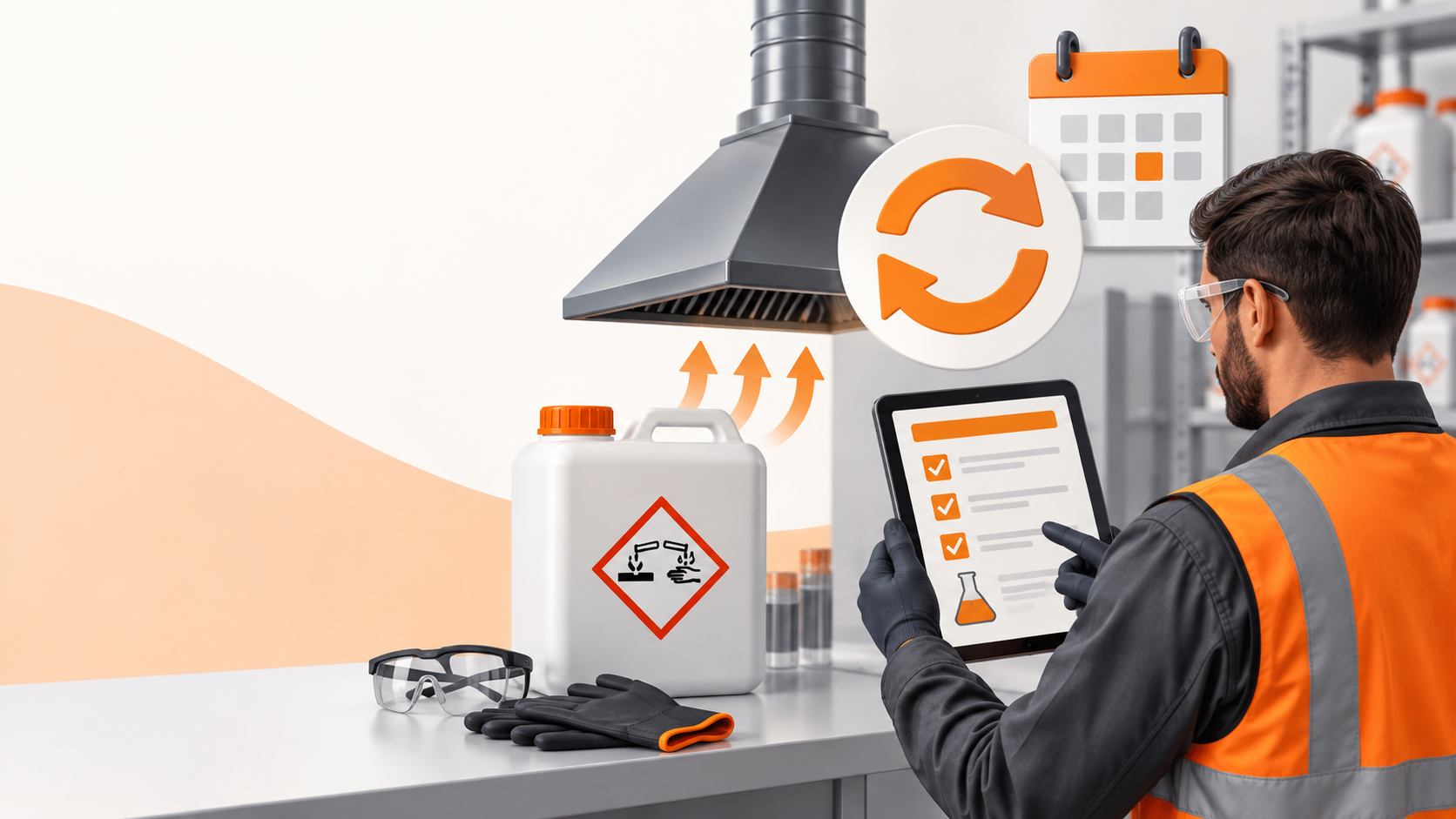
- UK COSHH rules require assessments to be reviewed regularly and immediately when there is reason to think an assessment is no longer valid or work changes significantly.
- A calendar review date is a backstop, while changes to products, tasks, people, equipment and control performance should trigger earlier review.
- A review can confirm that an assessment remains suitable and sufficient without repeating every assessment step.
- Review records should show what was checked, what evidence was used, what changed and who owns any follow-up action.
A COSHH assessment does not have a universal 12-month expiry date. It must be reviewed regularly and straight away when there is reason to think it is no longer valid or when the work changes significantly. A yearly reminder can be useful, but it cannot replace reviews triggered by real changes in the workplace.
Is an annual COSHH review a legal requirement?
COSHH does not prescribe one fixed annual review interval for every assessment. Regulation 6(3) requires employers to review an assessment regularly and forthwith if there is reason to suspect it is no longer valid, if exposure monitoring shows a review is needed, or if the work changes significantly. The assessment must then be changed where the review shows that this is necessary. The wording is available in the Control of Substances Hazardous to Health Regulations 2002.
The Health and Safety Executive (HSE) says the time between reviews depends on the type of risk, the work and the employer's judgement about how likely change is. HSE also explains that a review is primarily a check that the existing assessment remains suitable and sufficient. It does not automatically require the whole assessment to be repeated (HSE COSHH frequently asked questions).
Many organisations still choose a 12-month diary reminder. That can be a sensible management backstop, especially where work is stable, but it should be described as the organisation's review interval rather than a universal COSHH expiry rule. Higher-risk or fast-changing work may justify a shorter interval. Stable, tightly controlled work may support a different documented interval, provided trigger events are still acted on promptly.
What should trigger an immediate COSHH assessment review?
Review the COSHH assessment whenever new evidence could change the hazards, exposure, people at risk or effectiveness of controls. HSE specifically points to changes in staff, processes, substances or equipment, as well as worker concerns, accidents and near misses (HSE assessment guidance).
Use the following triggers in your local change-control and incident processes:
- A product or formulation changes. A replacement cleaner, different concentration or reformulated mixture may have different classifications, exposure limits or control advice.
- A new or revised safety data sheet arrives. Check what changed instead of filing the document without comparing it with the assessment.
- The task changes. Spraying rather than wiping, heating rather than using at room temperature, or increasing batch size can alter exposure even when the product is unchanged.
- Frequency, duration or quantity increases. A task moving from occasional use to every shift can change the exposure profile.
- Equipment or layout changes. New machinery, enclosure, extraction, ventilation, transfer points or work locations can create or remove exposure routes.
- Control evidence is poor. Defects, failed local exhaust ventilation checks, damaged PPE, poor housekeeping or unexpected monitoring results may show that assumed controls are not reliable.
- People or working arrangements change. New starters, contractors, lone working, pregnancy or other individual factors may require the assessment to be reconsidered through the appropriate workplace process.
- An incident, near miss or report occurs. Spills, symptoms, exposure complaints and unsafe observations are evidence that the recorded scenario may not match practice.
- Guidance or legal requirements change. Updated workplace exposure limits or authoritative control guidance may affect what is considered adequate.
These triggers are easier to manage when the chemical register, current SDS and related assessment are linked. Safe Foundry's chemical safety workflow shows how document and assessment records can stay connected without treating an SDS as the assessment itself.
What should a COSHH review actually check?
A useful COSHH review compares the written assessment with the task as it is performed today. Reading the assessment at a desk is rarely enough. Speak with the people doing the work and, where practical, observe a normal task cycle.
| Review area | Evidence to check | Typical question |
|---|---|---|
| Product identity | Container label, supplier, product code, current SDS | Are we assessing the exact product and concentration in use? |
| Task and exposure | Method, quantity, frequency, duration, temperature and release points | Does the assessment describe how exposure can occur in this activity? |
| People at risk | Operators, cleaners, maintenance staff, contractors and nearby workers | Have working patterns or affected groups changed? |
| Controls | Enclosure, extraction, ventilation, procedures, storage and PPE | Are controls present, used correctly and maintained? |
| Performance evidence | Examination records, monitoring, inspections, incidents and worker feedback | Is there evidence that controls work in practice? |
| Emergency arrangements | Spill response, first aid, waste handling and escalation | Are arrangements usable with the materials and quantities present? |
| Information and training | Instructions, labels, briefings and supervision | Do workers understand the current controls and limitations? |
Do not limit the review to hazard statements copied from the SDS. COSHH assessment is activity-specific. The same product may need different controls when brushed, sprayed, heated or cleaned up after a spill. The COSHH assessment features are most useful when the workplace context is reviewed alongside source information.
Do you need to rewrite the whole assessment?
No. A COSHH review may confirm the assessment is still suitable and sufficient, or it may require only affected sections to change. HSE states that reviewing does not automatically mean repeating the entire process and that only the parts that no longer reflect the situation need amending.
Use one of three outcomes:
- Confirmed current: evidence shows the task, product, exposure and controls still match the assessment.
- Amended: a limited change, such as a revised glove specification or task frequency, requires identified sections and instructions to be updated.
- Reassessed: a material change to the substance, process, release scenario or controls means the risk needs to be evaluated again.
Avoid changing an old record so completely that nobody can see what applied before. Keep the previous version or an audit history, record why the change was made and link the new version to any revised SDS. This is especially useful when investigating an incident or showing how a control decision developed.
How should you choose a review frequency?
Choose a review interval from the likelihood and consequence of change, then add event-driven triggers. A calendar date should prompt a check before records quietly become stale; it is not a guarantee that the assessment remained valid between dates.
Consider:
- how hazardous the substance and process-generated contaminants are;
- how variable the task, quantities and workforce are;
- how dependent safety is on engineering controls or correct technique;
- how often products or suppliers change;
- the quality of inspection, maintenance and exposure evidence;
- previous incidents, defects or recurring deviations;
- whether authoritative guidance or exposure limits are likely to change.
Record the reason for the chosen interval. For example: “Review every 12 months as a management backstop, and earlier after any product, process, quantity, equipment, incident or control-performance change.” That wording makes the event triggers visible instead of implying that no action is needed until the anniversary.
What should the review record contain?
A COSHH review record should make the decision traceable. Record the assessment identifier and version, review date, reviewer, evidence checked, worker consultation, observed differences, outcome, amendments, action owners and completion dates.
Where a change affects workers, communicate the revised findings and controls before the changed task continues. HSE says workers need to understand the outcome of the assessment and what it means for them. A digital record can help with reminders and history, but the quality of the review still depends on workplace evidence and competent judgement. See the help centre for practical guidance on maintaining records and source documents.
The strongest review system therefore has two clocks: a planned reminder and a live route from change, incident and control checks into the assessment. When either clock rings, the question is the same: does this assessment still describe the work and control the real exposure?
Frequently asked questions
Do COSHH assessments expire after 12 months?
No fixed 12-month expiry applies to every COSHH assessment. Employers must review assessments regularly and immediately when validity is in doubt, work changes significantly or monitoring indicates a review is needed.
Can I review a COSHH assessment without changing it?
Yes. If the review confirms that the assessment remains suitable and sufficient, record that conclusion and the evidence checked; a full rewrite is unnecessary.
Who should be involved in a COSHH review?
The review should involve someone with enough knowledge, skills and experience to assess the work, with input from the people who perform or supervise the task and those responsible for controls.
Does a new SDS always require a new COSHH assessment?
A new SDS should trigger comparison and review. A new assessment is needed only if the revised information or workplace circumstances materially change the risk or controls.
Learn how to assess process-generated dust and fumes without an SDS by defining the process, exposure routes, evidence and practical controls.
How to Check an SDS Matches the Chemical You UseCheck that an SDS matches your chemical by comparing product identifiers, supplier, concentration, form, label classification and intended use.
Chemical Stocktake Checklist: What to Record and CheckUse this chemical stocktake checklist to reconcile containers with your register, verify SDS links, find storage issues and assign follow-up actions.