
H-Statements Explained: SDS Hazard Codes and COSHH
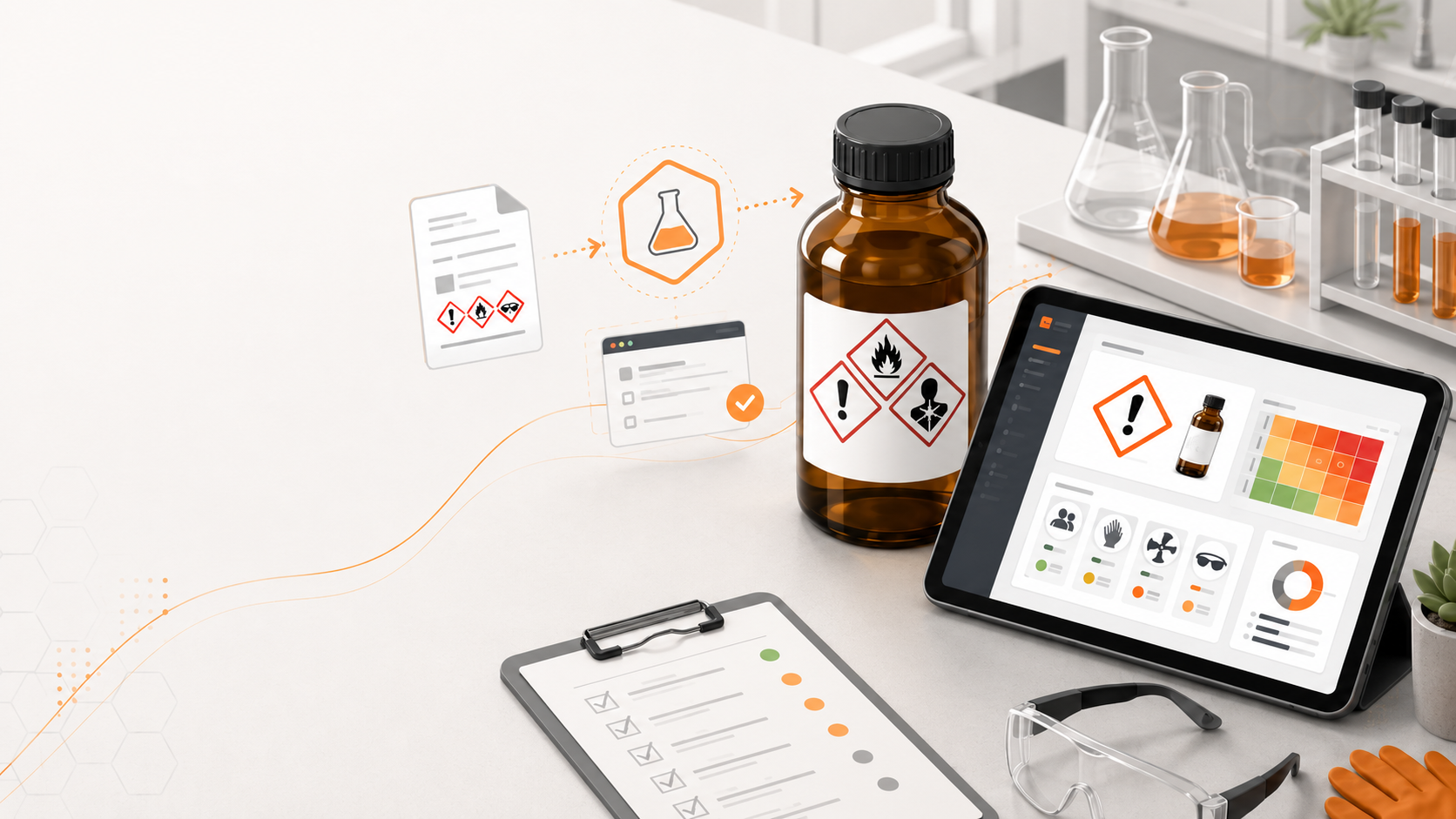
- A hazard statement (H-statement) is a standardised phrase from the GHS classification system, shown as a code such as H315, that describes the nature of a chemical's hazard.
- The first digit of an H-code signals the hazard type: codes in the 200s are physical hazards, the 300s are health hazards, and the 400s are environmental hazards.
- H-statements describe intrinsic hazard rather than workplace risk, so they are an input to a COSHH assessment and not a substitute for one.
- On a safety data sheet, H-statements appear in Section 2 (hazard identification), with their full text also listed in Section 16.
- Under UK COSHH, the health-hazard H-statements (the 300s) are what flag a substance as hazardous to health, whereas flammability and environmental hazards are handled mainly under separate regulations such as DSEAR.
A hazard statement, usually called an H-statement, is a standardised phrase that describes the nature and degree of a chemical's hazard. Each one is identified by the letter H followed by three digits, so H315 always reads "Causes skin irritation" whoever supplies the product. H-statements come from the GHS classification system, they appear on labels and safety data sheets, and for UK workplaces they are the starting point for a COSHH assessment rather than the assessment itself.
What is an H-statement?
An H-statement is one of the hazard statements defined under the Globally Harmonised System of Classification and Labelling of Chemicals, known as the GHS. The system fixes both the code and the exact wording, which means a supplier cannot reword, shorten or soften the phrase. That consistency is the point, because the same hazard is then described the same way across suppliers, sectors and countries.
In Great Britain, the GHS is implemented through GB CLP, the Classification, Labelling and Packaging Regulation. In Northern Ireland, EU CLP continues to apply under the Windsor Framework, so product labels there follow the EU version of the rules. In both cases the H-codes and their meanings are the same, so H314 means "Causes severe skin burns and eye damage" on either side.
An H-statement rarely travels alone. On a compliant label it sits alongside a signal word (either "Danger" for the more severe hazards or "Warning" for the less severe), one or more hazard pictograms (the red diamond symbols), and precautionary statements that advise on safe handling.
How do you read an H-statement code?
The three digits of an H-code are not random. The first digit tells you which broad family of hazard the statement belongs to, which lets you triage a substance at a glance before reading the detail.
| Code range | Hazard group | Example statement |
|---|---|---|
| H200 to H299 | Physical hazards | H225: Highly flammable liquid and vapour |
| H300 to H399 | Health hazards | H315: Causes skin irritation |
| H400 to H499 | Environmental hazards | H400: Very toxic to aquatic life |
Within each group, the remaining digits identify the specific hazard and, broadly, its severity. Among the health hazards, for instance, H319 is "Causes serious eye irritation" while H318 is the more serious "Causes serious eye damage".
You may also see codes that start with EUH. These are supplemental hazard statements specific to GB and EU CLP rather than the core international GHS set. Examples include EUH014 ("Reacts violently with water") and EUH208, which flags the presence of a sensitising substance in a mixture.
Where do H-statements appear on a safety data sheet?
On a 16-section safety data sheet (SDS), the primary place to find H-statements is Section 2, Hazard identification, where the product's classification and full label wording are set out. Section 16, Other information, then lists the full text of any H-codes that are referenced elsewhere by code alone, such as the classifications of individual ingredients named in Section 3.
Two related sections matter for the COSHH work that follows. Section 8, Exposure controls and personal protection, is where you look for any workplace exposure limit, which in Great Britain is published by the HSE in EH40. Section 7 covers safe handling and storage. The H-statements tell you what the hazard is, and these sections begin to tell you what to do about it.
What is the difference between an H-statement and a COSHH assessment?
An H-statement describes intrinsic hazard, a property of the substance that does not change with how you use it. A COSHH assessment describes risk, the likelihood and severity of harm given how much you use, the task, the exposure route and the controls already in place. This is the single most useful distinction to hold on to, because it explains why copying H-codes into a form is not a risk assessment.
The same H-statement can imply very different risk depending on context. A litre of a substance carrying H336 ("May cause drowsiness or dizziness") used briefly in a large, well-ventilated workshop presents a different risk from the same substance decanted daily in a small unventilated room. COSHH, the Control of Substances Hazardous to Health Regulations 2002, requires you to assess that real-world exposure and then prevent or adequately control it.
Which H-statements matter most for COSHH?
COSHH is concerned with substances that are hazardous to health, so the health hazards in the H300 to H399 range do most of the work in flagging what falls within scope. Physical hazards such as flammability and explosivity are covered mainly under DSEAR, the Dangerous Substances and Explosive Atmospheres Regulations 2002, and environmental hazards fall under separate environmental rules. A single product can, of course, carry hazards from more than one group.
A few health statements warrant particular attention:
- Carcinogens, mutagens and reproductive toxicants (CMR), flagged by codes such as H350, H340 and H360, attract stricter control duties to reduce exposure so far as is reasonably practicable.
- Sensitisers, such as H317 ("May cause an allergic skin reaction") and H334 (respiratory sensitisation), matter because harm can build after repeated low-level contact.
- Acute toxicity statements such as H330 ("Fatal if inhaled") point to hazards that can cause harm from a single, short exposure.
How do you turn H-statements into a COSHH assessment?
Reading the H-statements is only step one. A workable sequence looks like this:
- Collect the current SDS for every hazardous product and read the H-statements in Section 2.
- Confirm which are hazardous to health and therefore in scope for COSHH, separating out the physical and environmental hazards that belong to other regimes.
- Describe the actual use: quantity, frequency, task, who is exposed and by which route (inhalation, skin, ingestion).
- Check exposure limits in Section 8 and against EH40 where a workplace exposure limit exists.
- Decide and record controls, following the hierarchy of eliminating or substituting the hazard before relying on engineering controls, then safe systems of work, with personal protective equipment last.
- Review the assessment when the substance, the process or the quantity changes.
This is the step where the SDS stops being a document to file and becomes structured data. Purpose-built tools can read the H-statements straight from an SDS and map them into a draft COSHH assessment, which removes most of the manual transcription while leaving the workplace-specific judgements with you. Safe Foundry is one such option, and you can compare the inputs and outputs it supports or read more on classification basics in the help centre.
Read this way, an H-statement is less a piece of jargon and more a pointer. It names the hazard precisely so that the rest of your COSHH work can focus on the exposure you actually create.
Learn how to assess process-generated dust and fumes without an SDS by defining the process, exposure routes, evidence and practical controls.
How to Check an SDS Matches the Chemical You UseCheck that an SDS matches your chemical by comparing product identifiers, supplier, concentration, form, label classification and intended use.
Chemical Stocktake Checklist: What to Record and CheckUse this chemical stocktake checklist to reconcile containers with your register, verify SDS links, find storage issues and assign follow-up actions.