
Flammable Liquid Storage: Your DSEAR Duties Explained
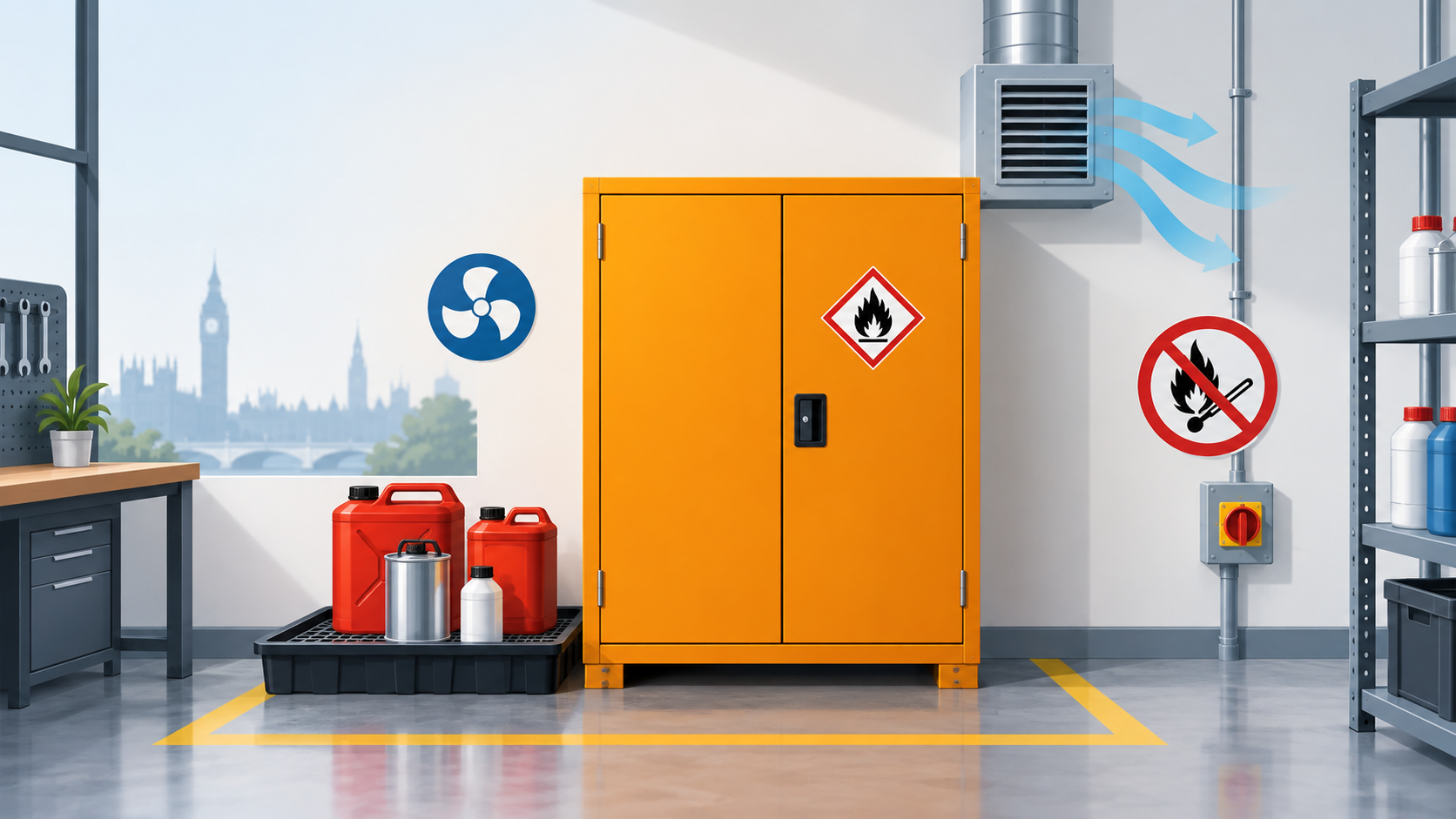
- DSEAR requires employers to assess and control fire and explosion risks where dangerous substances, including many flammable liquids, are present at work.
- The safest storage arrangement depends on the liquid's hazards, quantity, container, location and the foreseeable sources of ignition or release.
- Day-to-day working quantities should normally be kept as low as reasonably practicable, with reserve stock held in a suitable dedicated store.
- A storage cabinet can support risk control, but it does not replace a DSEAR assessment, suitable ventilation, spill planning, training or emergency arrangements.
Flammable liquids must be stored so that releases, vapour accumulation and ignition are prevented or controlled. Under the Dangerous Substances and Explosive Atmospheres Regulations 2002 (DSEAR), a UK employer should assess the specific fire and explosion risks, reduce the quantity present where reasonably practicable, control ignition sources and prepare for foreseeable incidents.
This article provides general guidance rather than legal advice. Storage controls should be selected for the actual substance, container, quantity, task and workplace.
What counts as a flammable liquid under DSEAR?
DSEAR covers dangerous substances that can put people at risk because they can cause fire, explosion or similar energetic events. That includes many liquids classified as flammable, as well as liquids that can generate a flammable atmosphere during storage, transfer or use.
The product label and safety data sheet (SDS) are the starting points. Section 2 identifies the supplied product's classification and label elements, while Sections 7, 9 and 10 commonly provide handling and storage advice, physical properties and stability or reactivity information.
An SDS describes the substance or mixture, but it does not assess how your organisation stores or uses it. HSE explains that an SDS is not a risk assessment, because it cannot account for the quantity, workplace, task, people or controls at a particular site.
What does DSEAR require employers to do?
The HSE overview of DSEAR explains that employers must assess risks from dangerous substances and eliminate or reduce them so far as is reasonably practicable. Where elimination is not reasonably practicable, controls should reduce the likelihood and consequences of a fire or explosion.
For flammable-liquid storage, a suitable assessment should consider:
- The identity, classification and physical properties of each liquid.
- The maximum and typical quantities kept in each location.
- Container sizes, materials, closures and resistance to damage.
- How a leak, spill or container failure could occur.
- Where vapours could travel or collect, including low points and enclosed spaces.
- Ventilation and whether it remains effective in normal and abnormal conditions.
- Ignition sources, including electrical equipment, hot work, static electricity and smoking.
- Incompatible substances, particularly oxidisers and materials that may react dangerously.
- Fire detection, warning, containment, evacuation and emergency response.
- Employees, contractors and others who could be affected.
Employers with five or more employees must record the significant findings of the DSEAR risk assessment. Records should reflect the real arrangement and be reviewed when there is reason to suspect they are no longer valid or when a significant change occurs.
How much flammable liquid should be kept in the work area?
DSEAR does not provide one universal quantity that is safe in every workplace. The guiding approach is to eliminate the dangerous substance where reasonably practicable or reduce the quantity to the minimum needed for the work.
A practical arrangement is to keep only the working quantity needed for the shift or activity at the point of use, then hold reserve stock in a suitable dedicated store. The defensible quantity depends on the liquid's properties, packaging, fire resistance of the enclosure, room layout, occupancy, ventilation and emergency arrangements.
Avoid treating a cabinet capacity or supplier claim as an automatic allowance. A larger cabinet can increase the fuel load and potential consequences of a single incident, so quantity is a risk-assessment decision rather than simply a question of available shelf space.
What makes a storage cabinet suitable?
A flammable-liquid cabinet should be purpose-designed, robust, clearly identified and used within its intended specification. It should help protect containers from workplace activity and provide a degree of fire resistance, but the cabinet is only part of the control system.
Check whether the proposed cabinet and location provide:
- Construction and fire performance appropriate to the assessed risk.
- Shelves and supports suitable for the container weights and materials.
- Spill retention that is compatible with the liquids stored.
- Doors and closures that operate correctly and are not obstructed.
- Security against unauthorised access where necessary.
- Separation from escape routes, heat and likely ignition sources.
- A location where leaks can be noticed and managed safely.
Do not use the cabinet as general storage. Paper, packaging, personal protective equipment and unrelated tools can add fuel, obstruct inspection or become contaminated.
Should a flammable-liquid cabinet be ventilated?
Ventilation is not a one-size-fits-all requirement. Poorly designed cabinet ventilation can spread vapour into an occupied area, compromise fire performance or create new ignition risks, while an unventilated enclosure may allow vapour to accumulate after a leak.
The decision should follow the DSEAR assessment and the cabinet manufacturer's instructions. Where mechanical extraction is used, it should discharge to a safe place, use suitable equipment and be maintained so that its performance remains dependable.
The wider room also matters. Vapour released during decanting, dispensing or cleaning may never reach the cabinet, so local or general ventilation at the task can be more important than the cabinet arrangement alone.
How should incompatible substances be separated?
Flammable liquids should be kept away from substances that can increase the likelihood or severity of fire, especially oxidisers. Acids, alkalis, water-reactive substances and other reactive chemicals may also require separate storage depending on their compatibility.
Use the SDS for each product, supplier information and the site's chemical compatibility assessment. A simple alphabetical shelf arrangement is unsafe because neighbouring product names reveal nothing about chemical reactivity.
HSE's HSG71 chemical warehousing guidance distinguishes controls such as keeping materials apart, segregating them and isolating them. The appropriate level depends on the hazards and consequences of interaction. A robust chemical register helps connect every stored product to its current SDS and assessed storage group.
How should spills and container failures be controlled?
Storage should anticipate the failure of the largest credible container, not only routine drips. Secondary containment can prevent a release spreading to drains, traffic routes, ignition sources or incompatible stock.
Spill trays, sumps and absorbents must be compatible with the liquid. Response equipment should be accessible without requiring a person to enter a dangerous vapour cloud, and contaminated absorbents should be handled as hazardous waste where applicable.
A practical inspection should look for:
- Corrosion, swelling, cracking, staining or damaged closures.
- Leaking or unlabelled containers.
- Overfilled shelves or containers stored on the cabinet floor.
- Materials placed in the spill sump, reducing its useful capacity.
- Expired or superseded stock that unnecessarily increases inventory.
- Evidence that staff are decanting or returning product incorrectly.
What ignition sources should be controlled?
A flammable atmosphere becomes an immediate fire or explosion risk when it meets an effective ignition source. Controls therefore need to cover both obvious flames and less visible sources.
Potential ignition sources include hot surfaces, electrical sparks, battery charging, static discharge, mechanical friction, hot work and smoking materials. Ordinary electrical equipment may be unsuitable where a hazardous area has been identified.
Where an explosive atmosphere may occur, the assessment may need to classify hazardous zones and select equipment accordingly. Zoning is a technical output of the assessment, not a label to apply to every chemical store by default.
What procedures and emergency arrangements are needed?
People should know how to receive, move, open, decant and return flammable liquids without defeating the controls. Training should match the work and cover label recognition, storage limits, spill response, alarm arrangements and actions prohibited in the area.
Emergency arrangements should address credible releases and fires. They may include raising the alarm, evacuation, contacting emergency services, isolating processes where safe and providing responders with information about the substances present.
Firefighting equipment does not make untrained employees responsible for fighting a fire. The priority is a clear, rehearsed response that does not expose people to escalating conditions.
How should flammable-liquid storage be reviewed?
Review storage when the substances, quantities, packaging, layout, ventilation, tasks or workforce change. Also review after a spill, fire, near miss, failed inspection or new supplier information.
A useful review links the physical store to the chemical register, current SDS versions and relevant assessments. Safe Foundry's workflow for turning SDS information into structured assessments can support that document trail, while the employer remains responsible for checking site-specific conditions and controls.
For implementation questions, see the chemical-safety help centre and the Safe Foundry feature overview.
What should a flammable-liquid storage check include?
Use this short check as a prompt, not as a substitute for a competent assessment:
| Check | Evidence to look for |
|---|---|
| Inventory | Current products, quantities, locations and SDS versions |
| Quantity control | Working stock limited and reserve stock appropriately stored |
| Containers | Compatible, closed, labelled and undamaged |
| Separation | Oxidisers and other incompatible substances kept apart |
| Spill control | Compatible retention and response equipment available |
| Ventilation | Suitable for normal work and foreseeable releases |
| Ignition control | Sources identified, removed or appropriately controlled |
| Procedures | Staff trained for storage, transfer, spills and alarms |
| Emergency planning | Alarm, evacuation and responder information established |
| Review | Inspections recorded and assessment updated after change |
The strongest storage system is one that remains accurate as stock and work change. A tidy cabinet is useful evidence, but a current inventory, specific DSEAR assessment and working controls are what make the arrangement defensible.
Frequently asked questions
Do all flammable liquids need to be kept in a cabinet?
Not automatically. The suitable control depends on the substance, quantity, container, workplace and risk assessment, although purpose-designed cabinets are commonly used for limited working quantities.
Can I store flammable liquids with oxidisers?
Flammable liquids and oxidising substances should be kept apart because oxidisers can intensify a fire. Use the safety data sheets and a documented compatibility assessment to decide the storage arrangement.
Does a fire-resistant cabinet make a room DSEAR compliant?
No. A cabinet is one possible control measure; DSEAR also requires consideration of releases, ignition sources, ventilation, hazardous areas, procedures, training and emergency arrangements.
Should empty flammable-liquid containers be treated as hazardous?
Yes, where residues or vapours remain. Empty containers can still create a fire or explosion risk and should be closed, labelled and managed under the site's procedures.
Learn how to assess process-generated dust and fumes without an SDS by defining the process, exposure routes, evidence and practical controls.
How to Check an SDS Matches the Chemical You UseCheck that an SDS matches your chemical by comparing product identifiers, supplier, concentration, form, label classification and intended use.
Chemical Storage Inspection Checklist for UK WorkplacesUse this chemical storage inspection checklist to find container, label, segregation, quantity, spill-control and housekeeping problems early.