
DSEAR vs COSHH: Which Assessment Do You Need?
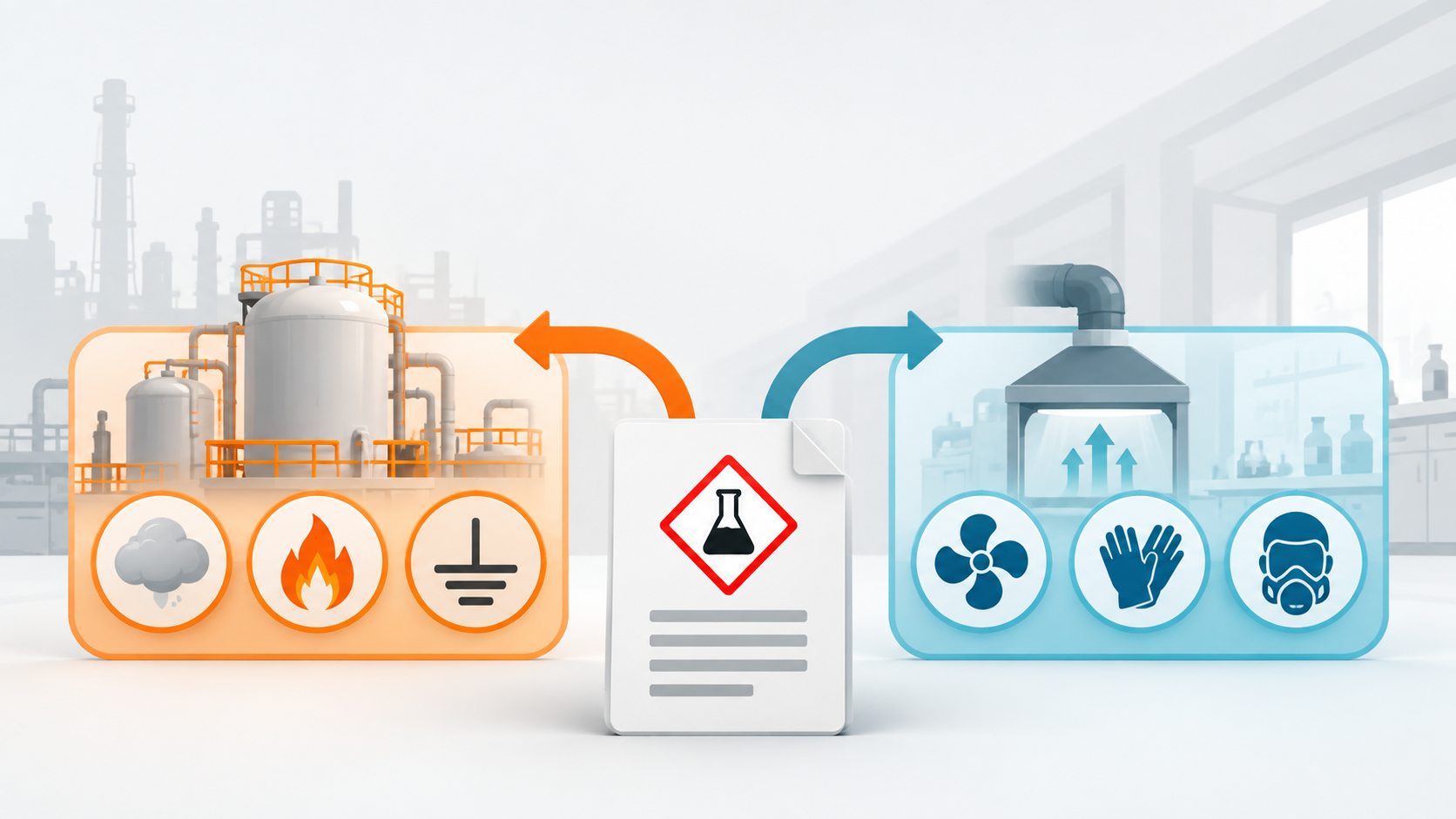
- DSEAR addresses fire, explosion, pressure and related safety risks, while COSHH addresses harm to health from workplace exposure.
- The same product can require both assessments because physical hazards and health hazards are separate questions.
- An SDS supplies evidence for DSEAR and COSHH, but neither assessment can be completed without task-specific workplace information.
- A combined document may be practical only if it clearly covers every duty and keeps the two control decisions distinct.
DSEAR and COSHH address different consequences of working with substances. DSEAR controls safety risks such as fire and explosion, while COSHH controls risks of ill health caused by exposure. Many substances require both assessments, and completing one does not automatically satisfy the other.
What is the difference between DSEAR and COSHH?
The main difference is the type of harm being controlled. The Dangerous Substances and Explosive Atmospheres Regulations 2002 focus on fires, explosions and comparable energetic events. The Control of Substances Hazardous to Health Regulations 2002 focus on diseases, irritation, sensitisation, poisoning and other harm to health.
| Question | DSEAR | COSHH |
|---|---|---|
| Main outcome | Fire, explosion, pressure or energetic reaction | Acute or long-term ill health |
| Typical evidence | Flashpoint, explosive limits, dust behaviour, reactivity and ignition | Toxicity, exposure routes, WELs, frequency and duration |
| Workplace factors | Release, ventilation, temperature, zoning and ignition sources | Task, exposure, people at risk and control effectiveness |
| Typical controls | Containment, ventilation, ignition control, segregation and mitigation | Elimination, substitution, enclosure, LEV, safe systems and PPE |
| Can the SDS replace it? | No | No |
HSE's DSEAR guidance says employers must assess and eliminate or reduce risks from dangerous substances. HSE's COSHH guidance requires employers to assess and adequately control exposure to substances hazardous to health.
When does a substance need both assessments?
A substance needs both assessments when the work creates a DSEAR safety risk and a COSHH health risk. This is common with solvents, fuels, aerosols, gases, reactive chemicals and combustible dusts.
Consider solvent cleaning. Vapour inhalation and skin contact are COSHH issues. A flammable vapour cloud reaching an ignition source is a DSEAR issue. Local exhaust ventilation may help both, but each assessment must test whether it is sufficient for its own outcome.
Other examples include:
- Flour dust that can harm breathing and form an explosive atmosphere
- Isocyanate products that can cause asthma and may contain flammable solvents
- Acetylene, which presents pressure and fire risks alongside possible asphyxiation concerns
- Metal powders that may be harmful when inhaled and explosible when dispersed
- Cleaning aerosols that may irritate lungs and also contain flammable propellant
When might only COSHH apply?
COSHH may apply without a material DSEAR risk where the substance can harm health but does not create a relevant fire, explosion or similar safety hazard in the assessed use. Examples may include some non-flammable irritants, biological agents and process fumes.
The decision must follow the actual activity. A supplier classification is important, but COSHH also covers substances created by work, including dust and fume, and substances that become hazardous because of how they are used.
Lead and asbestos are controlled under separate regulations rather than COSHH. Their absence from COSHH does not mean they are uncontrolled.
When might only DSEAR apply?
DSEAR may apply without a significant COSHH assessment where the principal hazard is physical safety rather than harm to health. A gas under pressure or a substance corrosive to metals may create DSEAR duties even where normal exposure does not create a COSHH health hazard.
DSEAR also covers combustible dust capable of exploding as a cloud in air. The dust may need a COSHH assessment too, but the explosion assessment remains distinct.
What information should each assessment use?
Both assessments begin with substance information and then add workplace evidence. The Safety Data Sheet can provide classifications, handling advice, physical properties, reactivity and exposure controls.
For DSEAR, consider:
- Quantity and physical state
- Release sources and persistence
- Flashpoint and process temperature
- Gas, vapour, mist or dust formation
- Ventilation and connected spaces
- Ignition sources, including static electricity
- Interactions and incompatible storage
- Consequences and mitigation
For COSHH, consider:
- Health hazards and routes of exposure
- Task, frequency and duration
- People exposed, including contractors
- Workplace Exposure Limits where they exist
- Existing engineering controls
- Skin and respiratory protection
- Monitoring and health-surveillance needs
- Cleaning, maintenance and emergencies
A current SDS is therefore necessary for many products but not sufficient. HSE confirms that an SDS is not a COSHH assessment.
Can DSEAR and COSHH share controls?
DSEAR and COSHH controls can overlap, but their effectiveness must be tested against both risks. Closed transfer can reduce vapour exposure and prevent a flammable release. Substitution may remove both toxicity and flammability.
Some controls solve only one problem. Gloves may reduce skin exposure but do not prevent a vapour explosion. Explosion-rated electrical equipment may control ignition but does not reduce inhalation exposure.
| Control | DSEAR contribution | COSHH contribution |
|---|---|---|
| Enclosed transfer | Limits dangerous release | Limits exposure |
| Local exhaust ventilation | May prevent dangerous atmosphere | Captures airborne contaminant |
| Minimum stock | Reduces event severity | May reduce exposure opportunity |
| Ignition control | Direct DSEAR control | Usually little direct health benefit |
| Respiratory protection | Does not prevent explosion | Protects wearer from residual inhalation risk |
| Segregation | Prevents dangerous reaction | May prevent harmful release |
Can one document cover both assessments?
One document can cover DSEAR and COSHH if it remains suitable and sufficient for both legal duties. The document should identify the separate hazard pathways, controls, evidence and review triggers.
A combined assessment works best for a tightly defined task. A generic product sheet labelled “COSHH/DSEAR” may conceal different quantities, locations and ignition conditions.
For traceability, record:
- The exact activity and products.
- Health and physical hazards separately.
- Exposure and release scenarios.
- Controls mapped to each scenario.
- Residual risk and required actions.
- Maintenance, training and emergency arrangements.
- Review triggers and ownership.
The Safe Foundry assessment workflow uses SDS information as a starting point while keeping workplace review central. See the broader chemical-safety features and help centre for product guidance.
Which assessment should be completed first?
Start by screening the activity for both health and safety hazards rather than choosing one regulation first. This avoids designing a COSHH control that introduces a DSEAR problem, or vice versa.
For example, enclosing a flammable process without suitable extraction could reduce worker contact but allow vapour to accumulate. Conversely, high general ventilation may reduce flammable concentration while still failing to capture a toxic contaminant at the worker's breathing zone.
The final assessment process should produce a coordinated control strategy, not two documents that contradict each other.
When should the assessments be reviewed?
Review DSEAR and COSHH assessments when the evidence, process or workplace changes and whenever there is reason to think controls are no longer effective. Relevant triggers include a new formulation, revised SDS, increased quantity, new equipment, changed ventilation, incident, near miss or monitoring result.
Employers with five or more employees must record significant findings under both regimes where the relevant duties apply. Keeping the assessments linked to the product and task makes it easier to identify every record affected by a change.
Frequently asked questions
Do I need DSEAR if I already have a COSHH assessment?
You may do if the substance or process can create fire, explosion, pressure or related safety risks. A COSHH assessment does not automatically cover those DSEAR hazards.
Does DSEAR apply to substances that are not harmful to health?
Yes. DSEAR can apply because of physical safety properties even where COSHH health risks are limited or absent.
Can DSEAR and COSHH be on the same form?
They can be documented together if the result remains suitable, sufficient and clear about each set of hazards, controls and review triggers.
Is an SDS enough to decide between DSEAR and COSHH?
No. The SDS identifies relevant properties, but the decision also depends on quantity, process, temperature, release, exposure, ventilation and ignition sources.
Learn how to assess process-generated dust and fumes without an SDS by defining the process, exposure routes, evidence and practical controls.
How to Check an SDS Matches the Chemical You UseCheck that an SDS matches your chemical by comparing product identifiers, supplier, concentration, form, label classification and intended use.
Chemical Storage Inspection Checklist for UK WorkplacesUse this chemical storage inspection checklist to find container, label, segregation, quantity, spill-control and housekeeping problems early.