
Does DSEAR Apply to Small Quantities of Chemicals?
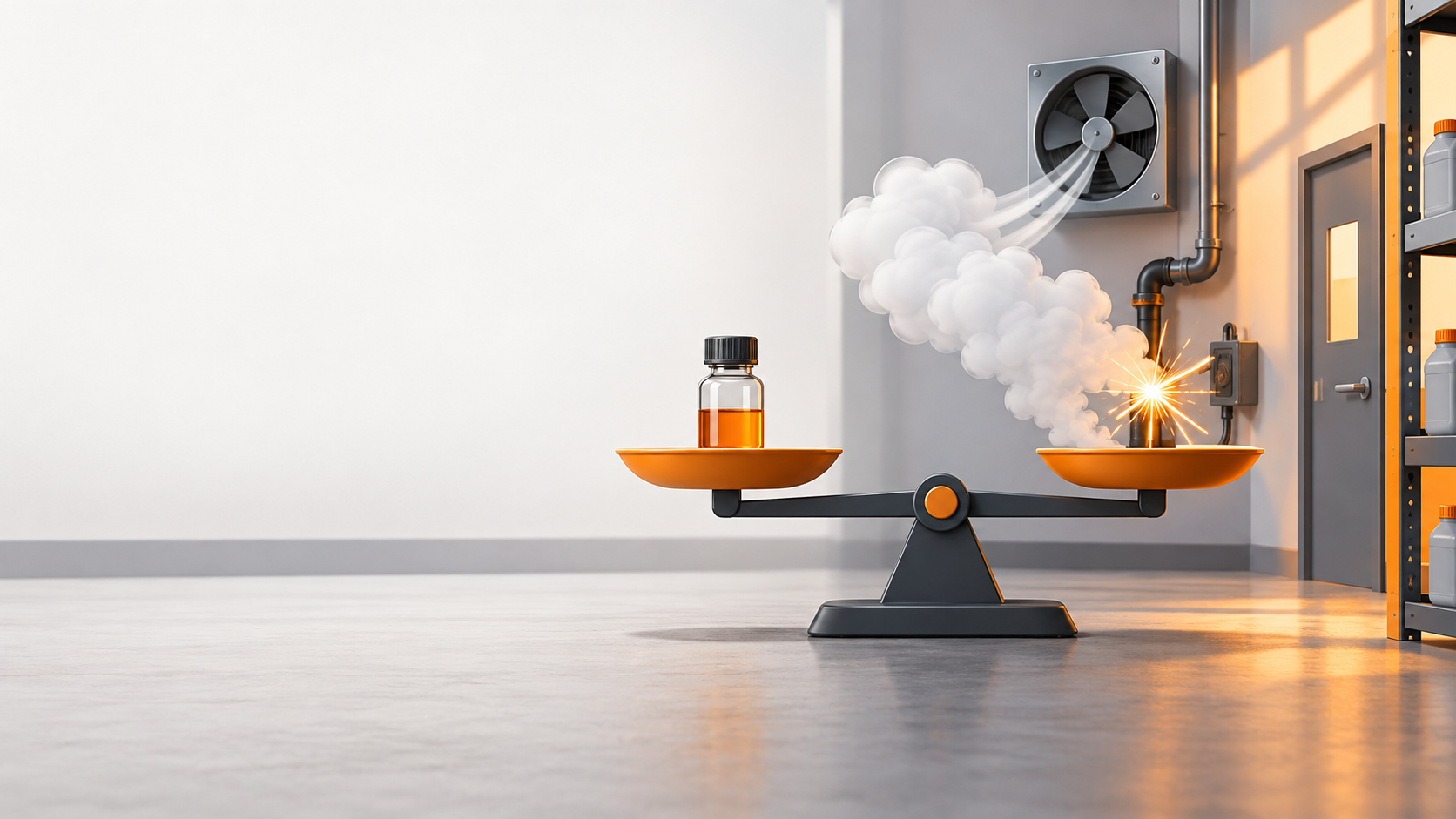
- DSEAR has no single universal small-quantity exemption that makes every dangerous substance scenario safe.
- Quantity matters alongside volatility, release method, room volume, ventilation, confinement, ignition and people exposed.
- A small amount may present trivial risk in one setting and a credible fire or explosion risk in another.
- The assessment should be proportionate and can record when no further detailed action is needed, with assumptions and review triggers.
DSEAR can apply to small quantities when a dangerous substance is present or liable to be present at work and could create a safety risk. There is no single universal volume below which every chemical and process is exempt. Assess substance, release, location, ignition sources and consequences together.
When does DSEAR apply?
DSEAR applies where work is carried out, a dangerous substance is present or may be present, and it could risk people's safety through fire, explosion, similar energetic events or metal corrosion. HSE includes liquids, gases, vapours and dusts and gives examples from laboratories, shops and workshops as well as industrial sites (HSE DSEAR in detail).
Company size and container size do not remove the need to consider the risk.
Why is there no universal small-quantity answer?
The same quantity can behave differently in different circumstances. Important factors include:
- flash point, volatility and physical form;
- whether the material is heated, sprayed or dispersed;
- normal and foreseeable release quantity;
- room size, pits, drains and confinement;
- natural and mechanical ventilation;
- ignition sources and hot surfaces;
- frequency and duration;
- number and location of people;
- incompatible substances and escalation potential.
Fifty millilitres used on an open bench beside an ignition source is not equivalent to the same quantity sealed in compatible packaging inside assessed storage.
Can a small quantity create an explosive atmosphere?
Yes, if enough vapour, gas, mist or dust mixes with air in a confined or poorly ventilated place. HSE's laboratory guidance notes that release quantity, continuing leaks and ventilation affect whether risk is negligible or serious (HSE laboratory DSEAR guidance).
Do not calculate only liquid volume. Consider how much vapour is generated, how quickly, where it travels and whether it accumulates.
What does a proportionate assessment look like?
A proportionate assessment records enough evidence to justify the conclusion. For a small quantity, capture:
| Question | Evidence |
|---|---|
| What is dangerous? | Exact substance, form and relevant properties |
| How much is present? | Normal and maximum quantity, including waste |
| How can it escape? | Pouring, spraying, leak, breakage or heating |
| Where can it collect? | Room, cupboard, pit, drain or enclosure |
| What can ignite it? | Electrical, flame, hot surface, static or friction |
| Who could be harmed? | Operator, nearby workers and responders |
| What controls exist? | Quantity limit, containment, ventilation and ignition control |
If evidence shows no safety risk or only trivial risk, HSE says no further action is needed. Record the basis, assumptions and triggers for review rather than relying on “small amount”.
Do common storage limits decide whether DSEAR applies?
Guidance values can inform controls but do not replace the risk assessment. HSE guidance for flammable liquids in workrooms emphasises reducing quantities to a minimum and justifying what is present for the work (HSE flammable-liquid storage).
A cabinet capacity, transport small-load threshold or supplier package size is not a universal workplace exemption. Different rules answer different questions.
What controls make small-quantity work safer?
Prevent release and ignition before relying on response. Use the minimum quantity, keep containers closed, choose stable dispensing, provide suitable ventilation, control static and other ignition sources, separate incompatibles and manage waste promptly.
The DSEAR workflow should link quantity assumptions to the actual task and location. If the maximum quantity increases or the process changes from wiping to spraying, trigger review.
When might specialist help be needed?
Seek specialist input when a small quantity is highly energetic, unstable, strongly volatile, dispersed as fine dust or used in a confined space. Hazardous-area classification, dust explosion, reactive chemistry or pressure risk may require competence beyond a general assessment.
The assessment features can organise evidence and review history but cannot turn an unsupported threshold into a safe conclusion.
How should the decision be recorded?
State the exact scenario and why controls make the risk trivial, tolerable with measures or in need of further work. Include maximum quantity, container, temperature, method, ventilation, ignition survey, people, controls and emergency arrangements.
Use the help centre for record guidance. The defensible answer is not “DSEAR does not apply because it is under one litre”; it is a short evidence-based assessment of the actual dangerous-substance scenario.
How can a small liquid quantity create a large vapour volume?
A modest spill can evaporate into far more vapour than its liquid volume suggests. The assessment should therefore consider volatility, temperature, evaporation rate and dilution by ventilation. Vapour density and room features may influence where a flammable mixture collects.
Do not assume that because the container is small, the affected space is small. A release inside a cabinet, machine, pit or poorly ventilated room may be more significant than the same release outdoors. Spraying and atomisation can also change behaviour compared with a calm pool.
Where a conclusion depends on dispersion, use competent methods and conservative evidence. Avoid copying a generic online calculator without checking its assumptions and units.
What small-quantity scenarios deserve extra caution?
Some circumstances can make a small inventory disproportionately important. Examples include:
- work inside tanks, cupboards or other confined spaces;
- flammable aerosols near hot equipment;
- fine combustible dust dispersed during cleaning;
- highly reactive or peroxide-forming substances;
- oxygen-enriched or oxygen-releasing materials;
- gases under pressure;
- mixtures heated above their flash point;
- ignition-sensitive work near static-generating transfer;
- substances corrosive to a critical metal component.
These examples are prompts, not automatic conclusions. The assessor should define the credible event and controls for the actual substance.
How should purchasing and local storage limits be used?
Set internal limits from the assessment and connect them to ordering and replenishment. A maximum at the bench, in the room and across the site can prevent gradual accumulation. Make clear whether limits refer to container capacity, actual contents or aggregate quantity.
Review automatic ordering, sample cupboards, maintenance stock and waste because these can bypass the intended maximum. A limit without a counting method and owner is difficult to enforce.
When does a simple assessment become a detailed one?
Escalate when the answer depends on uncertain release or ignition analysis. Warning signs include reliance on ventilation calculations, possible explosive dust cloud, several interacting substances, consequences extending beyond the room or the need to designate hazardous zones.
Record why specialist help is sought and what interim restrictions apply. Proportionality means matching effort to risk; it does not mean minimising the evidence because the original container looked small.
How should emergency arrangements reflect small quantities?
Emergency planning should match the credible event rather than disappear because the container is small. Decide whether workers should isolate, extinguish, contain or evacuate, and make that decision consistent with the substance, location and training.
Check alarms, escape, spill control, first response and information for emergency services. A small fire in a fume cupboard, vehicle or crowded room can still block escape or involve other materials. Keep response equipment accessible from a safe position.
What changes should trigger a fresh decision?
Review when quantity, package, task or surroundings change. A move from a bottle to an aerosol, from wiping to spraying, from open workshop to enclosed plant, or from manual use to heated equipment can invalidate a simple conclusion.
Connect review triggers to purchasing and engineering change. Small increases across several workstations can also create a larger aggregate storage or emergency scenario than any one user sees.
Record who checks these triggers and how temporary increases, samples and contractor materials enter the total. Reconcile the stated maximum with physical stock during inspections.
Frequently asked questions
Is there a one-litre DSEAR exemption?
No universal one-litre exemption covers every substance and activity. Quantity must be considered with release, ventilation, ignition and consequence.
Does a flammables cabinet remove the need for DSEAR?
No. A cabinet can be one storage control; the assessment must also cover use, transfer, waste, ignition and credible incidents.
Does DSEAR apply to one aerosol can?
Consider it proportionately. Product classification, storage, use, damage, heat and people determine whether any further measures are needed.
Can I record that DSEAR risk is trivial?
Yes, where evidence supports that conclusion. Record the assessed scenario, assumptions and changes that would require review.
Learn how to assess process-generated dust and fumes without an SDS by defining the process, exposure routes, evidence and practical controls.
How to Check an SDS Matches the Chemical You UseCheck that an SDS matches your chemical by comparing product identifiers, supplier, concentration, form, label classification and intended use.
Chemical Storage Inspection Checklist for UK WorkplacesUse this chemical storage inspection checklist to find container, label, segregation, quantity, spill-control and housekeeping problems early.