
DSEAR Risk Assessment: A Step-by-Step UK Guide
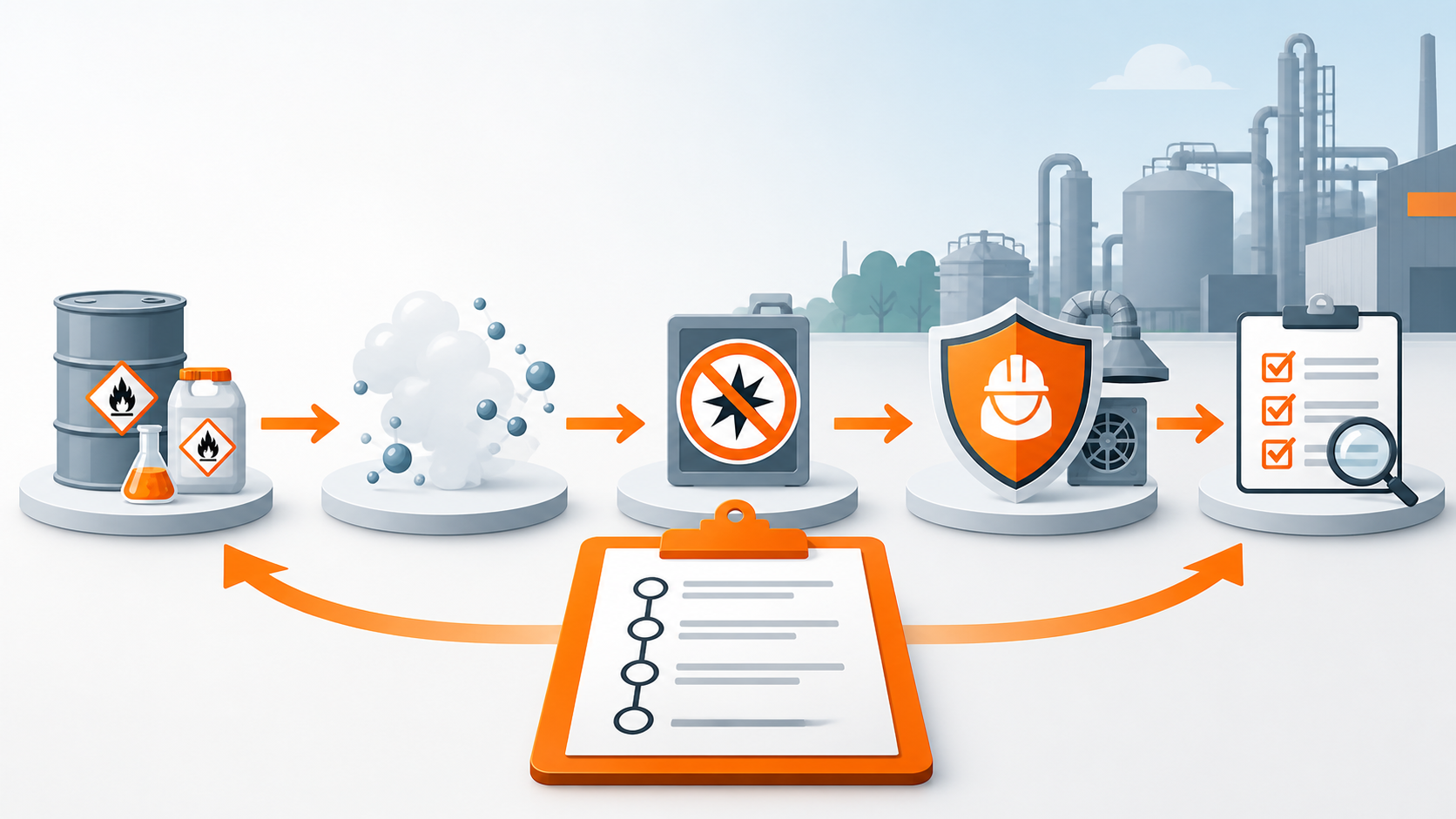
- A DSEAR assessment must examine the dangerous substance, the work activity and the ways a fire, explosion or similar event could harm people.
- Employers should eliminate the risk where reasonably practicable and otherwise control releases, dangerous atmospheres and ignition sources in a clear priority order.
- Hazardous-area zoning is required only where an explosive atmosphere may occur and must be based on release and ventilation evidence.
- Employers with five or more employees must record significant findings and review the assessment after relevant change or evidence of failure.
A DSEAR risk assessment identifies how dangerous substances could cause fire, explosion or a similar safety event at work, then selects controls and mitigation. The assessment must reflect the actual substances, quantities, releases, ventilation, ignition sources and people at risk. A copied product checklist is not enough.
What is a DSEAR risk assessment?
A DSEAR risk assessment is the suitable and sufficient assessment required when a dangerous substance is or may be present at work. It helps an employer decide how to eliminate or reduce safety risks so far as is reasonably practicable.
HSE's DSEAR guidance covers flammable liquids, gases and vapours, combustible dusts, unstable or reactive substances, gases under pressure and substances corrosive to metals.
The assessment should address normal work and foreseeable abnormal conditions, including delivery, transfer, cleaning, maintenance, breakdown, spill and waste handling.
Step 1: Which dangerous substances are present?
Begin with an inventory of substances that are present, used, produced or reasonably foreseeable. Include raw materials, products, intermediates, waste, residues and substances generated by the process.
Gather:
- Current Safety Data Sheets
- Product labels and supplier information
- Maximum and typical quantities
- Physical form and concentration
- Storage and use locations
- Process temperatures and pressures
- Dust or vapour generation
- Known incompatibilities
Do not rely only on flammable pictograms. A dust may be explosible without being supplied as a classified chemical, and a liquid may become dangerous when heated above its flashpoint.
Step 2: How is each substance used or stored?
Map the full activity because risk depends on the circumstances of the work. Describe how containers are opened, substances are transferred, waste is collected and equipment is cleaned.
Record who performs the work, who else could be affected, the duration and frequency, and whether contractors or visitors enter the area. Include connected rooms, drains and ducts through which vapour or dust could travel.
A useful process map shows:
- Delivery and receipt
- Storage
- Internal movement
- Decanting or transfer
- Processing or application
- Cleaning and maintenance
- Waste and disposal
- Emergency response
Step 3: Where could a dangerous release occur?
Identify credible release sources and estimate their frequency, duration and extent. A release may come from an open container, vent, seal, hose connection, filling point, filter, spill or equipment failure.
Ask:
- Is the release continuous, expected occasionally or unlikely in normal operation?
- Could liquid form vapour at the operating temperature?
- Could powder become an airborne dust cloud?
- Is the material heavier or lighter than air?
- Could it collect in a pit, cabinet, ceiling space or drain?
- Does extraction discharge to a safe place?
- Could a small leak persist unnoticed?
These answers support decisions about containment, ventilation and hazardous-area classification.
Step 4: Which ignition sources could become effective?
List every credible ignition source and decide whether it can be removed or controlled. Common sources include flames, hot surfaces, electrical equipment, mechanical sparks, static discharge, smoking, vehicles and hot work.
Static electricity deserves specific attention during liquid transfer, powder handling and movement of insulating materials. Earthing and bonding must be designed for the process rather than added as a generic note.
Control of ignition is only one layer. Preventing or minimising release normally provides stronger protection than assuming ignition sources will never appear.
Step 5: What could the consequences be?
Assess who could be harmed and the scale of a credible fire, explosion, pressure event or dangerous reaction. Consider employees, contractors, visitors, neighbours and emergency responders.
Consequences may include:
- Flash fire or pool fire
- Vapour-cloud or dust explosion
- Vessel rupture or projectile hazard
- Structural damage and fire spread
- Toxic products of combustion
- Escalation to adjacent incompatible stock
- Loss of escape routes
The assessment should remain proportionate, but low likelihood does not justify ignoring severe consequences where controls are reasonably practicable.
Step 6: Can the risk be eliminated?
DSEAR requires elimination where reasonably practicable before reliance on control measures. Consider removing the substance, changing the process or using a safer form.
Options include:
- Replace a flammable solvent with a non-flammable or less flammable alternative
- Use a lower process temperature
- Receive material in a form that avoids dust generation
- Eliminate open pouring through closed transfer
- Remove unnecessary stock from the workroom
Check that substitution does not introduce a greater COSHH, environmental or process hazard.
Step 7: How should the remaining risk be controlled?
Where elimination is not reasonably practicable, control the risk in DSEAR's priority order. HSE identifies measures including minimum quantities, prevention of releases, control at source, prevention of dangerous atmospheres, safe removal by ventilation, ignition control and separation of incompatibles.
| Control question | Evidence to record |
|---|---|
| Is stock minimised? | Working quantity and storage limit |
| Is the system contained? | Equipment specification and inspection |
| Is ventilation effective? | Design basis, commissioning and checks |
| Are ignition sources controlled? | Area rules, equipment suitability and permits |
| Are incompatibles separated? | Layout, bunding and storage matrix |
| Are releases detected? | Alarms, inspections or operator checks |
The chemical-safety workflow can help keep substance records and assessments connected, but engineering decisions may require specialist input.
Step 8: Is hazardous-area classification needed?
Classify places into zones where an explosive atmosphere may occur. Gas, vapour and mist use Zones 0, 1 and 2; combustible dust uses Zones 20, 21 and 22.
Zoning should be based on release grade, ventilation and persistence. It affects equipment selection and controls, but it is not a substitute for reducing the release.
Document areas where zoning is not needed as well as those where it is. This prevents later assumptions based only on the presence of a flammable product.
Step 9: What mitigation and emergency measures are needed?
Mitigation limits harm if prevention and control fail. Depending on the risk, consider fire resistance, explosion relief or suppression, separation distances, automatic shutdown, spill containment and limiting occupancy.
Emergency arrangements should define alarms, isolation, evacuation, first response and information for emergency services. Workers need proportionate instruction and training, and containers and pipes must be identifiable.
Step 10: How should findings be recorded and reviewed?
Employers with five or more employees must record significant findings. The record should describe the hazards, scenarios, existing controls, additional actions, owners, dates, zoning and equipment arrangements where relevant.
Review the assessment regularly and after:
- A new or reformulated substance
- Changed quantity, temperature or pressure
- New equipment or layout
- Ventilation modification
- Incident, near miss or alarm
- Evidence that controls are deteriorating
- Organisational or staffing change
The SDS-to-assessment process and help centre provide further Safe Foundry workflow guidance. A competent person should check complex ventilation, zoning and explosion-protection decisions before work proceeds.
Frequently asked questions
What should a DSEAR risk assessment include?
It should cover hazardous properties, supplier information, quantities, processes, interactions, storage, releases, ventilation, ignition sources, consequences, controls, mitigation and emergency arrangements.
How often should a DSEAR assessment be reviewed?
Review it regularly and whenever there is reason to think it is no longer valid or a significant change affects substances, equipment, processes, premises or organisation.
Can I use a DSEAR risk assessment template?
A template can structure the work, but it must be adapted to the actual substances, quantities, release conditions, ignition sources and people at risk.
Does every DSEAR assessment need hazardous-area zoning?
No. Zoning is relevant where an explosive atmosphere may occur. The assessment should document why zoning is or is not required.
Learn how to assess process-generated dust and fumes without an SDS by defining the process, exposure routes, evidence and practical controls.
How to Check an SDS Matches the Chemical You UseCheck that an SDS matches your chemical by comparing product identifiers, supplier, concentration, form, label classification and intended use.
Chemical Storage Inspection Checklist for UK WorkplacesUse this chemical storage inspection checklist to find container, label, segregation, quantity, spill-control and housekeeping problems early.