
Decanting Chemicals Safely: A COSHH Assessment Guide
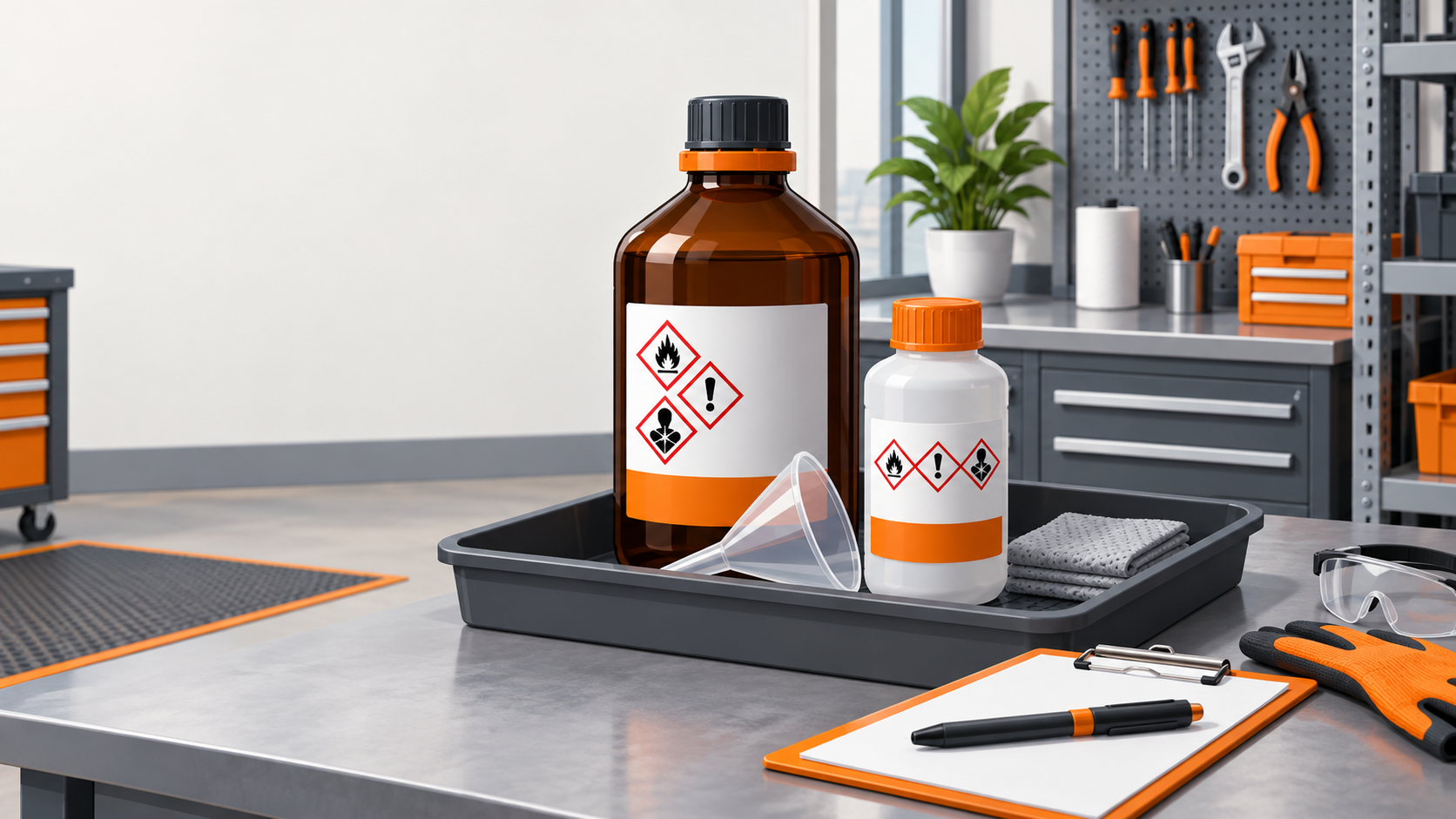
- Decanting changes exposure because a closed supplier container becomes an open transfer task with possible splashes, vapour or dust.
- A suitable assessment identifies the exact product, transfer method, quantity, people nearby and destination container.
- The receiving container must remain identifiable and suitable for its contents throughout use and storage.
- A spill tray and protective equipment support, but do not replace, a transfer method that minimises release at source.
Decanting chemicals safely starts with a task-specific COSHH assessment of opening, transferring, closing and using the receiving container. A supplier safety data sheet (SDS) describes the product, but it cannot tell you whether your operator pours above shoulder height, uses a pump or works beside a drain. Those details determine exposure and the controls needed.
Why does decanting change the risk?
A sealed container can be relatively stable in storage. Opening it and moving its contents creates a new opportunity for splashes, airborne release, spills and confusion about identity. A liquid can splash during pouring; a volatile product may release vapour; a powder may form dust. The Health and Safety Executive (HSE) asks employers to consider exposure routes, task frequency and duration, people nearby and existing controls in a COSHH risk assessment.
Describe each transfer as it actually occurs. “Decant chemical” hides important distinctions between filling a small trigger bottle from a dispenser, pouring a litre from a can, transferring a drum through a pump and tipping powder into a process vessel. The height of the pour, opening size, container stability, surface, ventilation and available space can all change how much material escapes. A change in method deserves a review even if the product name stays the same.
Include preparation and clean-up. Operators may touch contaminated caps, funnels or threads after the main pour. A receiving bottle can drip when a funnel is removed. A worker may carry it through a shared area before the cap is secure. Assess the full sequence from collecting the source container to returning both containers to their designated places.
What should the assessment record before a transfer?
Confirm the exact product and current SDS first. HSE explains that SDS information helps with assessment but is not itself the assessment. Check identity, physical form, relevant hazards, handling and storage guidance, first aid and spill advice. If the container or document does not match, stop and resolve the identity before transfer.
The task record should name the typical quantity per transfer, the maximum container size, frequency, location and people who may enter the area. It should also identify the receiving container, how it is secured against tipping and how the product remains identifiable. A photograph or inventory reference can support the record, but it cannot substitute for a legible container label at the point of use.
Ask the operator to demonstrate the method rather than relying only on a written procedure. Is the source too heavy to handle accurately? Does the funnel fit? Can the worker see the fill level? Is the cap within reach? Are gloves likely to be contaminated while closing the bottle? These observations uncover failure points that generic SDS language cannot describe.
How can the transfer release be reduced?
Start with a method that avoids opening or manual pouring where feasible. Closed transfer, a suitable pump or controlled dispenser may reduce splashes and vapour compared with free pouring. HSE's assessment guidance explicitly encourages containment, closed handling systems and minimising handling. Choose equipment for the actual product and task; a convenient pump is not useful if its materials are incompatible or its flow rate causes overfilling.
Where an open transfer remains necessary, use a stable work surface, a suitable receiving container and an appropriate spill tray. Keep the opening low and controlled, avoid lifting heavy containers above a small target and close both containers promptly. Ventilation may be needed for airborne exposure, but a general room fan is not proof of adequate control. Assess whether it captures or merely spreads released material.
Personal protective equipment addresses residual exposure. Specify the relevant eye, skin or respiratory protection from the assessment, taking the SDS and supplier instructions into account. Do not treat “gloves” as a complete specification: suitability depends on chemical, breakthrough, task time and the possibility of contamination during removal. HSE's control guidance stresses that equipment, procedures and behaviour work together.
How should the receiving container be managed?
The receiving container should suit the chemical and the way it will be used. A food or drink container is a poor choice because it invites mistaken use even if somebody writes a name on it. Use a container designed for the product and securely close it when not in use. Do not assume that material compatibility can be inferred from shape or colour; check supplier information where uncertain.
Keep the identity clear for the person who uses the chemical later. A local label should not create a false impression that the bottle is the original supplier packaging, but it should prevent an unknown substance appearing on the shelf. Depending on the product and local process, the workplace may need the product name, concentration or dilution, key hazards and a link to the controlled SDS or task instruction. Supplier labelling obligations are separate and should be checked for the specific supply situation.
Avoid accumulating unnamed partial bottles. Record where the decanted product is stored, who owns it and when it needs replacing. If a product is reformulated, the receiving container and associated instruction should be reviewed along with the SDS. Safe Foundry's chemical register features illustrate how document, product and location records can be linked, while the physical label remains essential at the container.
What should happen if the transfer goes wrong?
Plan for an overfill, dropped container or leak at the transfer station. The spill response must match the product and the quantity that could realistically escape. Identify who stops the work, how people are kept clear, which spill materials are suitable and when a trained responder or emergency service is needed. A generic “clean up spill” instruction can expose an untrained worker to a larger hazard.
Keep first-aid and emergency information accessible where the work occurs, not buried in an office folder. Make sure a worker knows how to report a splash, symptoms or a near miss. Following an incident, review the method and equipment before restarting the same transfer. The need for better controls is often visible in the near miss, not only in the injury record.
For a new decanting process, use the COSHH workflow overview as a checklist for tying hazard information to the actual activity. The final test is practical: can an operator identify the right product, make the transfer with the chosen equipment, label the receiving container and respond safely if the plan fails?
What should be checked at the transfer station?
Before the first transfer of a shift, confirm that the source and receiving containers match the instruction, the receiving vessel has capacity and the pump or funnel is clean and suitable. Check that a spill tray is empty and stable, the cap can be reached without moving a full open container, and the surrounding area is clear of people who do not need to be there. A short check at the station can prevent a spill that a lengthy desk assessment cannot.
After transfer, inspect the outside of both containers and the work surface. Residue on a thread, handle or trolley can spread exposure into storage or shared areas. Record a defective pump, repeated drips or a receiving bottle that is hard to label. These observations should drive a change in equipment or method, not simply a request to “be more careful”.
Frequently asked questions
Is decanting a separate COSHH task from using the chemical?
Often it has different exposure conditions, especially if a concentrate is transferred before a diluted product is used. The assessment should describe both steps, whether they are documented together or separately.
Can I pour chemicals into any clean spray bottle?
No. The bottle must be suitable for the product and its intended use, and its contents must remain identifiable. Check compatibility and the supplier's instructions when uncertain.
Does a spill tray make decanting safe on its own?
No. A tray may contain a leak, but it does not prevent a splash to the face or airborne release during pouring.
What if a decanted bottle has lost its label?
Stop using it and follow the site's procedure for an unidentified container. Do not guess its contents from colour, smell or where it was found.
Workplace exposure limits in EH40 help assess airborne exposure in Great Britain. Learn what the figures mean, what they miss and how to review controls.
Spray Painting COSHH: Assessing Mist and Controls at WorkSpray painting COSHH assessments must consider aerosol mist, other workers and the whole paint task. Learn how to review booths, RPE and clean-up controls.
SDS Section 9: Physical Properties That Change RiskSDS Section 9 lists physical and chemical properties. Learn which values affect workplace exposure, storage and spill planning, and how to use them.