
COSHH Training: What UK Workers Need to Know at Work
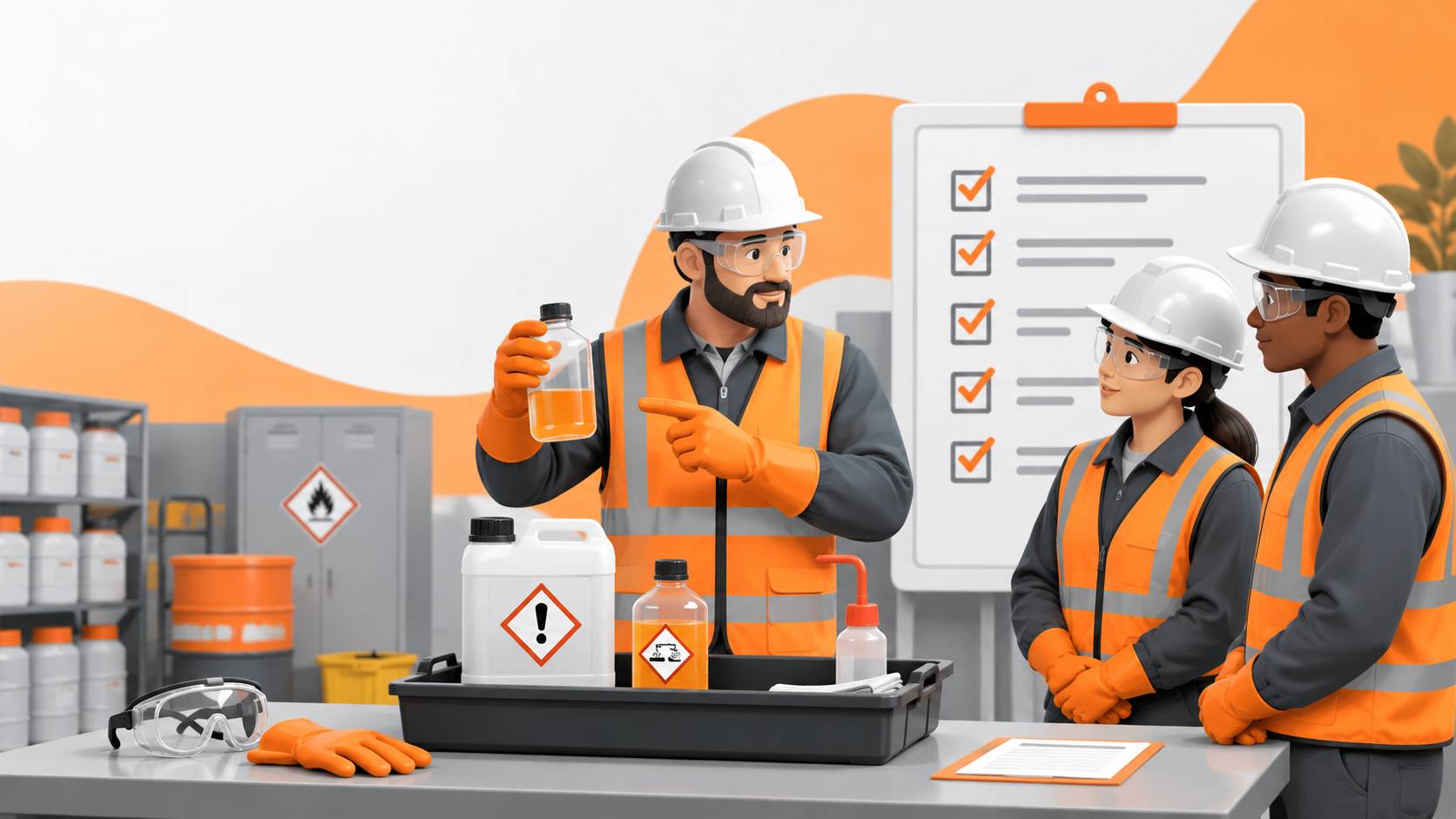
- COSHH training should explain the hazards and exposure routes of the worker's actual task, not merely supply an SDS to read.
- Workers need to know how to use controls, recognise failure and respond to a spill or other emergency.
- A practical demonstration and observation can reveal gaps that a signed attendance sheet cannot.
- Training should be revisited when products, work methods, equipment or assessment findings change.
COSHH training turns an assessment into a method people can use. Workers should understand what hazardous substance the task involves, how exposure could occur, which controls prevent it and what to do when those controls fail. A signature confirming that someone received a safety data sheet (SDS) does not show that they can work safely.
What information should workers receive?
The Health and Safety Executive (HSE) says workers need to understand the result of the COSHH assessment, the hazards and risks, relevant workplace exposure limits and what they must do to protect themselves. They must be trained to use controls and PPE correctly and know what to do in an accident or emergency. This is set out in HSE's assessment guidance.
Translate the assessment into the specific job. Name the product or process, where exposure can occur, who else may be affected, the operating method and the stop-work point. An SDS may provide product hazards and first-aid information, but HSE warns that it is not a risk assessment. Training should explain the workplace decisions added to the supplier information.
Different roles need different detail. An operator must know how to use a dispenser or extract hood; a supervisor must recognise a failed control and arrange a safe response; a cleaner or maintenance worker may need to know what residue remains after production. A contractor needs local risks and site arrangements before starting work.
How can competence be checked in practice?
Demonstrate the task at the work area. Ask the worker to identify the correct container, set up the control, complete the handling step, dispose of waste and explain the response to a failure. Observe whether the method is possible with the time, space and equipment actually available. HSE's good control practice stresses that people need to know why controls matter, how they work and how to recognise when they are not working.
Use a simple teach-back question: “What would you do if the extraction indicator is outside its range?” A worker who can recite a hazard code but cannot answer that question needs more task instruction. If several people struggle, the method or instruction may be poorly designed. Training cannot repair an unworkable process on its own.
Avoid treating a slide deck as the only training format. Short demonstrations, pictures at the work area, supervised practice and accessible written instructions may suit the task better. Provide material in a form workers can understand and check comprehension. The goal is reliable behaviour at the moment of exposure.
What should be recorded?
Record who was trained, for which task and controls, when, by whom and how competence was checked. Link the record to the current assessment or instruction version. A generic record of “COSHH awareness” may be useful orientation but should not be mistaken for authorisation to perform a specific high-risk task.
Keep a clear route for reporting symptoms, near misses, damaged equipment and unclear instructions. Workers should know that reporting a concern triggers review rather than blame. Supervisors should document any additional training after a change or incident and verify that the corrective control works.
Training records support management, but they are not proof that exposure is controlled. Observe work periodically, maintain equipment and ask whether the task still matches the assessment. HSE's control measures guidance treats supervision, procedures and maintenance alongside equipment.
When should COSHH training be refreshed?
Refresh when a product or SDS change affects the task, a new process or location is introduced, controls are changed, monitoring finds a problem or an incident reveals a gap. A fixed annual cycle may be useful for planning, but it should not delay training after a material change. Equally, repeating identical slides each year without checking the work may add little value.
Use versioned instructions so a supervisor knows which method a worker learned. The Safe Foundry workflow can help link product and assessment information; a training record should then show that the correct people received and understood the current method. The help centre offers product guidance for teams organising these records.
Good COSHH training ends with a worker able to answer: what can harm me here, how do these controls prevent it and what do I do if they do not work?
What might a task-based session look like?
For a decanting task, begin at the actual workstation. The trainer shows the product identity and current instruction, asks the worker to point out the possible splash and vapour routes, then demonstrates the approved pump, receiving container and closure. The worker practises under supervision and explains the stop point for a leak or failed ventilation. Only then is the training recorded for that task. This approach checks what the worker can do, not merely whether they attended.
The same session should cover what happens before and after the transfer: checking a label, retrieving the right receiving container, storing it and reporting a near miss. Ask the worker what they would do if the usual equipment were missing. If the answer is “pour carefully”, the system needs a clear alternative or stop instruction.
How should a supervisor use training records?
Use the record to see who is authorised for a particular method and which instruction version they learned. Before assigning a changed task, check whether the worker needs a new demonstration. Record a change to product, equipment, concentration or emergency response in a way that can be connected to the affected roles. Avoid sending every employee the entire SDS library as a substitute for targeted instruction.
Supervisors should also check the work itself. A person may have performed the task correctly in training but later face a blocked hood, missing gloves or a new container shape. Ask what made the safe method hard to follow, fix the barrier and then refresh instruction if needed. This closes the gap between documented competence and conditions on the floor.
At review, compare incidents and near misses with the training content. If several people make the same error, revise the task design or instruction before repeating the same course. Training is strongest when it is tied to a control that works in the real workplace.
How can training cover emergencies without overload?
Focus on the first safe decisions for the worker's task: stop the activity, avoid contact, warn others and use the site's response route. Then show where the exact product's emergency and first-aid information can be found. Workers do not need to memorise every line of an SDS, but they should know how to identify the product and summon the people trained to respond.
Practise one credible scenario, such as a leaking transfer bottle or failed extract hood. Ask what the worker would do before touching equipment or attempting clean-up. If the expected action is unclear, improve the instruction and work area signage. A short drill can teach more than a long list of hypothetical accidents.
Brief temporary staff and new starters before they perform the task, even if a formal refresher session is scheduled later. Confirm that language, shift pattern and access to equipment do not prevent them from following the instruction. The control should work for the people actually doing the job.
Ask them to demonstrate the stop decision.
Frequently asked questions
Is giving workers an SDS enough COSHH training?
No. They need to understand the actual task, exposure routes, controls and emergency actions, with opportunity to practise where appropriate.
Do contractors need COSHH information from the host?
Yes, where site substances and controls affect their work; the host also needs to know what hazardous substances the contractor brings.
How often must COSHH training be repeated?
Review it when work, products, controls or findings change, and use an appropriate planned refresher schedule for the task.
What if a trained worker ignores a control?
Find out whether the control is practical, available and understood before deciding the corrective action; retraining alone may not solve a design problem.
Workplace exposure limits in EH40 help assess airborne exposure in Great Britain. Learn what the figures mean, what they miss and how to review controls.
Spray Painting COSHH: Assessing Mist and Controls at WorkSpray painting COSHH assessments must consider aerosol mist, other workers and the whole paint task. Learn how to review booths, RPE and clean-up controls.
SDS Section 9: Physical Properties That Change RiskSDS Section 9 lists physical and chemical properties. Learn which values affect workplace exposure, storage and spill planning, and how to use them.