
COSHH for Cleaning Products: A Practical UK Work Guide
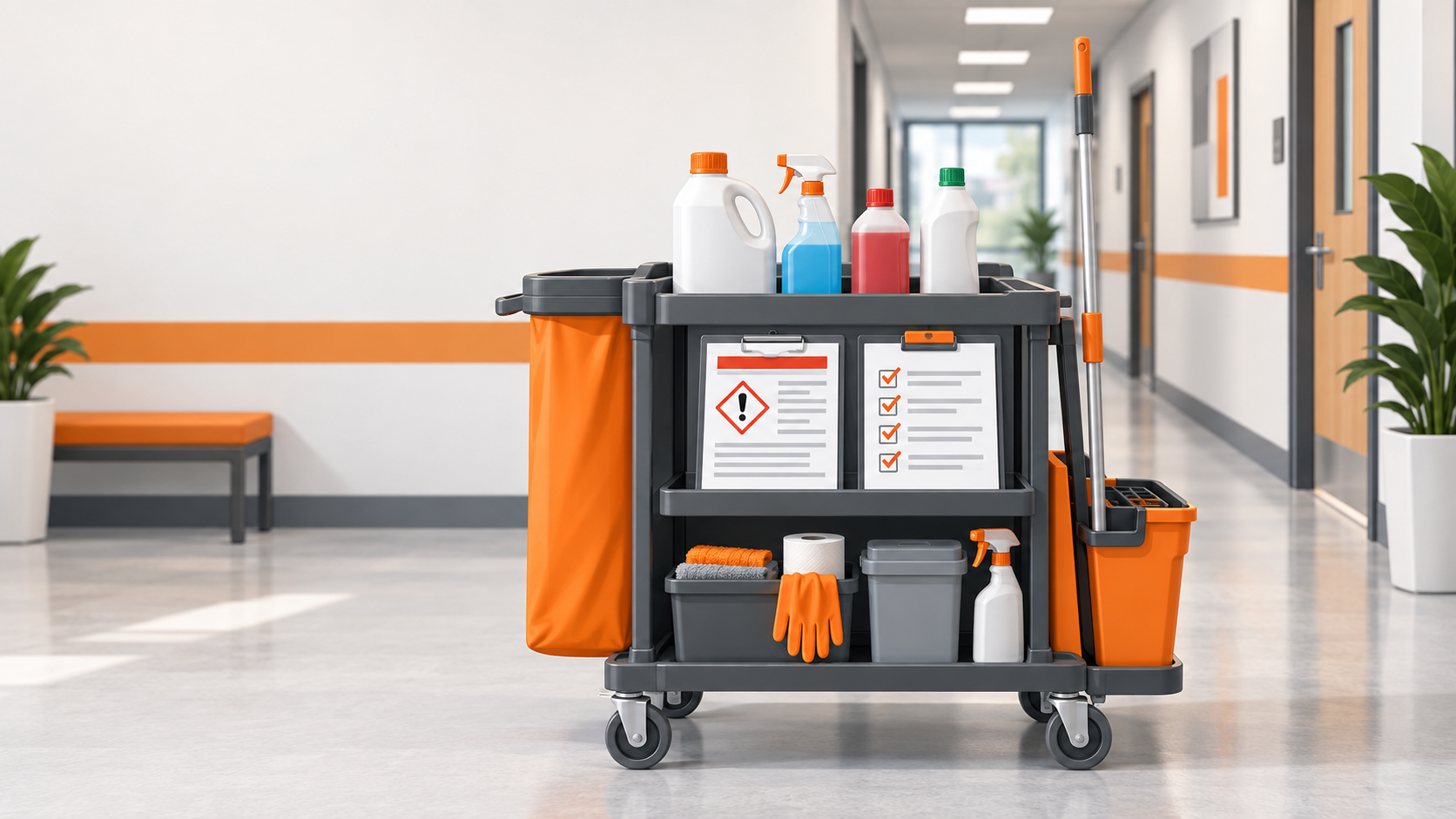
- A COSHH assessment for a cleaning product must describe how it is used, who may be exposed and which controls work in that setting.
- Frequent wet work can harm skin even when a cleaning product carries no dramatic hazard pictogram.
- Spraying can create inhalable mist that wiping or controlled dispensing may avoid.
- Product labels and safety data sheets inform the assessment but cannot describe a cleaner's real task or workplace.
COSHH for cleaning products means assessing the cleaning activity, not simply filing a safety data sheet (SDS) for each bottle. The same product may create different exposure when diluted into a bucket, sprayed at face height or used repeatedly by hand. A useful assessment records those differences and the controls workers can actually follow.
Which cleaning activities need a COSHH assessment?
Start with the work: preparing the product, applying it, leaving it to act, wiping or rinsing it away, and disposing of residues. Consider routine cleaning and less frequent work such as descaling, deep cleaning and dealing with a spill. The Health and Safety Executive (HSE) says COSHH covers substances hazardous to health and asks employers to identify who may be harmed and how, including exposure through breathing, skin contact or swallowing. HSE's assessment guide is the starting point.
An SDS is useful for identifying ingredients, hazards, handling precautions and first-aid information. It is not a description of the room, application method, duration or people nearby. HSE explicitly cautions that an SDS is not a risk assessment. A toilet cleaner used briefly in a ventilated washroom and the same cleaner used repeatedly in a confined space may need different task controls.
List everyone who may be exposed, not just the cleaner. A nearby worker, visitor or maintenance contractor may enter before surfaces dry or while a spray is airborne. Record where and when the work happens so the assessment can lead to a practical instruction: for example, restrict access while a task is under way, rather than leaving a vague note to “use with care”.
What exposure routes are easy to overlook?
Skin exposure deserves its own line in the assessment. HSE's guidance for cleaners notes that frequent or prolonged wet hands can contribute to dermatitis, and that some cleaning ingredients can cause skin allergy or asthma. Consider contact from soaked cloths, splashes during dilution, contaminated gloves and repeated hand washing. A glove choice on an SDS is a starting point; the actual glove must suit the product and task, and workers need a way to change it when damaged or contaminated.
Breathing exposure changes with application. A trigger spray may generate mist near a worker's face, while pouring can produce vapour or splashes. HSE advises preventing exposure at source where possible, including changing an application method. For a suitable task, using a controlled dispenser, pre-dosed product or cloth application may reduce release. Check that the substitute method still cleans effectively and does not introduce a different problem.
Eye contact can occur while opening a container, diluting concentrate or working above shoulder height. The assessment should name the step where a splash could happen and the response available at that location. If a product is labelled corrosive, a generic “wear eye protection” line is too thin: specify the operation, suitable equipment, supervision and how a worker will reach help promptly.
How should you assess dilution and mixing?
Write down who makes dilutions, what equipment they use and how the intended concentration is achieved. “Dilute as directed” is not enough if the site has several bottle sizes or unmarked buckets. Use the supplier's instructions for the exact product and provide measuring or dispensing equipment that makes the correct method repeatable. Include the prepared solution's identity and date or other local control needed to prevent confusion with a different chemical.
Do not assume two cleaners can be mixed because both are sold for the same room. The assessment should prevent unplanned mixing, especially when multiple products are present on a trolley or in a cupboard. Read the product instructions and SDS for incompatibilities, keep original containers identifiable and train workers to stop when a container is unlabelled or its contents are uncertain. HSE's COSHH assessment page includes correctly labelled containers and separating incompatible materials among storage controls.
Concentrates merit separate attention from ready-to-use solutions. The person diluting may experience higher splash or skin exposure than the person applying the prepared product. If a contract cleaner and site employee share the work, state who supplies the concentrate, who trains the user and where the current SDS and instructions can be found.
Which controls should the assessment actually specify?
Choose controls in the order they change exposure most. Could the task use a milder product, a less hazardous physical form or a method that avoids spraying? Could the work be organised so fewer people are present? Where exposure remains, specify ventilation, controlled dispensing, spill handling, hand care and suitable protective equipment. HSE's control measures guide treats equipment, working procedures, maintenance and worker behaviour as parts of one control system.
The worker instruction should be brief enough to use during a shift, while the assessment retains the reasoning. For each task, identify the product, concentration, application method, maximum practical quantity, location, exposed people, controls and emergency action. A table with a named action owner is more useful than a paragraph that simply repeats the SDS precautionary statements.
Training should include a demonstration of the real task: selecting the right bottle, dispensing, changing a cloth, removing contaminated gloves and reporting a spill or skin symptom. Check that the instruction fits the cleaning round and that supplies are available where needed. If workers cannot follow the method in the available time, the control needs redesign, not just a reminder.
When should you review the cleaning assessment?
Review when a product, concentration, application method, room layout, ventilation or work pattern changes, or when workers report symptoms, spills or near misses. HSE says COSHH assessments should be kept up to date and controls checked for effectiveness. A new SDS revision is a prompt to compare changed information with the actual task, rather than an automatic instruction to rewrite every assessment.
Keep the product document linked to the task record so a reviewer can see which information was used. Safe Foundry's feature overview shows one way to keep chemical information and assessments connected; the local work method and final judgement still need a competent review. For a team building its first process, the assessment workflow provides a useful starting structure.
The test of a good cleaning assessment is operational: a worker can identify the right product, prepare it correctly, avoid the main exposure routes and know what to do when the planned method fails. If any of those answers depend on unwritten local knowledge, update the assessment and instruction before treating them as complete.
What would a short task check look like?
Consider a team cleaning a washroom with a ready-to-use product and a separate descaler. Before the round, the supervisor checks both product identities, where each is used and whether the instruction calls for spraying, wiping or controlled dispensing. During the round, the cleaner keeps the products separate, limits access where needed and reports an unexpected leak. Afterwards, the team checks whether gloves, cloths and containers were changed or stored as planned. This example is a prompt for local assessment, not a universal method for those products.
The record should distinguish the routine round from the occasional descaling task. The latter may involve a different concentration, contact time, splash risk and response. A single heading labelled “cleaning” would conceal those differences and make training less useful.
Frequently asked questions
Do ordinary cleaning products always need a separate COSHH form?
The employer must assess hazardous-substance risks from the work, but the format can reflect the task and level of risk. A single suitable record may cover genuinely similar work where products, exposure and controls are comparable.
Does a safety data sheet replace a cleaning risk assessment?
No. The SDS describes the product; the assessment must also address how cleaners use it, who may be exposed and whether local controls are effective.
Should wet work be considered if the product has no hazard pictogram?
Yes. Frequent or prolonged contact with water and cleaning solutions can contribute to skin problems, so task frequency and hand care matter.
Can cleaners mix products if both are used in the same room?
Do not treat a shared use location as evidence of compatibility. Follow the exact product instructions and SDS, and stop if the contents or intended method are uncertain.
Workplace exposure limits in EH40 help assess airborne exposure in Great Britain. Learn what the figures mean, what they miss and how to review controls.
Spray Painting COSHH: Assessing Mist and Controls at WorkSpray painting COSHH assessments must consider aerosol mist, other workers and the whole paint task. Learn how to review booths, RPE and clean-up controls.
SDS Section 9: Physical Properties That Change RiskSDS Section 9 lists physical and chemical properties. Learn which values affect workplace exposure, storage and spill planning, and how to use them.