
COSHH Assessments: One Per Task, Product or Location?
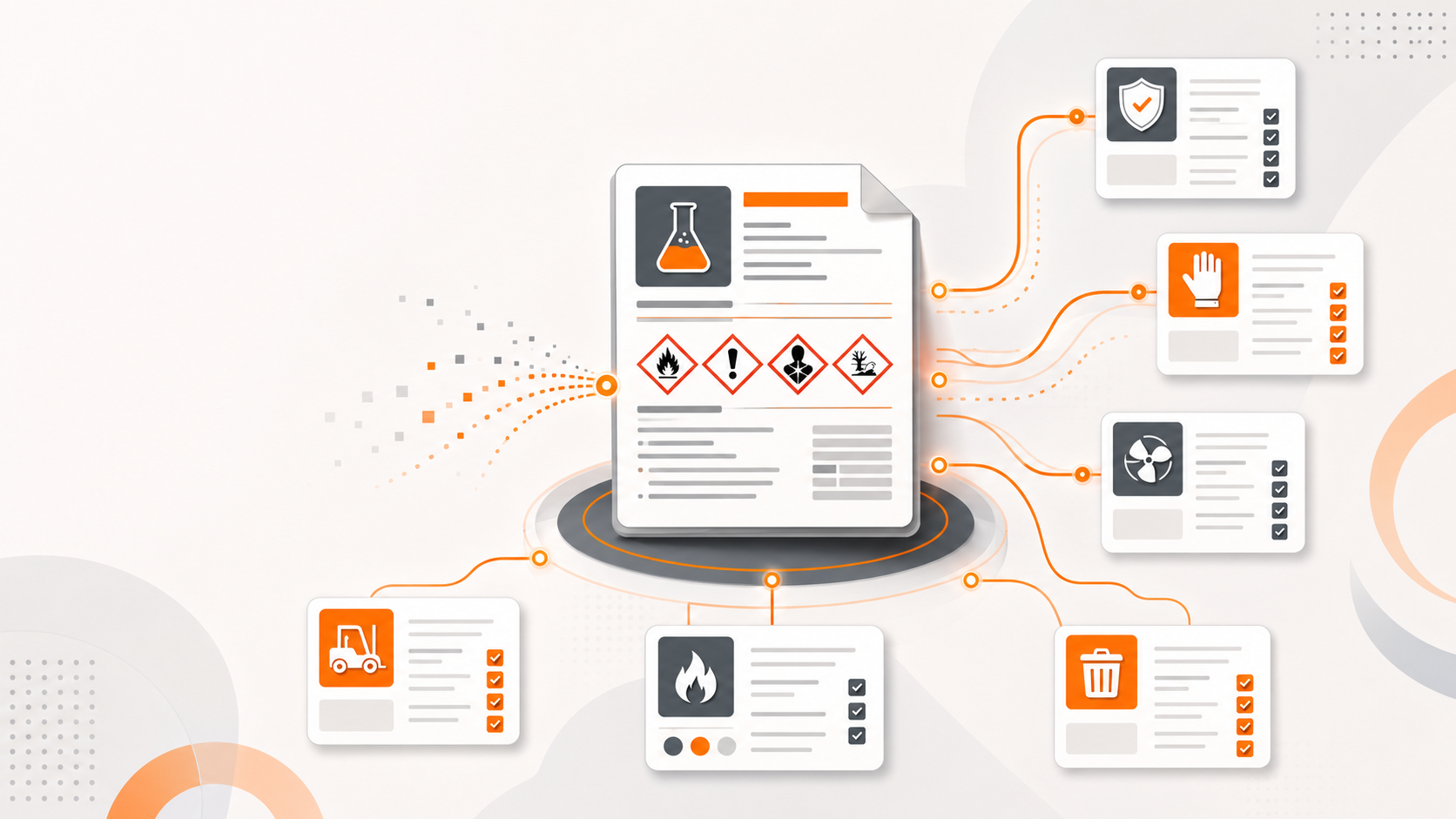
- A COSHH assessment is based on the work activity and the exposure it creates, not on a fixed rule of one assessment per product, task or location.
- One activity-based COSHH assessment can cover several similar products, or the same product across several locations, where the substance is used the same way under the same conditions.
- You need a new or revised COSHH assessment whenever the task, the exposure conditions, the control measures or the people exposed genuinely change.
- A Safety Data Sheet (SDS) is hazard information about a substance, not a COSHH assessment; the assessment is what adds your workplace context of quantity, frequency, ventilation and who is exposed.
- The Control of Substances Hazardous to Health Regulations 2002 (COSHH) prohibit work liable to expose employees to a hazardous substance unless a suitable and sufficient risk assessment of that work has first been made (Regulation 6).
COSHH assessments are based on the work activity and the risk it creates, not on a fixed rule of one per product, task or site. You usually do not need a separate assessment for every product, because one activity-based assessment can cover several similar products or locations where a substance is used in the same way under the same conditions. You do need a new or revised assessment whenever the task, the exposure conditions, the control measures or the people involved genuinely change.
Do you need a separate COSHH assessment for every product?
No. A COSHH assessment looks at the health risk from how a substance is actually used, so the unit that matters is the task, not the product on the shelf. Two different products used the same way, in the same conditions, by the same people can often sit under one assessment. Equally, a single product used in two very different ways, such as brushed on in a ventilated booth versus sprayed in a small room, can need two assessments because the exposure is different. Under the Control of Substances Hazardous to Health Regulations 2002 (COSHH), an employer must not carry out work liable to expose employees to a hazardous substance without first making a suitable and sufficient assessment of the risk created by that work (Regulation 6). That duty attaches to the work, which is why the activity, not the product count, drives the number of assessments you need.
What actually decides how many COSHH assessments you need?
The number of COSHH assessments you need is decided by how many genuinely different exposure scenarios you have, not by how many products or rooms you have. An exposure scenario is the combination of the substance, the task, the quantity and frequency, the controls in place, and the people who could be exposed. Where those factors are effectively the same, one assessment can cover the whole set. Where any of them changes enough to change the risk, that scenario needs its own assessment or a documented variation.
This is why counting products or locations is the wrong starting point. A workshop with 40 products might reduce to a dozen task-based assessments. A single degreasing solvent might need three, one for each way it is applied.
Task, product or location: which one drives the assessment?
Task is the primary driver, because it sets the exposure. Product and location matter only where they change that exposure. The table below shows how each factor typically affects whether you can reuse an assessment or need a new one.
| Factor | Can often reuse one assessment when… | Usually needs a new or revised assessment when… |
|---|---|---|
| Task / activity | The same substance is used the same way (same method, same duration, same controls) | The application method, quantity, frequency or duration changes the exposure |
| Product | Products share the same hazards, hazard statements and route of exposure | A product has different hazards, a different physical form, or a higher exposure risk |
| Location | The layout, ventilation and controls are equivalent across sites or rooms | Ventilation, containment or space differs (for example indoor versus outdoor, or a confined space) |
| People exposed | The same trained group, with the same susceptibility, does the work | New or more vulnerable groups are involved, or numbers rise significantly |
When can one COSHH assessment cover several products?
One COSHH assessment can cover a group of products when they present the same hazards and are used the same way, so the risk and the controls are effectively identical. This grouping is consistent with how HSE's COSHH Essentials scheme works, allocating substances to hazard groups by their CLP classification and expected exposure rather than treating every product as unique. The condition COSHH sets is that each assessment stays suitable and sufficient for your actual tasks, so a group only holds while the products in it genuinely share hazards, exposure route and controls. In practice, a sensible group shares the same hazard classification, the same route of exposure (inhalation, skin, ingestion), the same control measures and the same task.
The safeguard is that grouping has to be justified, not assumed. If you group five solvent-based cleaners under one assessment, the honest test is whether swapping one for another would change any control you rely on. If it would not, the group holds. If one of them is, for example, also a skin sensitiser or has a much lower workplace exposure limit, it falls outside the group and needs its own treatment. Recording which products a grouped assessment covers, and why they belong together, is what makes it defensible if an inspector or an incident investigation asks.
When do you need a separate COSHH assessment for a different location?
You need a separate or revised COSHH assessment for a different location when the location changes the exposure or the controls, not simply because it is a different room or site. The same task carried out in two places with equivalent ventilation, containment and space can share one assessment. The moment the surroundings change how much of the substance a person could breathe in or contact, the assessment has to reflect it.
Common location changes that warrant a fresh look include:
- Local exhaust ventilation present in one area but not another
- Moving a task from an open workshop into a confined or poorly ventilated space
- Outdoor use where weather and dispersion differ from indoor use
- Shared spaces where nearby workers become exposed bystanders
Why isn't a Safety Data Sheet a COSHH assessment?
A Safety Data Sheet is not a COSHH assessment because it describes the substance in general, while a COSHH assessment describes the risk in your workplace. The SDS follows the standard 16-section format set out in REACH Annex II (retained in Great Britain as UK REACH), with the hazards on it classified under GB CLP. It tells you the hazards, the hazard statements and the recommended precautions, but it does not know how much you use, how often, in what space, with what ventilation, or who is nearby. HSE is explicit that a good safety data sheet does not substitute for carrying out and recording a COSHH risk assessment. The COSHH assessment is the step that takes that hazard information and applies it to your task, your quantities and your people.
This is the practical reason product count and assessment count do not line up. You hold one SDS per product, but a product can appear in several task-based assessments, and one assessment can cover several products used the same way. Turning the hazard data on an SDS into a task-based judgement is the work, and it is where tools such as Safe Foundry read the SDS and draft the assessment structure so you can concentrate on the workplace context that the sheet cannot supply. You can see how that mapping works on the how it works page, and what the drafted output includes under features.
How should you decide in practice?
Decide by exposure scenario, working from the task outward. A workable order is:
- List the tasks, not the products. Start from what people actually do with substances.
- Group products that share the same hazards and the same use within a task.
- Check the exposure factors for each task: quantity, frequency, duration, form, and route.
- Check the location and controls, and split the assessment where ventilation, containment or space differs.
- Check who is exposed, including bystanders and any more vulnerable workers.
- Record the grouping logic, so it is clear why several products or sites sit under one assessment.
Reviewing assessments is part of the same discipline. COSHH requires you to keep assessments up to date and to review them regularly, and immediately if there is reason to think they are no longer valid, for example after a change of process, product or control. A grouped assessment should be revisited whenever a new product is added to the group, to confirm it genuinely belongs.
For teams standardising this across a site, keeping the task list, the product groups and the review dates in one place is usually more reliable than a folder of near-duplicate documents. If you are weighing up how to structure that, the FAQ and help centre cover common grouping and review questions in more detail.
Frequently asked questions
Do I need a COSHH assessment for every chemical in my workplace?
Not necessarily for every chemical individually, but you must assess every activity where anyone could be exposed to a hazardous substance. Chemicals used the same way, with the same hazards and controls, can be assessed together as a group.
Can one COSHH assessment cover more than one site or room?
Yes, if the task, substances, controls and ventilation are equivalent across those places. If the ventilation, containment or space differs enough to change exposure, that location needs its own assessment or a documented variation.
Is a Safety Data Sheet enough to meet COSHH?
No. A Safety Data Sheet gives you hazard information about a substance, but COSHH requires an assessment of the risk from how you actually use it. The SDS is an input to the assessment, not a substitute for it.
How often do COSHH assessments need reviewing?
There is no single fixed interval; you review when something changes that could affect the risk, such as a new product, process, control or exposure, and periodically to confirm the assessment still reflects reality. «VERIFY: confirm current HSE wording on review frequency, which is trigger-based rather than a set number of years»
Does a new supplier or brand of the same chemical need a new assessment?
Check the new product's Safety Data Sheet first. If the hazards, hazard statements and route of exposure match the product it replaces, it can usually stay under the existing assessment; if any hazard or control differs, reassess.
Learn how to assess process-generated dust and fumes without an SDS by defining the process, exposure routes, evidence and practical controls.
How to Check an SDS Matches the Chemical You UseCheck that an SDS matches your chemical by comparing product identifiers, supplier, concentration, form, label classification and intended use.
COSHH Assessment Review Checklist for UK WorkplacesUse this COSHH assessment review checklist to compare records with current tasks, products, exposure routes, controls and workplace evidence.