
Chemical Waste Handling: A COSHH Checklist for Teams
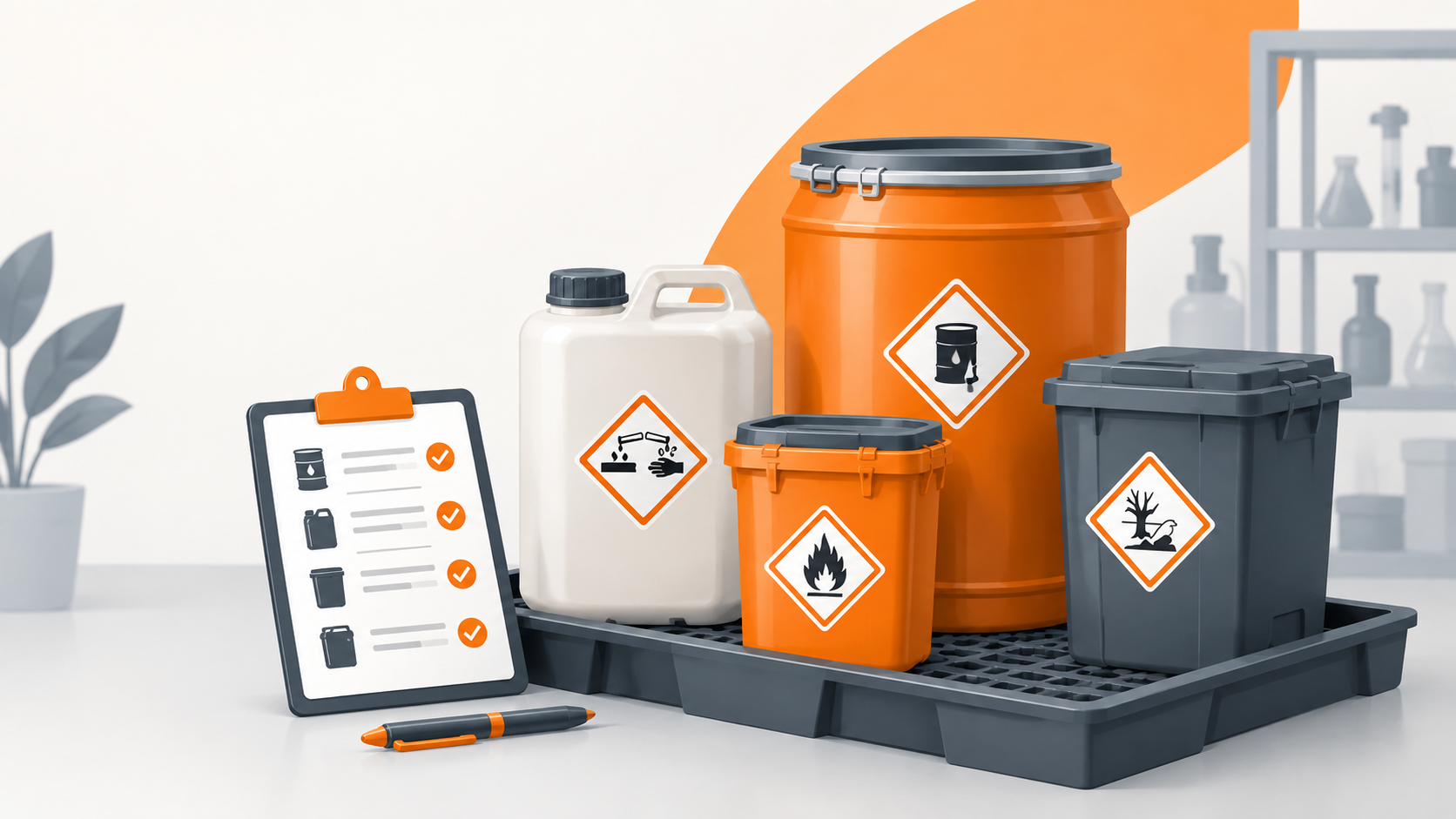
- Waste handling belongs in the COSHH assessment because exposure can occur during collection, transfer, storage and handover.
- Waste composition may differ from the original product and should not be assumed from one supplier SDS.
- Containers should be suitable, identifiable, closed and managed so incompatible materials are not mixed.
- The waste route should have a named owner and clear instructions for spills or unexpected contents.
Chemical waste handling is a workplace task with its own exposure points. A process may end, yet workers still touch contaminated tools, transfer residues or move containers through shared areas. Assess those steps alongside the main activity, using the actual waste composition and quantities rather than treating disposal as an afterthought.
Where can workers be exposed to waste?
Map the route from the point where waste is created to collection, temporary storage and handover. A worker may scrape a residue into a container, pour used solvent, handle contaminated wipes or open a drum to add more material. Splash, vapour, dust and skin contact can arise at each step. The Health and Safety Executive (HSE) asks COSHH assessors to consider exposure routes, people affected and controls for the work; its assessment guide specifically mentions planning storage and disposal of waste.
Do not assume the original product's safety data sheet (SDS) fully describes the waste. The process may add reaction products, contamination, water or other materials. HSE says an SDS supports assessment but is not the workplace assessment. Use process knowledge and competent advice to characterise waste where its contents are uncertain.
Include cleaners, stores staff, drivers and contractors who may encounter the containers. A handover point is still part of the workplace risk until responsibility is clearly transferred. Define who closes and labels the container and who checks it before movement.
How should waste containers be chosen and labelled?
Use containers suitable for the material and handling method. Consider chemical compatibility, secure closure, fill level, stability and whether a worker can add material without unnecessary exposure. A container that is easy to fill but impossible to close cleanly creates repeated contact. Put it on a suitable surface with containment where the credible spill calls for it.
Keep contents identifiable. A vague label such as “chemical waste” does not help a responder, stores worker or waste contractor understand what is inside. Record the process or source, known constituents where appropriate, relevant hazards, date and responsible person according to site and legal requirements. Specific waste classification and consignment duties need competent advice for the material and jurisdiction; this article does not classify waste.
Prevent unplanned mixing. Two liquids that came from the same room may be incompatible. Follow supplier and process information and use a documented segregation plan. If a container's contents are unknown, do not add material to it based on colour or odour. Isolate it and seek competent advice.
Which controls make the route workable?
Reduce waste at source where feasible, then contain it close to where it is generated. Closed collection, suitable funnels, transfer equipment and clear routes can reduce spills. HSE's control measures guidance includes spillage capture, decontamination, clean-up procedures and methods of work. Personal protective equipment supports these measures for residual exposure.
Train people on the exact route: where waste goes, what may share a container, how to close it, when to request collection and what to do if it leaks. The instruction should be short enough to use at the point of disposal. If a worker must travel across the site to find an approved container, the system invites improvised storage.
Inspect accumulation points. Are lids closed? Are containers bulging, corroded or overfilled? Is the spill kit accessible without walking through a leak? Are drains and traffic routes protected? Record defects and take action rather than treating inspection as a formality.
What should happen at handover or after a leak?
Before collection, verify that container identity, condition and documentation match the agreed waste route. Communicate hazards to the receiving party through the appropriate process. Keep evidence of handover and any incident so a later reviewer can trace where material went and what changed.
For a leak, the response depends on substance, quantity and location. Alert others, restrict access and use trained responders within the site's plan; do not ask someone to clean an unknown waste mixture. Review why the container or method failed and whether the main task should change to reduce waste at source.
The Safe Foundry feature overview can help connect source products and task assessments; the help centre supports organising those records. A reliable waste route ends with a container whose contents are known, controls that work and a clear handover, not a forgotten drum in a storeroom.
What would a waste stream record include?
For each recurring stream, record the process that creates it, the likely constituents, the container type, where it is filled, the expected rate of accumulation and the named owner. Note the maximum approved fill level, closure method and what material must never be added. Include the route from the workbench to the collection area and any protective equipment or transfer tool needed. The record should make the routine method visible to a new worker without pretending that every waste batch is chemically identical.
For example, a paint-cleaning operation might generate used solvent, contaminated wipes and empty containers. Those are different handling tasks even though they come from one job. The person decanting liquid may face splash and vapour exposure; the person bagging wipes may handle contaminated surfaces; the stores worker may move sealed packages. Separate the controls by step, and check whether the contractor collecting waste receives the right information at handover.
How can the route be checked before a collection?
Walk it with the people who perform it. Can a worker identify the approved container without searching? Is the lid closed between additions? Is the route clear of public or food areas? Can the container be moved without tipping or manual handling that creates a new risk? Are any labels wet, damaged or too vague to support emergency response? Fix these observations before the collection is due, rather than treating the paperwork as proof that storage is sound.
If an unexpected reaction, pressure build-up or leak is found, stop normal handling and use the site's emergency escalation. Do not try to release pressure or combine contents to save space. Record what is known, preserve the identity of source materials and seek competent advice. Afterwards, review the upstream process as well as the waste container: preventing the problematic mixture may be the strongest control.
What does a change in process mean for waste?
A small change upstream can create a new waste stream. A different cleaning agent, paint hardener, process temperature or absorbent may alter the contents of a collection container. Before the change is introduced, ask whether the existing container, label, storage conditions and contractor handover still apply. Record the revised route and brief the people who add waste, not only the manager who authorised the purchase.
The same applies to temporary work. A one-off maintenance job may create contaminated wipes or liquids that do not fit any routine bin. Plan the route before the job starts. If the waste cannot be confidently identified afterwards, keep it separate and seek competent advice instead of combining it with an established stream to clear the bench.
The strongest review question is whether the next worker can identify the waste without asking its creator. If not, improve the label and handover before more material is added. This protects both routine handlers and anyone responding to an abnormal event.
Frequently asked questions
Can I use the original product SDS for a waste mixture?
It may provide information about one ingredient, but the mixture may differ; assess what the process actually produced.
Can different chemical wastes share one container?
Only when the combination has been assessed and approved for that waste route; shared location does not prove compatibility.
Does COSHH stop when the production task ends?
No. Collection, clean-up, storage and transfer can expose workers and should be assessed.
What should a worker do with an unlabelled waste container?
Do not add to it or guess its contents. Isolate it and use the site's procedure for competent identification and management.
Workplace exposure limits in EH40 help assess airborne exposure in Great Britain. Learn what the figures mean, what they miss and how to review controls.
Spray Painting COSHH: Assessing Mist and Controls at WorkSpray painting COSHH assessments must consider aerosol mist, other workers and the whole paint task. Learn how to review booths, RPE and clean-up controls.
SDS Section 9: Physical Properties That Change RiskSDS Section 9 lists physical and chemical properties. Learn which values affect workplace exposure, storage and spill planning, and how to use them.