
Chemical Register vs COSHH Assessment: Differences
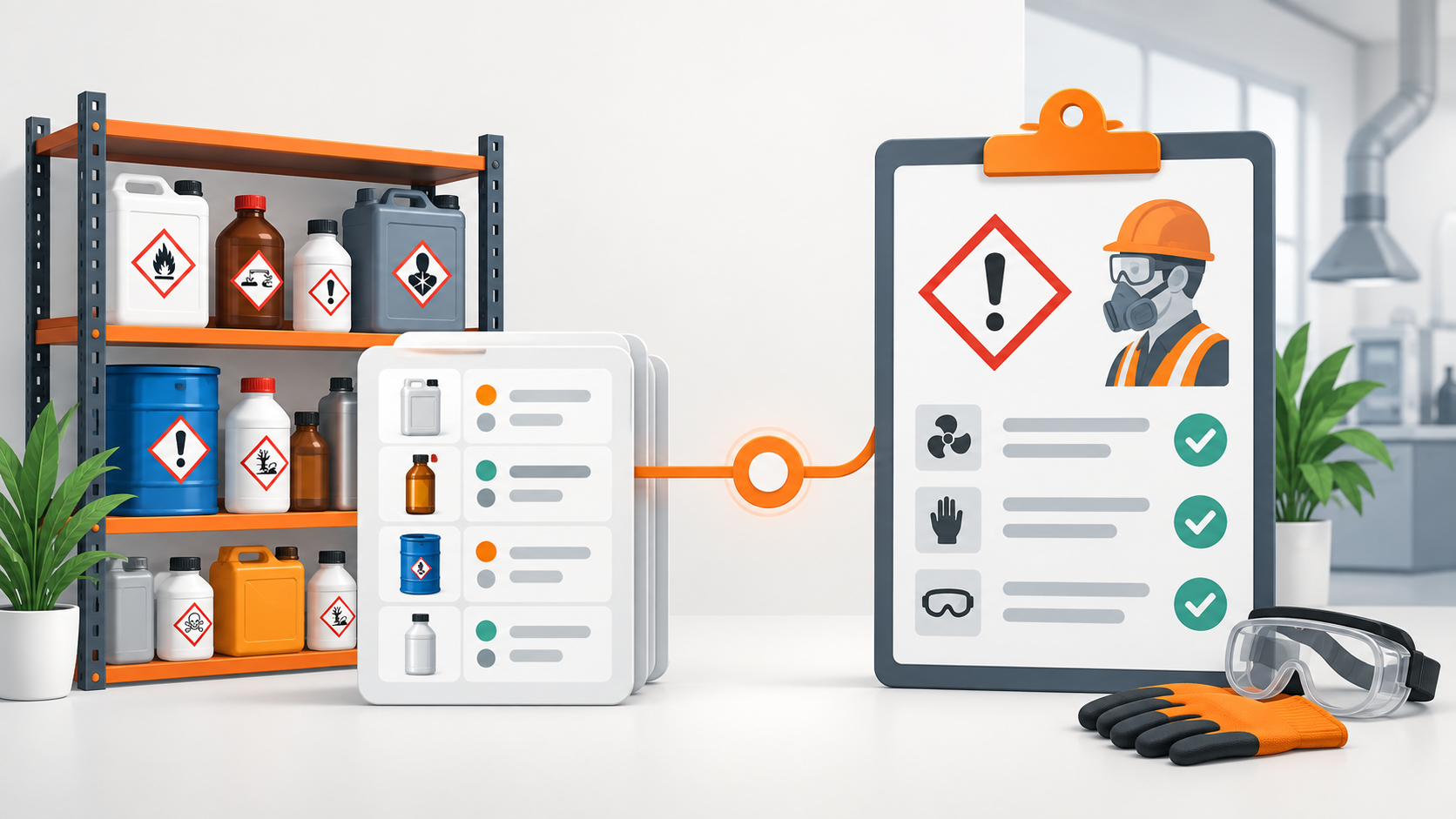
- A chemical register lists products and locations, while a COSHH assessment evaluates exposure and controls for a specific work activity.
- One product can link to several COSHH assessments when it is used in materially different tasks, quantities or conditions.
- An SDS supports both records but replaces neither because it is supplier information rather than a site-specific inventory or exposure assessment.
- Connecting product, SDS and assessment records makes supplier updates easier to trace without copying the same data into disconnected files.
A chemical register answers what chemicals are present and where they are kept. A COSHH assessment answers how a hazardous substance could expose people during a defined activity and which controls are needed, so the two records serve different purposes and should be linked rather than merged into one vague checklist.
An SDS supports both records but does not replace either. It contains supplier information, not your current stock locations or task-specific exposure conditions.
What is a chemical register?
A chemical register is a controlled inventory of substances and mixtures held, used, generated or awaiting disposal. It commonly records product, supplier, identifier, location, quantity, SDS version, hazard summary, owner and lifecycle status.
The register supports several safety processes:
- Finding the correct SDS during routine work or an incident.
- Identifying products that require COSHH or DSEAR assessment.
- Screening storage compatibility and stock quantity.
- Locating obsolete, duplicate or unknown chemicals.
- Tracking supplier and formulation changes.
- Giving managers a view across rooms, departments or sites.
A register is broad and product-centred. It should not pretend to describe every activity performed with each product.
What is a COSHH assessment?
A COSHH assessment considers the risks from exposure to substances hazardous to health in a particular workplace activity. It should identify the substance, people exposed, routes and level of exposure, existing controls, additional actions, emergencies and review arrangements.
HSE's COSHH assessment guidance emphasises understanding the work, considering how exposure occurs and deciding what needs to be done. The significant findings must be recorded where the employer has five or more employees.
A COSHH assessment is task-centred. The same solvent used for enclosed dispensing, open wiping and spraying may require different assessments because the exposure potential and controls differ.
How do the records compare?
| Question | Chemical register | COSHH assessment |
|---|---|---|
| Main purpose | Identify products, quantities and locations | Evaluate exposure and controls for an activity |
| Organising unit | Product and stock location | Task, process or use scenario |
| Main evidence | Label, SDS, purchasing and stocktake data | SDS plus observation, process data and control information |
| People at risk | Usually owner or department fields | Specific workers and others who may be exposed |
| Controls | May flag storage group or assessment status | Specifies prevention and control measures |
| Review trigger | Stock, supplier, SDS or location change | Task, exposure, control, evidence or incident change |
| Typical output | Searchable inventory and document links | Recorded findings, actions and communication |
The distinction matters because a register row marked “COSHH complete” can conceal several unassessed activities. Conversely, separate assessment files with no register make it difficult to identify whether a supplier update affects the whole site.
Does UK law require a chemical register?
The COSHH Regulations do not prescribe a document with the exact title “chemical register”. However, employers must assess risk, control exposure, provide information and maintain relevant records. A register is a practical way to organise the information needed to discharge those duties.
Other legal and emergency-planning requirements may make accurate inventory information important depending on the substances, quantities and site. Treat the register as an operational control, not a certificate of compliance.
The legal duty is about effective risk management. A beautifully formatted list that omits a cleaning cupboard or points to superseded SDS cannot support sound decisions.
Does every product need a COSHH assessment?
COSHH applies to substances hazardous to health, which is wider than products carrying a hazard pictogram. Hazardous substances may include process-generated dust, fumes, vapours, mists, gases, biological agents and substances with workplace exposure limits.
Triage each register entry by actual use. A product may be out of COSHH scope, require a simple assessment, or need detailed exposure evaluation and specialist input.
Record the outcome transparently. Useful statuses include assessment required, draft, approved, review due, not required with rationale and no longer used.
Can several products share one COSHH assessment?
Grouping may be reasonable where products are used in the same way and genuinely share relevant hazards, exposure potential and controls. It is not justified simply because products have similar names or sit on the same shelf.
A grouped assessment should identify the covered products, the evidence supporting similarity and the conditions within which the grouping remains valid. A supplier reformulation, new hazard statement or different physical form should trigger review.
HSE's approach to similar activities can support proportionate assessment, but the employer remains responsible for ensuring the representative assessment covers the real risks.
Why does one product sometimes need several assessments?
Exposure is created by the interaction between the substance and the task. The same product can be low exposure in a closed automated system and much higher exposure when sprayed, heated or used in a confined space.
Separate or clearly differentiated scenarios may be needed when there are changes in:
- Application method or energy.
- Quantity and duration.
- Temperature or pressure.
- Ventilation or enclosure.
- Worker group and frequency.
- Personal protective equipment.
- Emergency and maintenance work.
The register should show all relevant links rather than forcing one product into one assessment slot.
Where does the SDS fit?
The SDS supplies classification, composition, handling, storage, exposure-control and reactivity information. HSE clearly states that the SDS is not a risk assessment.
A robust relationship is:
Product identity → current SDS version → stock locations → activities → relevant assessments → actions and reviews.
This chain allows a changed SDS to identify affected locations and assessments. Copying unstructured SDS text into many files makes updates harder because nobody can tell which copies are current.
How should a small organisation connect the records?
Start with stable identifiers rather than names alone:
- Assign one product record for each verified supplier formulation.
- Attach the current SDS and record its revision or issue date.
- Add every physical stock location and owner.
- Link each work activity that uses or generates the substance.
- Link the relevant COSHH assessment to the activity and product.
- Record review triggers and unresolved actions.
- Archive superseded versions without presenting them as current.
Safe Foundry's workflow turns structured SDS information into a starting point for site review, while chemical-safety features connect documents and assessments. The help centre provides practical product guidance.
What are the common documentation mistakes?
Common mistakes include treating the SDS folder as the register, using one generic assessment per product, merging different formulations under one trade name and deleting old records without preserving the decision history.
Another failure is recording only the main store. The register should reflect products in vehicles, cleaning cupboards, workshops, laboratories, waste areas and temporary project locations.
Which document should you create first?
Create enough of the inventory to know what exists, then prioritise assessments by hazard and exposure. Do not wait for a perfect stocktake before controlling an obvious high-risk task.
The two records should improve together. The register gives assessment coverage; the assessment adds meaning to each product's use. Their value comes from a maintained relationship, not from the titles on the files.
Frequently asked questions
Is a chemical register the same as a COSHH register?
The term COSHH register is used inconsistently. Check whether the document is only a product list or also links each product to current SDS and task-specific assessments.
Does every chemical register entry need a COSHH assessment?
Not automatically. The employer should decide whether hazardous-substance exposure arises and document the appropriate assessment or rationale based on actual use.
Can one COSHH assessment cover several products?
Sometimes, where the products and activities genuinely present equivalent hazards and controls. The grouping rationale and any limits should be clear and reviewed when a formulation changes.
Can one product need more than one COSHH assessment?
Yes. Spraying, brushing and using the same product in a closed system can create materially different exposure routes and controls.
Learn how to assess process-generated dust and fumes without an SDS by defining the process, exposure routes, evidence and practical controls.
How to Check an SDS Matches the Chemical You UseCheck that an SDS matches your chemical by comparing product identifiers, supplier, concentration, form, label classification and intended use.
COSHH Assessment Review Checklist for UK WorkplacesUse this COSHH assessment review checklist to compare records with current tasks, products, exposure routes, controls and workplace evidence.